

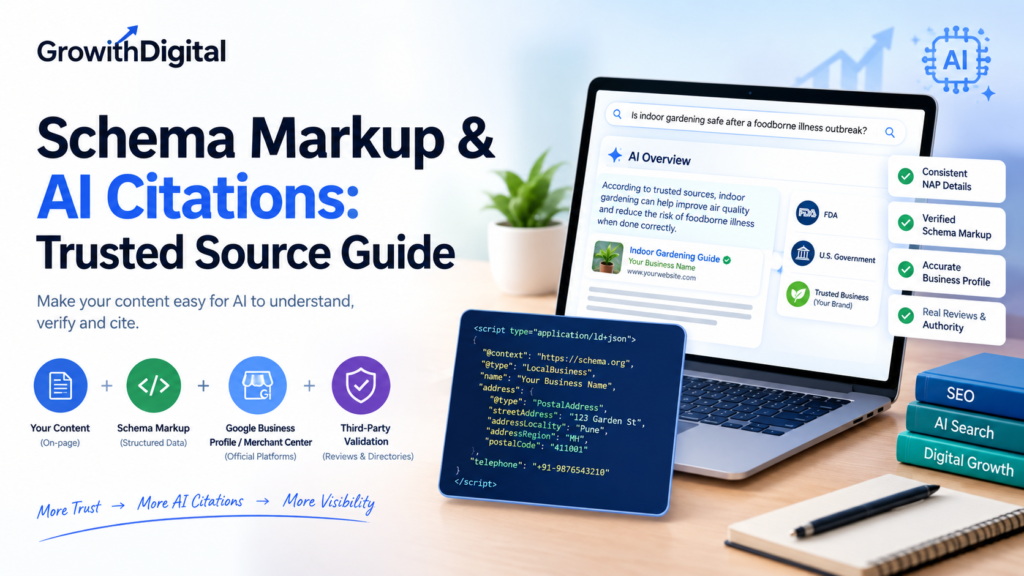
When a client’s indoor gardening page ranked second in Google, right behind the FDA, during a foodborne illness outbreak, and then showed up in the AI Overview beside government agencies, the reason was not luck. It was consistent schema markup working alongside genuinely useful content. That single example explains more about winning AI citations than most SEO checklists ever will.
Schema does not create trust, it proves it
As Search Engine Journal explains in its research on schema and AI citations, structured data does not manufacture authority out of nothing. What it does is make existing trust verifiable to a machine. AI systems cross-check four things before they hand out AI citations: the words on your page, your schema markup, official platforms like your Google Business Profile or Merchant Center feed, and third-party corroboration such as reviews and directory listings. When all four agree, AI citations follow. When they contradict each other, even slightly, AI models quietly move on to a competitor.
Why small mismatches cost you AI citations
The detail that trips up most Kolhapur and Sangli businesses is consistency, not complexity. Writing “Suite 4B” on your website and “Ste. 4B” on your Google Business Profile looks harmless to a human, but it is exactly the kind of mismatch that makes an AI system less confident about citing you. Scaling a flawed schema template across hundreds of pages before validating it just multiplies that same error, and multiplies the number of missed opportunities along with it.
This is the same trust layer we outline in our Answer Engine Optimization guide for 2026, and it builds directly on the crawl and structure basics covered in our AI search technical signals checklist.
How to earn more AI citations with schema
- Start with one page, not a hundred. Build and validate a single schema template properly before rolling it out site-wide.
- Match your platform of record. Your schema should mirror your Google Business Profile and, for e-commerce, your Merchant Center feed exactly, including address formatting and business hours.
- Add depth for products. Material, size, shipping speed and return policy in schema give AI systems more to confidently cite.
- Fix inconsistencies first. Before adding new schema, audit your existing name, address and phone details across your website, directories and Google Business Profile.
- Build real authority before markup. Schema cannot invent expertise. Reviews, press mentions and genuine credentials have to exist before schema can help AI cite them.
FAQ
What are AI citations? They are the moments an AI system like ChatGPT, Gemini or Google’s AI Overview names or links to your business as the source of an answer, similar to how a search engine ranking works but inside a generated response.
Does adding schema guarantee AI citations? No. Schema makes your existing trust signals verifiable to a machine, but it cannot create authority or accuracy that does not already exist on your site and other platforms.
What is the single biggest mistake businesses make? Scaling an unvalidated schema template across every page. One inconsistent template repeated hundreds of times produces hundreds of pages an AI system is less confident about, not more.
Put your schema to the test
Most local businesses in Ichalkaranji and Pune have never checked whether their website, Google Business Profile and schema markup actually agree with each other. Growith Digital audits all four trust layers before writing a single line of schema, so the AI citations you eventually earn are ones that stick. Talk to our team about a schema and AI citation audit for your business.
[…] right now, the same way we described the shift toward machine-readable trust signals in our schema markup and AI citations guide. If your e-commerce platform, such as WooCommerce or Shopify, adopts this checkout standard, your […]