

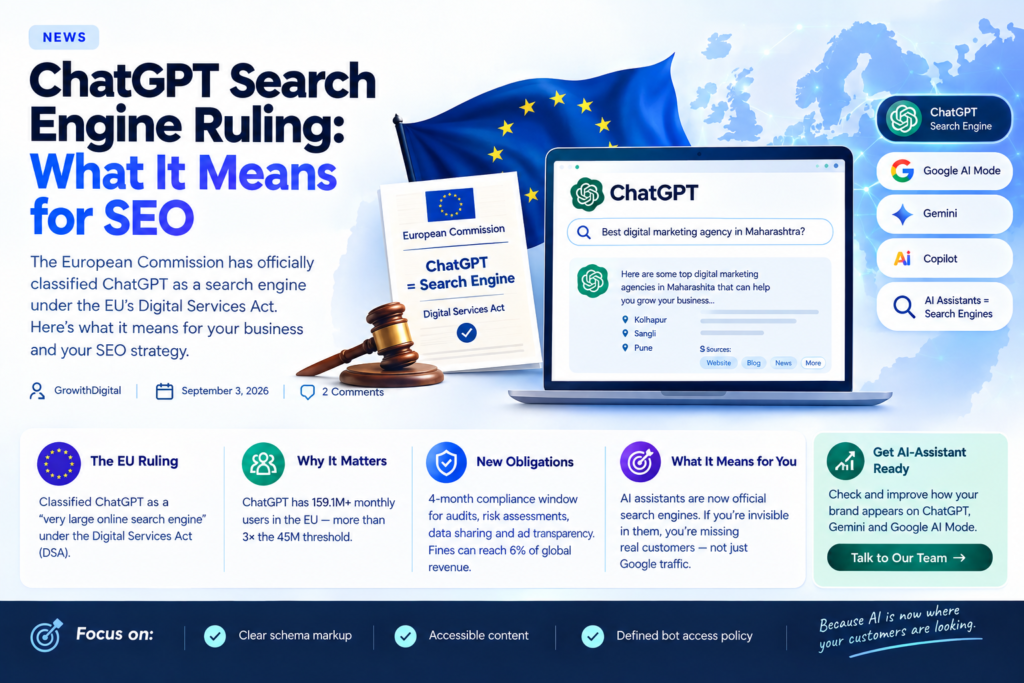
On August 31, 2026, the European Commission did something no regulator had done before: it classified an AI chatbot as a search engine. The ChatGPT search engine designation under the EU’s Digital Services Act is not a headline you can skip past if you run marketing for a business that sells anywhere near Europe, and it confirms something Maharashtra SMEs should already be planning around: AI assistants are now officially, legally, search engines.
Why regulators now call it a search engine
According to Search Engine Journal’s report on the ChatGPT search engine ruling, the European Commission decided ChatGPT qualifies because it “responds to users’ prompts and queries, including by searching the web.” OpenAI disclosed roughly 159.1 million average monthly users in the EU, more than triple the 45-million threshold that triggers the designation. Reddit and Roblox received similar “very large online platform” status the same day.
Once classified, the ChatGPT search engine label brings a four-month compliance window covering systemic risk assessments, independent audits, data sharing with regulators, and advertising transparency, the same obligations Google Search has carried for years. DSA fines can reach 6% of global annual revenue, and the Commission has already levied 870 million euros in penalties, including 550 million euros against AliExpress.
What this means beyond Europe
You do not need to sell into the EU for this to matter. A ChatGPT search engine designation from one of the world’s most aggressive tech regulators confirms what we have been telling clients in Kolhapur, Sangli and Pune since we first wrote about how younger customers are shifting their trust to AI assistants: this is not a temporary trend that regulators, or your customers, are going to reverse.
If ChatGPT is legally a search engine, then being invisible inside it is the same business risk as being invisible on Google was ten years ago. The technical groundwork is identical to what we outlined in our AI search technical signals checklist: clear schema, accessible content and a defined bot access policy.
What Maharashtra businesses should do now
- Stop treating AI assistants as experimental. A government classifying the ChatGPT search engine the same as Google Search removes any excuse to deprioritize it.
- Check how your brand appears today. Ask ChatGPT, Gemini and Google AI Mode directly about your products or services and see what comes back.
- Keep your public information consistent. Regulated platforms are held to accuracy standards, and consistent, accurate information about your business is what gets rewarded in their answers.
- Watch for advertising changes. Transparency requirements on the ChatGPT search engine could eventually open new, more accountable ad formats inside AI answers.
FAQ
Is ChatGPT officially a search engine now? Yes. The ChatGPT search engine classification came from the EU’s Digital Services Act, when the European Commission designated ChatGPT a “very large online search engine” on August 31, 2026, the first such ruling for an AI chatbot.
Does this affect businesses outside Europe? The compliance obligations are EU-specific, but the classification confirms that AI assistants function as search engines globally, which is directly relevant to how any business, including SMEs in Maharashtra, should approach visibility.
What should I check first? Search for your own business and top products inside ChatGPT and see whether the answer is accurate, current and favorable.
Get AI-assistant ready
Whether or not the ChatGPT search engine ruling affects you legally, it should change your marketing priorities. Growith Digital helps Maharashtra businesses check and improve how they appear across the ChatGPT search engine, Gemini and Google AI Mode. Reach out to our team to see where you currently stand.
[…] connects directly to what we cover in why regulators now treat ChatGPT as a search engine and in our breakdown of how AI search is doing the thinking for your […]
[…] they work, and a business optimized only for chat-style AI assistants, the approach we describe in our piece on the ChatGPT search engine ruling, can still be completely absent from developer-facing […]