
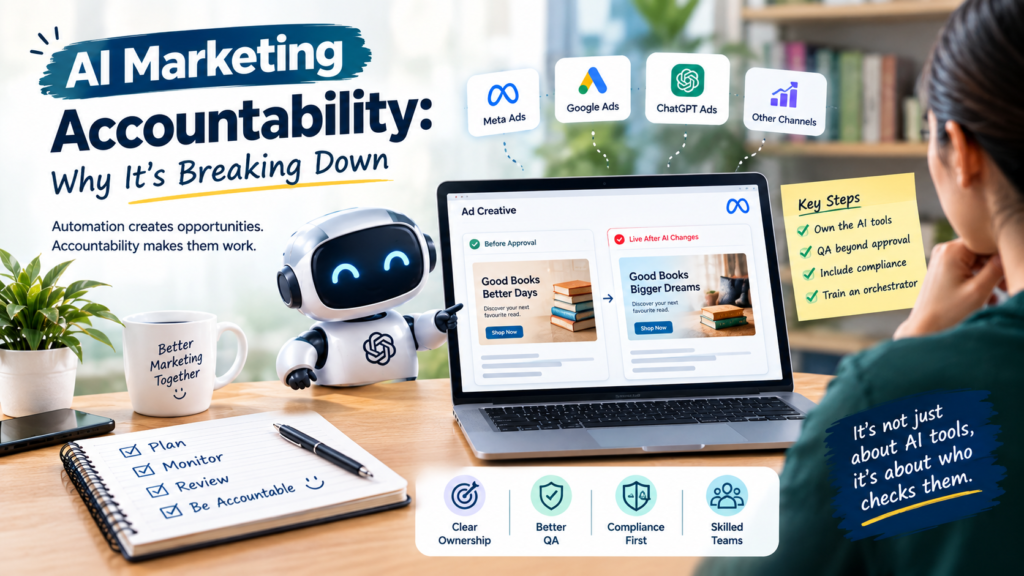
When Meta’s algorithm quietly altered a bookstore’s ad creative after it had already been approved, and nobody caught it, the problem was not that AI had gone rogue. It was that no one had ever been assigned to check. That gap is the real story behind AI marketing accountability, and it explains why so many campaigns fail in ways that have nothing to do with the technology itself.
The hiring imbalance behind the problem
As Search Engine Journal argues in its piece on AI marketing accountability, 35% of companies now prioritize AI skills when hiring, compared to just 14% focused on design and template work, and only 15% on compliance expertise. Money is flowing toward automation that generates output, while almost no one is being hired to check that output before or after it goes live.
Guy Hanson, VP at Validity, points out that approval responsibility “falls between the cracks” in both large and small teams. Enterprises spread responsibility so thin across departments that no single person owns it, while smaller agencies often have one person juggling strategy, execution and quality control at the same time. Neither structure was built with AI marketing accountability in mind, because neither structure was built assuming a machine would keep changing the work after a human signed off on it.
Where the compliance blind spot shows up
As AI agents access more customer data autonomously to personalize campaigns, most organizations have not actually verified that their legal consent basis covers these new uses. That is precisely the kind of gap that invites regulatory scrutiny, the same pattern we described in how marketing budgets need to be restructured for the AI search era and in our guide to AI search for local businesses in Maharashtra.
Building real AI marketing accountability
- Name an explicit owner for every AI tool. Define exactly what each AI agent is allowed to do and exactly when a human has to step in.
- Extend QA past the approval stage. Schedule audits comparing live ad creative and campaign content against what was originally approved, ideally within 24 hours of going live.
- Budget compliance alongside automation. Treat legal and compliance review as part of the same investment as your AI tools, not a separate, deprioritized line item.
- Train someone as the orchestrator. The most valuable role emerging right now is the generalist who prompts AI tools, validates what comes back, and catches errors before a client or customer does.
FAQ
Is AI actually reducing marketing accountability? No. AI marketing accountability problems existed before AI tools became common. Automation is simply exposing teams that never had clear ownership or QA processes in the first place.
Who should own AI marketing accountability in a small agency? Even a one-person marketing team should assign explicit review checkpoints and a fixed schedule for auditing live campaigns against what was approved, rather than assuming automation needs no oversight.
What is the fastest fix? Start auditing live ad creative against approved versions within 24 hours of launch. This single habit catches most of the silent changes that erode AI marketing accountability.
Build accountability into your AI-driven campaigns
Growith Digital helps SMEs across Maharashtra set up practical QA and ownership structures for their AI-assisted marketing, so AI marketing accountability is not left to chance. Talk to our team about a campaign audit process built for your business.