
Introduction
PPC advertising is becoming increasingly automated. Platforms can now make decisions about bidding, targeting, audiences, search queries, placements, landing pages, and even ad creative.
That can save advertisers time, but it can also create a difficult question:
How do you know what automation is doing inside your account—and whether it is helping your business?
The answer is not to remove automation completely. Instead, advertisers need to build systems that provide visibility, clear boundaries, reliable data, and measurable business goals.
With PMax and AI automation, the goal should be to give the platform enough freedom to find opportunities while keeping humans responsible for strategy, brand standards, and performance evaluation.
Here are practical ways to maintain control without fighting automation.
1. Start With Transparent PPC Reporting
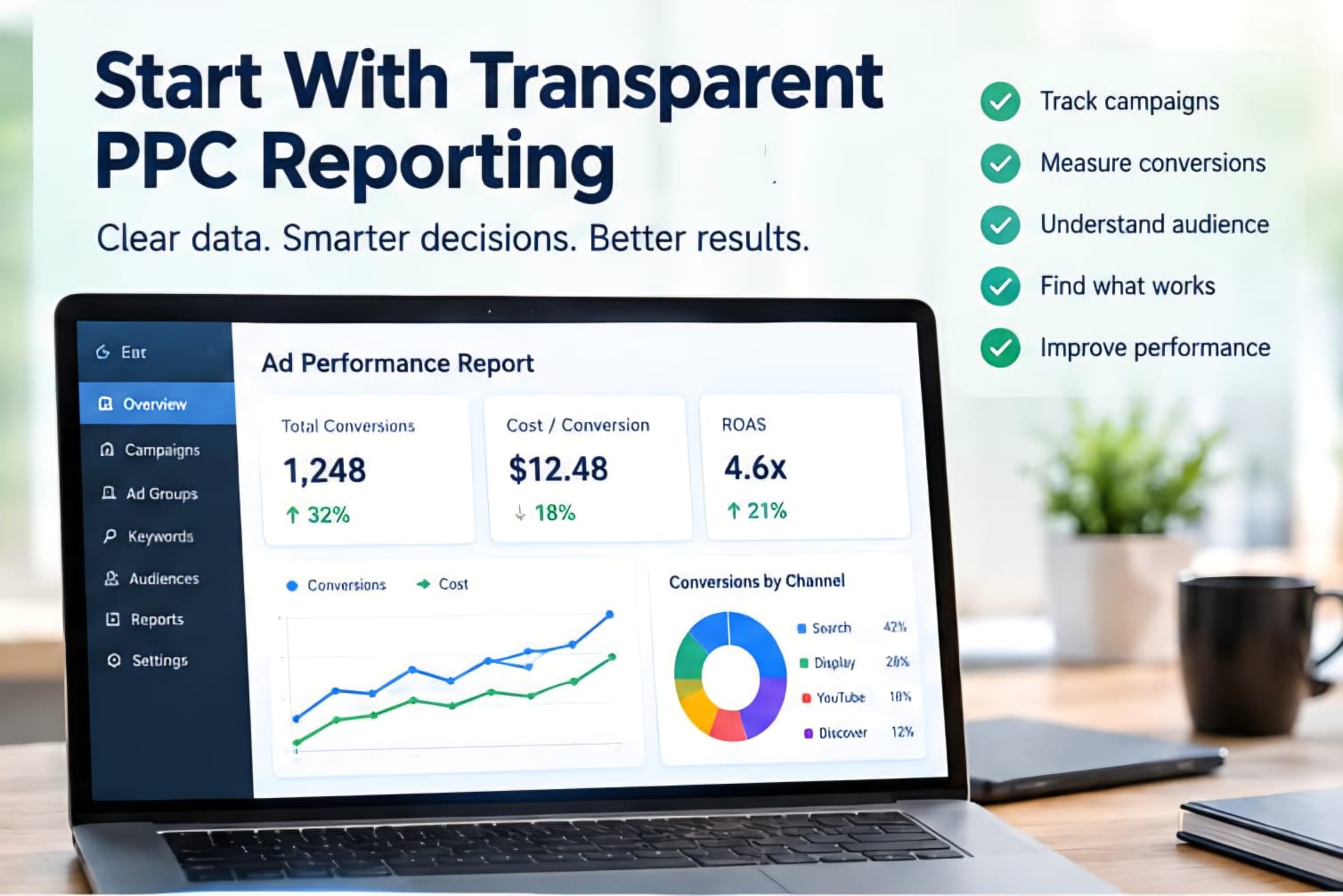
Automation becomes easier to trust when you can clearly see what is happening.
A campaign may generate more conversions, but that number alone does not explain where those conversions came from or whether they are valuable to the business.
Your reporting should help answer questions such as:
- Which campaigns are generating conversions?
- Which conversion actions are being counted?
- What is the cost per qualified lead?
- Which products or services generate the strongest results?
- Are new audiences producing meaningful engagement?
- Is automated bidding moving toward the correct business goal?
Good reporting does not mean looking at every individual decision made by the algorithm.
Instead, focus on patterns and outcomes.
Give Automation Enough Data Before Making Changes
One unusual search query or placement does not automatically mean the campaign is performing poorly.
Before changing targeting or excluding traffic, consider:
- How much data has been collected?
- Is the conversion tracking accurate?
- Is the traffic producing meaningful business results?
- Could the same audience appear through another targeting method?
- Would excluding it remove potentially valuable future traffic?
Allow enough time for meaningful patterns to develop before making major changes.
For many accounts, reviewing at least several weeks of reliable data provides a stronger basis for decisions than reacting to individual events.
2. Make Conversion Tracking Your Control Center
Automation can only optimize toward the signals you provide.
If your conversion tracking is incorrect, the platform may successfully optimize toward the wrong outcome.
For example, imagine a lead-generation company where the account counts:
- Contact-page visits
- Button clicks
- Form submissions
- Phone calls
- Qualified sales leads
as equal conversions.
The algorithm may then find more people who generate low-value actions instead of customers.
That is why conversion tracking should be audited before judging an automated campaign.
Track Business Outcomes, Not Just Clicks
Where possible, separate valuable conversions from weaker engagement signals.
Useful measurements may include:
- Qualified leads
- Completed purchases
- Revenue
- Customer acquisition cost
- Return on ad spend
- Phone calls
- Appointment bookings
- High-value form submissions
The more accurately your conversion data represents the business, the more useful automation becomes.
3. Give AI Clear Creative Guardrails
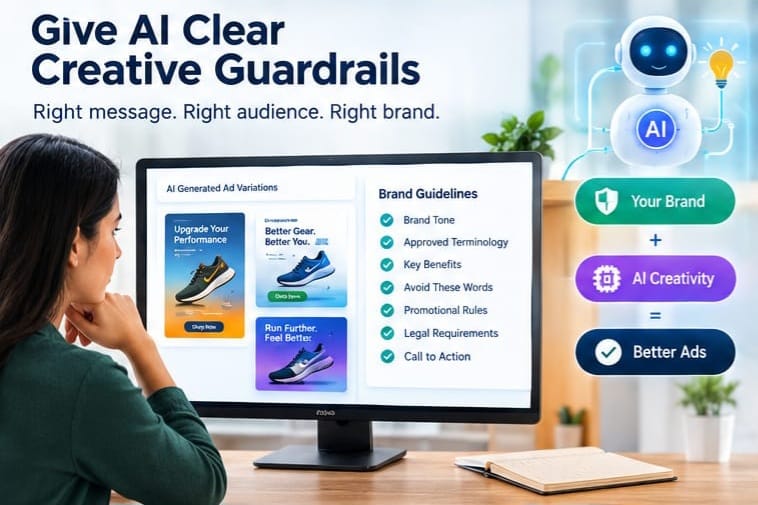
One of the biggest changes introduced by AI-powered advertising is the ability to adapt creative for different users and surfaces.
This can be useful—but brands still need control over their messaging.
Your landing pages, headlines, descriptions, images, videos, and other assets should communicate a consistent value proposition.
Build a Strong Brand Framework
Before allowing AI to generate or adapt messaging, define:
- Brand tone
- Approved terminology
- Key product benefits
- Important claims
- Words to avoid
- Promotional restrictions
- Legal requirements
- Primary calls to action
This gives AI more useful boundaries.
Instead of simply telling a system what product you sell, provide enough context for it to understand how that product should be presented.
Make Individual Assets Understandable
AI can combine and adapt creative assets across different placements.
That means an asset that makes sense when viewed alongside another headline may become confusing when displayed independently.
For example, a headline such as “Custom Builds” may sound relevant to a computer company, but the phrase could also apply to motorcycles, furniture, homes, or other products.
More specific messaging can reduce ambiguity.
Instead of relying only on broad phrases, consider language that communicates:
- What you sell
- Who it is for
- Why it matters
- What makes your offer different
4. Use Human Review Without Blocking Automation
Human involvement does not have to mean manually controlling every ad variation.
A better approach is to create checkpoints.
For example:
Human strategy → AI execution → Human review → Performance analysis
This approach allows automation to handle repetitive optimization while people remain responsible for strategic decisions.
Review Creative Regularly
Create a simple review process for automated campaigns.
Check:
- Headlines
- Descriptions
- Images
- Videos
- Landing pages
- Brand language
- Promotional claims
- Search themes
- Audience signals
If your platform provides creative previews or asset-level reporting, use them to understand how your messaging appears across different surfaces.
5. Avoid Over-Segmenting Automated Campaigns
One common reaction to automation is creating more campaigns and ad groups to regain control.
That can create another problem.
If you divide a limited budget across too many campaigns, each campaign may receive insufficient data.
For example, instead of creating separate campaigns for every small keyword variation, organize campaigns around meaningful business differences.
These could include:
- Product categories
- Major services
- Geographic markets
- Different profitability levels
- Different conversion goals
- Separate business objectives
Give Automation Useful Signals
Modern campaign types can use broader signals to discover opportunities.
For example, search themes and similar features can help communicate important areas of your business without requiring advertisers to manually build an enormous keyword list.
Exact and phrase-based keywords can still be valuable when they consistently generate important business results.
The goal is not maximum control over every query.
The goal is enough structure to protect business priorities while giving automation room to find incremental opportunities.
6. Separate Campaigns When Business Goals Are Different
Not every conversion should necessarily share the same optimization target.
Imagine an account advertising:
- Premium consulting services
- Low-cost services
- Enterprise contracts
- Entry-level products
These areas may have completely different economics.
Combining them into one campaign can make optimization more complicated.
Before consolidating campaigns, ask:
Do these campaigns have similar conversion values, CPA expectations, and business objectives?
If the answer is no, separate structures may provide clearer control.
Avoid Budget Fragmentation
At the same time, excessive segmentation can prevent campaigns from receiving enough data.
A useful balance is to consolidate where objectives are similar and separate where business economics are genuinely different.
7. Use Brand and Traffic Controls Strategically
Automation can expand matching beyond the searches advertisers traditionally manage manually.
That can create opportunities, but it can also create concerns around:
- Competitor traffic
- Irrelevant searches
- Sensitive topics
- Brand safety
- Poor-quality placements
- Unwanted queries
Use available exclusions, brand controls, content suitability settings, and other platform safeguards where appropriate.
The important point is to use controls based on business risk, rather than automatically excluding anything unfamiliar.
An unfamiliar query is not necessarily a bad query.
8. Evaluate Automation With Business Metrics
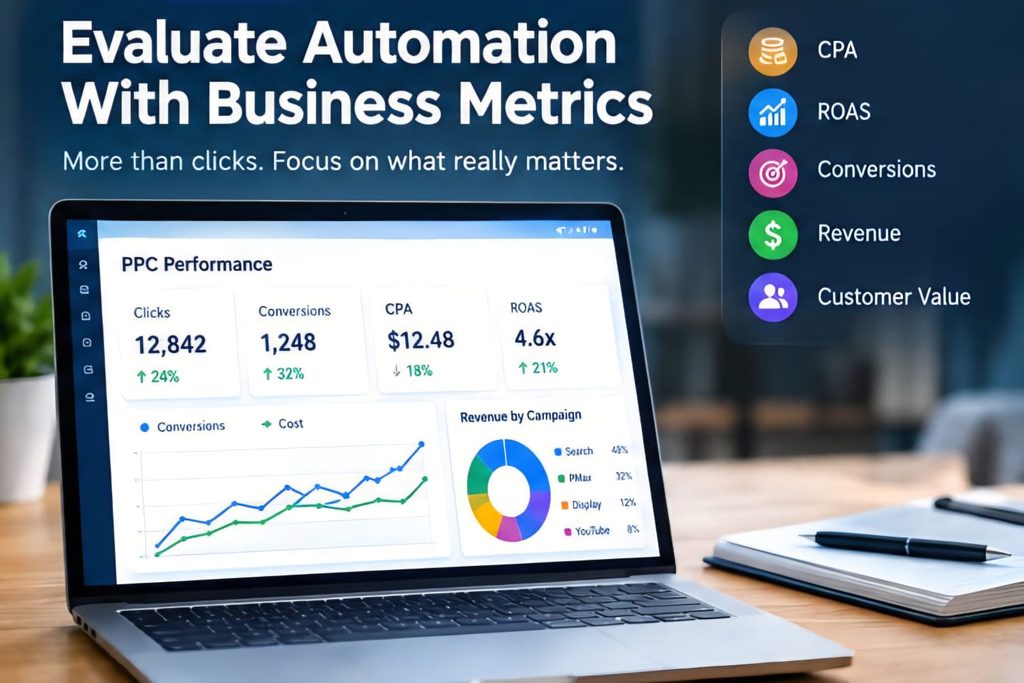
The biggest mistake is judging automation only by platform metrics.
A campaign can produce:
- More clicks
- More impressions
- More conversions
and still fail to produce better business results.
Instead, connect PPC reporting with actual business outcomes.
Useful Metrics to Monitor
Depending on the business model, consider:
| PPC Metric | Business Question |
|---|---|
| CPA | What does acquiring a customer cost? |
| ROAS | How much revenue does advertising generate? |
| Conversion Rate | Are visitors taking meaningful actions? |
| Qualified Leads | Are leads actually valuable? |
| Revenue | Is advertising producing sales? |
| Customer Value | Are new customers worth acquiring? |
| Profit Margin | Does paid traffic support profitable growth? |
This changes the conversation from “What did the algorithm do?” to “Did the advertising support the business?”
9. Create an Automation Governance Checklist
A simple checklist can make automated PPC management much easier.
Before Launch
Check:
- Conversion tracking
- Conversion values
- Landing pages
- Brand guidelines
- Creative assets
- Budget
- Target CPA or ROAS
- Audience signals
- Exclusions
- Geographic targeting
During Campaign Management
Review:
- Conversion quality
- CPA or ROAS
- Search and audience insights
- Creative performance
- Budget pacing
- Landing-page behavior
- Brand safety
- New traffic patterns
Before Making Major Changes
Ask:
- Do I have enough data?
- Is the conversion data reliable?
- Is the problem consistent?
- Could this traffic generate incremental value?
- Will the proposed change restrict useful automation?
- Does the change support a real business objective?
This prevents reactive optimization.
10. Think of Automation as a System, Not a Black Box
The biggest mindset shift is understanding that automation does not mean giving up all control.
Instead, control moves to a different level.
You may have less control over the exact auction-by-auction decision, but you can still control:
- Business objectives
- Conversion definitions
- Budgets
- Brand standards
- Creative inputs
- Campaign architecture
- Exclusions
- Reporting
- Testing
- Strategic direction
This is where PMax and AI automation become more manageable.
The advertiser’s job increasingly becomes setting the right conditions for the system rather than manually controlling every individual action.
Internal Linking Opportunities
For a PPC or digital marketing website, consider linking this article naturally to related content such as:
- Performance Max Campaign Guide — explain how PMax works and where automation is used.
- Conversion Tracking Guide — explain how incorrect conversion signals affect automated bidding.
- Google Ads Account Structure Guide — cover campaign and ad-group organization.
- PPC Budget Management Guide — explain how to allocate budgets across campaigns.
- Smart Bidding Guide — explain automated bidding and conversion-based optimization.
- AI-Powered PPC Trends — discuss how AI is changing paid search.
Use descriptive anchor text rather than generic phrases such as “click here.”
External Authority-Link Suggestions
For supporting references, consider linking to authoritative first-party resources such as:
- Google Ads Help for official information about Performance Max, conversion tracking, and campaign controls.
- Microsoft Advertising Help for official information about AI-powered advertising features and campaign management.
These links can support technical claims while keeping the article focused on practical PPC strategy.
Frequently Asked Questions
1. What is PMax and AI automation?
PMax and AI automation refers to using AI-driven advertising systems to automate areas such as bidding, targeting, matching, creative optimization, and campaign delivery.
The advertiser still controls important inputs such as goals, budgets, assets, conversion signals, and strategic direction.
2. Does PPC automation mean advertisers lose control?
No. Automation reduces the amount of manual control available at individual auction or query levels, but advertisers can still control campaign objectives, conversion tracking, budgets, creative standards, exclusions, and account structure.
3. How can I monitor an automated PPC campaign?
Use regular reporting to monitor conversions, CPA, ROAS, revenue, lead quality, creative performance, search insights, budget pacing, and website behavior.
The exact metrics should depend on the business objective.
4. How often should automated campaigns be reviewed?
Automated campaigns should be monitored regularly, but advertisers should avoid making major changes based on isolated results.
Review performance trends over a meaningful period and make sure sufficient conversion data exists before drawing conclusions.
5. Should I completely automate my Google Ads account?
Automation can reduce repetitive work, but it should operate within a clear strategy.
Businesses should maintain human oversight over conversion definitions, brand messaging, budgets, business objectives, and major structural decisions.
Conclusion
Automation is changing PPC management, but it does not have to mean losing control.
The strongest approach is to control the inputs, monitor the outcomes, and give AI clear boundaries.
With accurate conversion tracking, transparent reporting, strong creative guidelines, sensible campaign structures, and regular business-focused analysis, advertisers can use automation without treating the platform as a black box.
PMax and AI automation work best when technology handles repetitive optimization while humans remain responsible for strategy, brand standards, measurement, and business decisions.
The goal is not to control every automated decision.
The goal is to build an advertising system where automation has enough freedom to discover opportunities—and enough guardrails to keep those opportunities aligned with the business.