
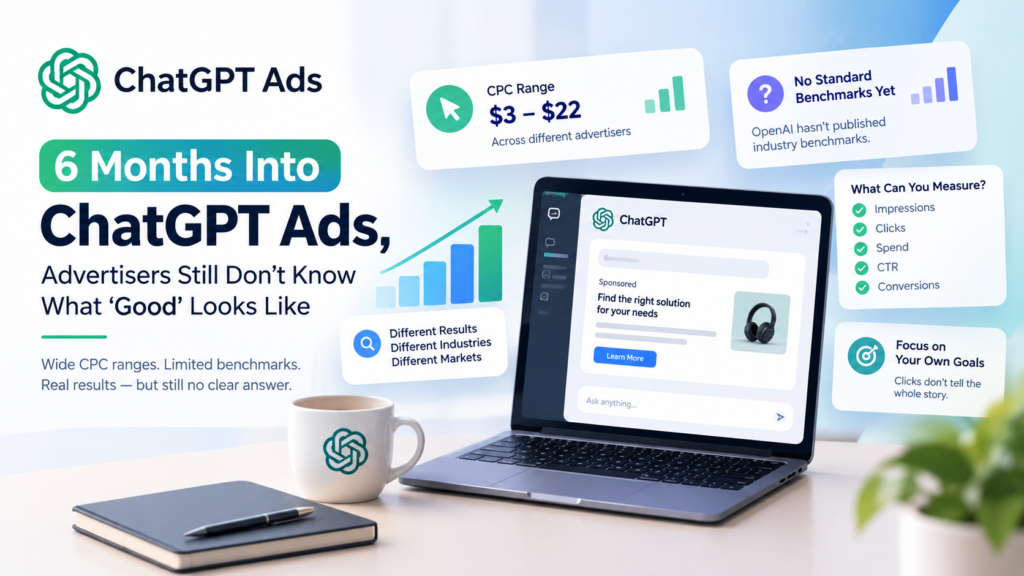
6 Months Into ChatGPT Ads, advertisers have more real-world campaign data than they did at launch.
6 months into ChatGPT Ads, advertisers have something they didn’t have when the platform first launched: real campaign data.
But there is still a major question without a clear answer: What does good ChatGPT Ads performance actually look like?
Early advertiser results show a wide range of CPCs, engagement rates, conversion results, and return on ad spend. Some campaigns have generated promising results, while others have struggled to turn clicks into meaningful business outcomes.
The challenge is that there is still limited public benchmark data from OpenAI.
That means advertisers can’t simply look at a CPC or CTR and determine whether a campaign is performing well. They need to consider their own costs, conversion quality, revenue, audience, geography, and business objectives.
What We Know 6 Months Into ChatGPT Ads
ChatGPT Ads are advertising placements within ChatGPT’s ad-supported experience.
OpenAI has gradually expanded the advertising platform since its initial testing, giving advertisers more tools for campaign creation, bidding, targeting context, conversion measurement, and performance reporting.
The platform is different from traditional search advertising in one important way.
Instead of matching ads primarily against a typed keyword, ChatGPT advertising can use the context and intent of a conversation to determine relevant advertising opportunities.
That creates a potentially different environment for advertisers.
A person might not search for a specific product using a traditional keyword. Instead, they could describe a problem, compare solutions, ask for recommendations, or discuss what they are trying to accomplish.
For advertisers, that makes relevance and context especially important.
What Can Advertisers Measure In ChatGPT Ads?
OpenAI Ads Manager provides several standard campaign metrics that advertisers can use to evaluate performance.
Depending on the campaign and setup, reporting can include:
- Impressions
- Clicks
- Spend
- Click-through rate
- Average CPC
- CPM
- Conversions
- Attributed sales
- Cost per attributed sale
- ROAS
Advertisers can also export campaign information for additional analysis.
Conversion tracking can be supported through tools such as the OpenAI Pixel and Conversions API, allowing advertisers to measure actions including leads, purchases, and sign-ups.
This gives advertisers a reasonable starting point.
But there is a difference between having campaign metrics and having enough information to benchmark those metrics.
Why ChatGPT Ads Benchmarks Are Still Difficult To Define
One of the biggest challenges for advertisers is the lack of mature benchmark data.
For an established advertising platform, marketers may have access to industry averages, competitive reporting, historical campaign data, and other reference points.
ChatGPT Ads is still developing.
There isn’t enough publicly available information to establish a universal CPC, CTR, CPA, or ROAS target that should apply to every advertiser.
That matters because a $4 CPC could be expensive for one business and inexpensive for another.
A campaign selling a high-value product may be profitable with a much higher CPC than a business selling a low-margin product.
CPC Alone Doesn’t Tell The Whole Story
The 6 Months Into ChatGPT Ads milestone shows how differently advertisers are experiencing the platform.Advertisers should avoid treating CPC as the main definition of campaign success.
Consider two campaigns:
Campaign A
- $3 CPC
- High click volume
- Low-quality traffic
- Few qualified leads
Campaign B
- $10 CPC
- Lower click volume
- Highly relevant visitors
- Strong lead quality
- Multiple customers
Looking only at CPC would make Campaign A appear cheaper.
Looking at business outcomes could produce a very different picture.
That’s why ChatGPT Ads performance needs to be evaluated beyond the initial click.
Early ChatGPT Ads Results Show Significant Variation
Advertisers that have publicly shared campaign results are reporting substantially different numbers.Early results from 6 Months Into ChatGPT Ads show significant variation between advertisers and markets.
Some campaigns have produced CPCs below $5, while other tests have reported CPCs closer to $10 or significantly higher.
Results can vary based on factors such as:
- Industry
- Product price
- Audience
- Geography
- Ad relevance
- Landing-page experience
- Campaign objective
- Bid strategy
- Conversion tracking
- Market competition
This variation doesn’t necessarily mean that one advertiser is doing something wrong.
It may simply reflect the different conditions under which each campaign is running.
Why Geography Can Change ChatGPT Ads CPC
Location is another factor advertisers need to consider when comparing results.
A campaign running in one country may have a very different CPC from an otherwise similar campaign running somewhere else.
Differences can come from:
- Available advertising inventory
- Advertiser demand
- Audience characteristics
- Purchasing behavior
- Campaign competition
- Local market conditions
Therefore, marketers should be cautious when comparing a campaign’s CPC with an advertiser’s result from another country.
A number without its market context doesn’t tell the complete story.
The $3–$5 Starting Bid Shouldn’t Be Treated As A Benchmark
One figure that has attracted attention in discussions around ChatGPT Ads is the recommended starting maximum CPC bid.
However, a starting bid recommendation is not the same thing as a performance benchmark.
A starting bid tells an advertiser where to begin testing. 6 months into ChatGPT Ads, reliable industry benchmarks are still limited.
A benchmark would tell an advertiser how campaigns are typically performing across a defined population.
Those are very different things.
Advertisers should therefore avoid assuming that a recommended bid represents the average CPC they should expect to pay.
ChatGPT Ads Reporting Has Some Important Gaps
Advertisers have access to core campaign metrics, but there are still areas where additional transparency could make campaign analysis easier.
For example, advertisers may want more information about:
- Competitive pressure
- Auction-level performance
- Impression share
- Relative ad position
- Audience characteristics
- Conversation-level matching
- Industry benchmarks
Without those signals, marketers may struggle to understand why two campaigns with similar objectives produce very different CPCs.
If CPC suddenly increases, for example, the available reporting may not fully explain whether the change came from competition, delivery, relevance, audience mix, or another factor.
How ChatGPT Ads Matching Is Different From Search Ads
Traditional search advertising is heavily associated with keyword-based intent.
ChatGPT Ads operate in a more conversational environment.
The context of a user’s interaction can help determine whether an advertisement is relevant.
This means advertisers need to think beyond keyword lists.
Context Matters More
Advertisers should consider the questions and situations that could naturally lead someone toward their product or service.
For example, a software company might not only think about keywords such as:
- Project management software
- Team collaboration tools
- Business productivity software
It could also consider conversational situations such as:
- How can I organize a remote team?
- What’s a good way to manage projects?
- How can my company improve team collaboration?
The goal is to understand why someone might need the product, not simply which phrase they might type.
How Advertisers Should Evaluate ChatGPT Ads
With limited industry benchmarks, advertisers should create their own measurement framework before launching campaigns.
1. Define A Clear Business Goal
Decide what success means before spending money.
That could be:
- Qualified leads
- Online purchases
- Revenue
- New customers
- App registrations
- Subscriptions
- Product trials
A campaign without a defined business objective becomes difficult to evaluate.
2. Set A Target CPA or ROAS
Instead of asking only, “What CPC should we get?” consider the economics of the business.
For example:
CPC → Conversion Rate → CPA → Revenue → Profit
This gives advertisers a much better way to determine whether traffic is economically valuable.
3. Track Quality After The Click
A click is only the beginning of the customer journey.
For lead-generation campaigns, measure:
- Lead quality
- Qualified leads
- Sales opportunities
- Closed customers
- Revenue generated
For ecommerce campaigns, track:
- Purchases
- Average order value
- Revenue
- Repeat purchases
- Profitability
4. Use External Analytics
Ads Manager shouldn’t necessarily be the only source of truth.
Advertisers can compare platform reporting with their own analytics, CRM, ecommerce platform, or attribution tools.
This can reveal information that isn’t obvious from the advertising dashboard alone.
5. Compare Your Own Campaigns Over Time
Until broader ChatGPT Ads benchmarks become available, historical internal data can be particularly valuable.
Track changes in:
- CPC
- CTR
- Conversion rate
- CPA
- Revenue
- ROAS
- Lead quality
Your own campaign history can provide a more relevant reference point than another company’s published result.
What Advertisers Should Watch Over The Next Six Months
ChatGPT Ads is still an evolving advertising platform.
As more advertisers participate, the amount of available performance data should increase.
Several developments will be worth watching:
More Benchmark Data
Industry and campaign benchmarks would make it easier for advertisers to understand where their performance sits relative to comparable campaigns.
Better Competitive Reporting
More information about auction dynamics and competition could help advertisers understand changes in CPC and delivery.
More Detailed Audience Insights
Advertisers may benefit from greater visibility into who is seeing and interacting with ads, particularly when planning campaigns around specific customer profiles.
Improved Attribution
As conversion tracking develops, better connections between advertising interactions and downstream business outcomes could make campaign evaluation more reliable.
Is ChatGPT Ads Worth Testing?
There isn’t one answer that applies to every advertiser.
The more useful question is whether the platform can generate results that meet your business’s acquisition and profitability requirements.
A company shouldn’t launch ChatGPT advertising simply because another advertiser reports a low CPC.
Likewise, a higher CPC doesn’t automatically mean a campaign is unsuccessful.
The important measurements are the ones connected to the business outcome.
For example:
Ad spend → Traffic → Leads → Qualified leads → Customers → Revenue
That entire chain matters.
FAQs
What are ChatGPT Ads?
ChatGPT Ads are advertising placements shown within eligible ChatGPT experiences. Advertisers can create campaigns and measure metrics such as impressions, clicks, CPC, conversions, and other performance indicators.
What is a good CPC for ChatGPT Ads?
There is currently no universal CPC that can be considered “good” for every ChatGPT Ads campaign. CPC can vary by advertiser, industry, geography, audience, campaign setup, and other factors.
Is the $3–$5 ChatGPT Ads bid a benchmark?
No. A recommended starting bid should not be interpreted as an industry-wide CPC benchmark. Advertisers should evaluate actual CPC against their campaign economics and business goals.
How should businesses measure ChatGPT Ads performance?
Businesses should look beyond clicks and CPC. Useful metrics can include conversion rate, CPA, qualified leads, revenue, ROAS, customer acquisition cost, and profit.
Should advertisers test ChatGPT Ads?
Businesses considering the channel can run controlled tests with clearly defined objectives and measurement. The test should be evaluated against the advertiser’s existing acquisition economics rather than an assumed universal benchmark.
Conclusion
6 months into ChatGPT Ads, advertisers have more real-world information than they did at launch, but the industry still lacks enough standardized data to define a universal idea of “good” performance.
CPCs can vary substantially between campaigns, markets, and advertisers. A low CPC isn’t automatically valuable, and a high CPC isn’t automatically a problem.
The more useful approach is to connect advertising metrics with actual business results. At 6 Months Into ChatGPT Ads, advertisers have more data than they had at launch, but there is still no universal performance benchmark.
Advertisers should measure the complete journey from click to conversion to customer and revenue, while using their own historical campaign data to establish realistic targets.
As OpenAI continues developing Ads Manager and more advertisers publish results, the industry should gain a clearer picture of what normal performance looks like.
For now, the strongest benchmark is not somebody else’s CPC.
It’s whether ChatGPT Ads can produce profitable outcomes for your own business.