
Introduction
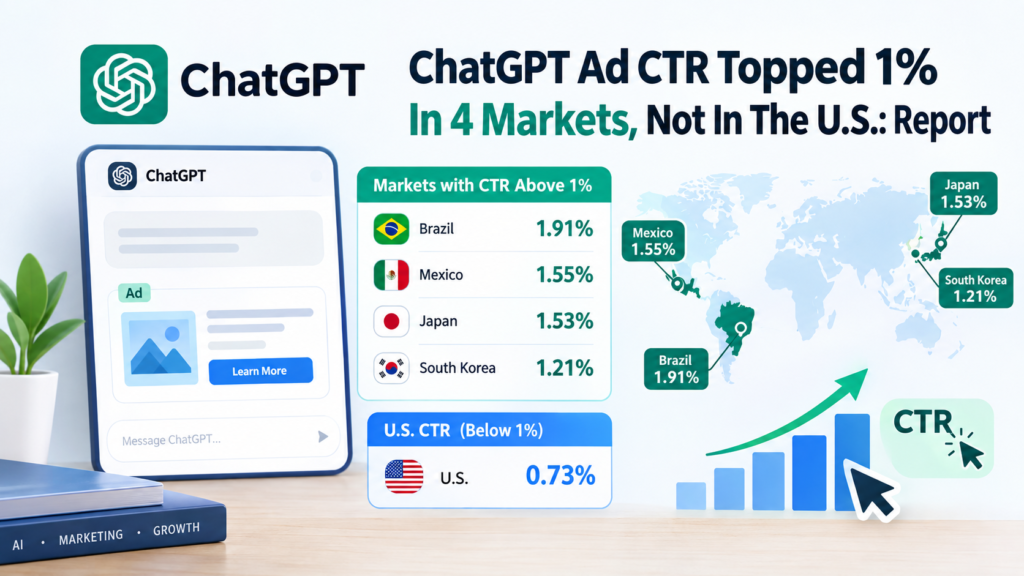
ChatGPT Ad CTR Topped 1% In 4 Markets, according to a new report analyzing advertising activity across ChatGPT. Brazil, Mexico, Japan, and South Korea recorded CTRs above 1%, while the United States and several other English-speaking markets remained below that level.
The findings offer an early look at how people interact with ads inside ChatGPT. They also show why advertisers may need to consider market-specific performance instead of relying on a single global benchmark.
The report from Graphite uses Similarweb panel data to examine ChatGPT advertising performance across different markets.
ChatGPT Ad CTR Topped 1% In 4 Markets
The report, titled The State of ChatGPT Ads, analyzed ChatGPT advertising activity among Free and Go users.
According to the data, ChatGPT Ad CTR Topped 1% In 4 Markets:
- Brazil: 1.91%
- Mexico: 1.55%
- Japan: 1.53%
- South Korea: 1.21%
These four markets recorded the highest CTR figures in the report.
By comparison, the United States, United Kingdom, Canada, Australia, and New Zealand all recorded rates below 1%.
This difference makes the report particularly useful for understanding how ChatGPT ad performance can vary from one market to another.
U.S. ChatGPT Ad CTR Stayed Below 1%
The U.S. recorded a 0.73% ChatGPT ad CTR in the report.
Other English-language markets were relatively close:
- Canada: 0.75%
- U.K.: 0.74%
- U.S.: 0.73%
- Australia: 0.67%
- New Zealand: 0.60%
The figures show a noticeable gap between the highest-performing market and the U.S.
Brazil’s 1.91% CTR was more than twice the U.S. rate of 0.73%.
However, this does not mean advertisers should automatically expect a similar result from their own campaigns. The data represents broader market activity rather than the performance of one individual advertiser.
What Does ChatGPT Ad CTR Measure?
One of the most important details in the report is how CTR is calculated.
Graphite measures clicks against ad-bearing ChatGPT exchanges. An exchange consists of a user message followed by a ChatGPT response that contains an advertisement.
In simple terms:
ChatGPT Ad CTR = Ad clicks ÷ Responses containing an ad
This measurement is different from the campaign-level CTR advertisers may see in traditional advertising platforms.
The report combines activity across advertisers within each market. Therefore, the reported number should be treated as a market-level measurement rather than a universal campaign benchmark.
Why the Measurement Matters
A traditional advertising dashboard may show:
- Impressions
- Clicks
- CTR
- Conversions
- Cost per click
- Conversion rate
The Graphite report takes a broader approach by examining clicks across ad-bearing ChatGPT responses.
That distinction matters when interpreting ChatGPT Ad CTR Topped 1% In 4 Markets.
The 1% threshold describes the reported market-level rate. It does not mean every advertiser in those countries achieved a CTR above 1%.
Why Does ChatGPT Ad CTR Vary by Market?
The report does not identify one specific reason for the differences between countries.
Several factors can influence ChatGPT advertising performance, including:
- User behavior
- Advertiser mix
- Industry categories
- Campaign targeting
- Local advertising conditions
- Ad creative
- Landing-page experience
- Length of time ads have been available
Another important factor is the data period.
The report says different markets have between five and 25 weeks of data. This means the countries are not being measured over exactly the same period.
As a result, ChatGPT Ad CTR Topped 1% In 4 Markets should be understood as a snapshot of the available data rather than a permanent ranking of advertising performance.
ChatGPT Advertisers Are Still Experimenting
The report also examined the advertisers receiving the largest share of ChatGPT ad impressions.
Only Jotform and Resume.io appeared among the 10 largest advertisers by worldwide impression share in all 20 weeks analyzed.
Other companies appeared in the top 10 during fewer weeks:
- Cursor and Monday.com appeared in 15 weeks.
- Booking.com appeared in 10 weeks.
- Design.com appeared in eight weeks.
The changing advertiser mix suggests that businesses are still experimenting with ChatGPT Ads.
This is important because advertiser competition, campaign formats, and user behavior can change as the platform develops.
B2B SaaS Led U.S. ChatGPT Ad Impressions
The report also examined U.S. advertising activity by industry category.
B2B SaaS accounted for 19.9% of U.S. ChatGPT ad impressions between March 30 and August 4.
The category included 1,210 advertisers, with Monday.com identified as the leading advertiser.
Retail and consumer brands represented another significant category, accounting for 10.4% of U.S. ChatGPT ad impressions across 1,510 advertisers.
Graphite categorized advertisers responsible for 98.95% of U.S. impressions.
These figures show that ChatGPT advertising has attracted substantial interest from software and business-focused advertisers.
Ecommerce Advertising Remains an Area to Watch
Retail and ecommerce advertisers have had a smaller presence on ChatGPT compared with some other categories.
Graphite connects this partly to challenges involving product feeds and the conversational structure of ChatGPT.
That could change as ecommerce integrations develop.
OpenAI’s partnerships and new advertising options could make ChatGPT increasingly relevant for businesses selling physical products online.
ChatGPT Ads Are Expanding Into More Markets
The data analyzed in the report does not represent every country where ChatGPT Ads are currently available.
OpenAI initially began testing ads in the United States in February 2026. The program later expanded into additional markets, including the U.K., Mexico, Brazil, Japan, and South Korea.
Further expansion has taken ChatGPT Ads into additional countries across Europe and Southeast Asia.
This rapid international expansion means ChatGPT ad CTR benchmarks are likely to evolve.
As more users and advertisers enter the platform, market-level CTRs may change considerably.
New Advertising Options Could Change ChatGPT Ad Performance
The ChatGPT advertising ecosystem is also developing through new partnerships.
In September 2026, Amazon Ads began a pilot that allows selected U.S. advertisers to extend Amazon campaigns into ChatGPT.
OpenAI also announced Shopify as its first ecommerce partner.
These developments could increase the number of retail and ecommerce advertisers using ChatGPT.
They could also introduce different campaign objectives, product advertising formats, and measurement methods.
For that reason, ChatGPT Ad CTR Topped 1% In 4 Markets is best viewed as an early benchmark rather than a fixed industry standard.
What Advertisers Should Learn From the CTR Data
The biggest takeaway is not simply that four markets crossed the 1% mark.
Instead, the data shows that ChatGPT ad performance can vary significantly by market.
Advertisers should avoid judging campaigns based on CTR alone.
Important metrics to monitor include:
- Click-through rate
- Conversion rate
- Qualified leads
- Cost per acquisition
- Revenue
- Return on ad spend
- Landing-page engagement
- Customer lifetime value
A high CTR can indicate that users are interested enough to click, but it does not necessarily mean those clicks are generating valuable customers.
Build Your Own ChatGPT Ad Benchmarks
Businesses can create more useful benchmarks by comparing campaigns based on:
- Market: Compare campaigns operating in the same country.
- Industry: Compare similar businesses and audiences.
- Campaign objective: Separate awareness, traffic, and conversion campaigns.
- Audience: Monitor how different user groups respond.
- Business results: Connect clicks to leads, sales, and revenue.
This approach gives marketers more context than comparing their campaign with a global average.
Why ChatGPT Ad CTR Matters for Digital Marketers
The growth of ChatGPT Ads adds another layer to the digital advertising ecosystem.
Search advertising has traditionally relied on platforms such as Google and Microsoft. ChatGPT introduces a conversational environment where advertisements appear alongside AI-generated responses.
That creates a different user experience.
Advertisers therefore need to pay attention not only to ChatGPT Ad CTR, but also to how their ads fit within conversational search journeys.
Creative relevance, landing-page quality, targeting, and business objectives can all influence campaign results.
Frequently Asked Questions
What is ChatGPT Ad CTR?
ChatGPT Ad CTR measures ad clicks relative to ad-bearing ChatGPT exchanges. In the Graphite report, an exchange represents a user message and a ChatGPT response containing an advertisement.
Which countries had ChatGPT Ad CTR above 1%?
According to the report, ChatGPT Ad CTR Topped 1% In 4 Markets: Brazil, Mexico, Japan, and South Korea.
Brazil recorded 1.91%, Mexico 1.55%, Japan 1.53%, and South Korea 1.21%.
What was the U.S. ChatGPT Ad CTR?
The United States recorded a 0.73% CTR in the report among Free and Go users.
Does a CTR above 1% mean a campaign is successful?
Not necessarily. CTR measures clicks, but advertisers also need to consider conversions, qualified leads, acquisition costs, revenue, and return on ad spend.
Can these numbers be used as a ChatGPT Ads benchmark?
They can provide useful market-level context, but they should not be treated as a universal campaign benchmark. The report combines advertisers and covers different periods across markets.
Final Thoughts
The latest report shows that ChatGPT Ad CTR Topped 1% In 4 Markets: Brazil, Mexico, Japan, and South Korea.
Brazil recorded the highest reported rate at 1.91%, while the United States registered 0.73%. Other English-language markets also remained below 1%.
The numbers are useful for understanding early ChatGPT advertising trends, but advertisers should interpret them carefully. Different markets have different data periods, advertiser mixes, and campaign conditions.
As ChatGPT Ads expand into more countries and new ecommerce and advertising partnerships emerge, performance benchmarks are likely to become more detailed.
For now, marketers should use market-level CTR data as context while building their own benchmarks around clicks, conversions, leads, acquisition costs, and revenue.