

Introduction
Many businesses invest in paid advertising to reach people searching for their products or services. However, some valuable opportunities appear when customers search for ways to leave a competitor.
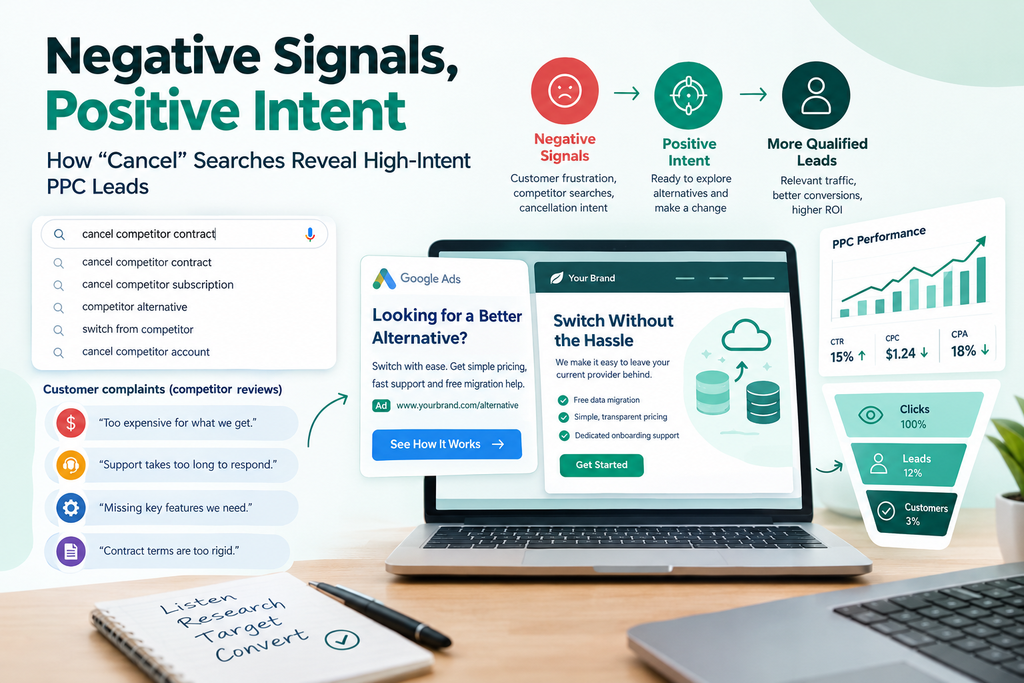
This is where Negative Signals, Positive Intent becomes an interesting strategy for pay-per-click (PPC) marketing. Searches such as “alternative to expensive software,” “switch from competitor,” and “cancel subscription and find another provider” can reveal customer frustration and a possible willingness to change.
These searches do not guarantee a sale, but they can help marketers identify people who have a specific problem to solve.
By understanding search intent, researching customer complaints, and creating relevant landing pages, businesses can turn these insights into opportunities for qualified PPC leads.
What Is Negative Signals, Positive Intent in PPC Marketing?
Negative Signals, Positive Intent is a PPC approach that identifies potential customers through searches related to dissatisfaction, cancellation, and competitor alternatives.
Traditional paid advertising often focuses on keywords such as “best CRM software,” “digital marketing services,” or “affordable project management tools.” These terms can attract relevant visitors, but they may also attract people who are only researching the market.
Consider someone searching for “alternative to expensive CRM software.” This query suggests a specific concern: the current solution may cost too much.
The search contains two important signals:
- Negative signals: Dissatisfaction with pricing, customer support, product features, or service quality.
- Positive intent: A possible interest in finding a better solution or switching providers.
The key idea behind Negative Signals, Positive Intent is to understand the problem behind the search rather than relying only on conventional product keywords.
Marketers must still verify relevance, competition, search demand, and conversion performance before investing in these terms.
Why Negative Signals, Positive Intent Can Reveal Valuable PPC Opportunities
Competitor-related searches can help businesses discover demand that ordinary product keyword research may overlook.
1. Customers Have Already Identified a Problem
People rarely consider changing a provider without a reason. They may be unhappy with increasing prices, complicated contracts, poor customer support, or missing features.
For example, a business owner searching for an alternative to an expensive accounting tool may already understand the value of the category. The remaining challenge is finding a solution that better matches their budget.
With Negative Signals, Positive Intent, marketers can use this insight to create advertisements that address the customer’s actual concern.
Instead of promoting a long list of features, an advertisement might highlight transparent pricing, easy onboarding, or flexible subscription options, provided these benefits are accurate.
2. Specific Searches Can Reveal Stronger Intent
A broad search such as “business software” provides limited information about what a person needs.
A search such as “project management software with better customer support” reveals a more specific requirement.
This distinction helps marketers build focused campaigns and relevant landing pages.
Negative Signals, Positive Intent does not mean every specific search will convert. It means using the available signals to develop and test more relevant advertising messages.
3. Competitor Complaints Reveal Unmet Customer Needs
Reviews and customer discussions often reveal repeated frustrations that influence buying decisions.
Common complaints include:
- Unexpected subscription costs.
- Slow responses from support teams.
- Difficult account setup.
- Missing integrations.
- Limited product functionality.
- Complicated data migration.
- Inflexible contract terms.
These complaints can inspire new keyword ideas and landing page messages.
For instance, repeated concerns about migration may suggest an opportunity to promote a product with verified data-transfer assistance.
How to Find Competitor Cancellation Keywords
Finding the right search terms requires research into customer behavior, not just a list of competitor names.
1. Research Competitor Reviews
Review platforms such as G2, Capterra, and Trustpilot can help you understand why customers are dissatisfied.
Look for recurring patterns in critical reviews instead of basing your strategy on one person’s experience.
Ask these questions:
- What do customers complain about most often?
- Why are users considering another provider?
- Which product limitations appear repeatedly?
- What improvements do customers want?
- Are pricing or service issues influencing switching decisions?
Under the Negative Signals, Positive Intent approach, these insights can help you create keyword themes around affordability, usability, support, and alternatives.
For example, repeated complaints about complicated setup may inspire research into searches such as “easy-to-use CRM software” or “CRM with onboarding support.”
Validate these ideas with keyword research before creating campaigns.
2. Analyze Google Ads Search Term Reports
Your Google Ads search term report shows the queries that triggered your ads, subject to Google’s reporting and privacy limitations.
Review relevant searches containing terms such as:
- Cancel
- Alternative to
- Switch from
- Better than
- Competitor brand names
- Problems with
- Migration from
Not every cancellation query is commercially valuable. Someone looking for a competitor’s customer support number may have no interest in your offer.
However, someone researching alternatives after deciding to leave a provider may be worth testing.
Negative Signals, Positive Intent encourages marketers to evaluate the complete search query before adding it as a negative keyword.
3. Use Sales and Customer Support Feedback
Your own sales and support teams can reveal which problems influence customer decisions.
Sales representatives may hear objections about pricing, onboarding, or product capabilities. Support teams may notice recurring complaints about the customer experience.
Bring these insights into PPC planning.
For example:
| Customer problem | Potential keyword theme |
|---|---|
| High subscription costs | Affordable alternatives |
| Slow customer support | Software with responsive support |
| Difficult data migration | Easy migration solutions |
| Missing integrations | Software with required integrations |
| Complicated setup | Easy-to-use business tools |
Use these themes to build targeted keyword groups, advertisements, and landing pages.
How to Turn Negative Signals, Positive Intent Into PPC Leads
Keyword discovery is only the beginning. A campaign needs the right message and offer to turn relevant clicks into qualified prospects.
1. Write Ads That Address Customer Frustrations
Generic advertisements often focus on product features without explaining why a visitor should consider switching.
A better approach is to connect the ad message with the problem behind the search.
Example Google Ads creative
Headline: Looking for a Better CRM Alternative?
Description: Explore transparent pricing, simple onboarding, and support options designed to make switching easier.
Call to action: Compare Plans
Use these claims only if your business genuinely provides the stated benefits.
Negative Signals, Positive Intent works best when the advertisement communicates a relevant solution without making misleading promises about competitors.
2. Create a Dedicated Landing Page
Sending every visitor to your homepage may make it harder for them to find the information they need.
A dedicated landing page can focus on the particular issue that motivated the search.
Include:
- A headline that addresses the customer’s main concern.
- A short explanation of your solution.
- Relevant features and benefits.
- Clear pricing and contract terms.
- Information about setup and migration.
- Genuine testimonials or verified case studies.
- A visible call to action.
For example, a business targeting price-related searches could create a page explaining its subscription plans, included features, and potential cost differences.
The purpose is to help customers make an informed comparison rather than simply criticize another provider.
3. Offer Practical Switching Support
Changing providers can feel difficult. Customers may worry about losing data, interrupting operations, learning a new system, or paying additional fees.
Your offer should address these concerns where possible.
Potential offers include:
- Free product demonstrations.
- Guided onboarding.
- Data migration assistance.
- Clearly explained trial periods.
- Flexible subscription plans.
- Personalized consultations.
The best offer depends on the customer’s specific problem.
For instance, a price-sensitive customer may appreciate transparent plans, while a company with a large customer database may value migration support more.
This is an important part of Negative Signals, Positive Intent because the offer must match the motivation behind the search.
4. Choose a Clear Call to Action
Your call to action should reflect how ready the visitor is to make a decision.
Useful options include:
- Explore Alternatives
- Compare Pricing
- Book a Demo
- See How Switching Works
- Start a Trial
Test different calls to action and measure qualified leads rather than clicks alone.
How to Build a Repeatable PPC Campaign Strategy
Negative Signals, Positive Intent can become a recurring optimization process instead of a one-time keyword discovery exercise.
Step 1: Identify Repeated Customer Complaints
Collect relevant feedback from competitor reviews, customer conversations, sales notes, and support discussions.
Group similar problems into themes such as pricing, customer service, usability, and missing features.
Step 2: Develop Keyword Ideas
Turn each problem into search queries that potential customers might use.
For example, complaints about expensive subscriptions may inspire research into affordable alternatives, flexible pricing, and monthly subscription options.
Check search demand, relevance, and potential business value before launching a campaign.
Step 3: Review Existing Campaign Data
Check whether relevant competitor searches already appear in your Google Ads account.
Review your negative keyword lists to see whether suitable queries have been excluded.
Do not remove negative keywords indiscriminately. Irrelevant searches should still be excluded when appropriate.
Step 4: Organize Keywords by Search Intent
Create separate keyword groups for different customer problems.
For example, pricing-related searches can be grouped separately from migration-related searches.
This structure helps you align advertisements, landing pages, and offers with the visitor’s needs.
Step 5: Test Your Landing Pages and Offers
Compare a problem-focused landing page with your existing page when you can run a meaningful test.
Start with a clear hypothesis. For example, test whether providing migration assistance increases qualified leads from relevant switching searches.
Evaluate results after collecting enough reliable data.
Step 6: Measure Lead Quality and Profitability
Track the metrics that show whether your campaign is creating business value:
- Click-through rate (CTR).
- Cost per click (CPC).
- Conversion rate.
- Cost per qualified lead.
- Customer acquisition cost (CAC).
- Lead-to-customer conversion rate.
- Revenue and return on ad spend (ROAS), where applicable.
A high click-through rate does not automatically mean a campaign is profitable. Lead quality and actual customer outcomes should guide optimization decisions.
Common Mistakes to Avoid
Even a well-researched competitor campaign can waste money when search intent and the advertising offer do not match.
Treating Every Cancellation Search as a Sales Opportunity
Some users only want cancellation instructions or account support. They may never consider switching providers.
Evaluate the complete query before bidding.
Using Generic Landing Pages
A visitor searching for a cheaper alternative may expect pricing information, while someone researching migration may want details about setup and data transfer.
Make the landing page relevant to the reason behind the search.
Making Unsupported Competitor Claims
Avoid unverified comparisons, exaggerated promises, or misleading claims about other businesses.
Use accurate product information and fair comparisons. Check applicable advertising policies and trademark requirements before launching competitor campaigns.
Ignoring Negative Keywords
The strategy is not to stop using negative keywords. It is to apply them carefully.
Exclude searches that are irrelevant to your business, but review your exclusions regularly to avoid blocking potentially valuable queries.
Focusing Only on Clicks
Clicks and impressions do not prove that a campaign is generating customers.
Evaluate lead quality, conversion costs, and revenue wherever possible.
How AI Can Support Negative Signals, Positive Intent Research
AI tools can help marketers organize customer feedback, identify repeated complaint themes, and generate keyword ideas.
For example, a marketer could analyze anonymized review data to identify recurring concerns about pricing, onboarding, and customer support.
Those themes can then guide keyword research, ad messaging, and landing page experiments.
However, AI-generated suggestions should always be verified. Tools may misinterpret customer feedback or recommend search terms with little commercial value.
Use automation to speed up research and reporting while retaining human oversight and protecting confidential customer information.
Frequently Asked Questions
1. What does Negative Signals, Positive Intent mean?
Negative Signals, Positive Intent is a PPC marketing approach that identifies potential buying opportunities through dissatisfaction, cancellation searches, and competitor-related queries. These signals can help businesses understand why people may consider switching providers.
2. Are competitor cancellation keywords useful for Google Ads?
They can be useful when a query is relevant to your product and suggests a possible interest in switching. However, some cancellation searches are purely informational. Review search intent, campaign costs, and lead quality before increasing your advertising budget.
3. How can I find high-intent competitor keywords?
Review competitor feedback, sales objections, keyword research tools, and Google Ads search term reports. Look for recurring problems and develop relevant keyword ideas around alternatives, pricing, support, and migration.
4. Should I create a separate landing page for competitor searches?
A dedicated landing page can help when visitors share a specific concern. It lets you explain your solution, answer relevant questions, provide accurate comparisons, and offer a suitable next step.
5. How do I measure the success of these PPC campaigns?
Measure qualified leads, conversion rates, cost per qualified lead, customer acquisition cost, and revenue where available. Click-through rate and cost per click are useful supporting metrics, but they do not independently prove profitability.
Conclusion: Turn Customer Frustration Into PPC Opportunities
Negative Signals, Positive Intent gives marketers a different way to approach keyword research. Instead of focusing exclusively on product names and popular buying terms, it encourages them to understand why customers are considering a change.
Competitor complaints, cancellation searches, and alternative-related queries can reveal real problems that potential buyers want solved. By validating these signals, creating relevant ads, and offering helpful landing pages, businesses can test new opportunities for qualified PPC leads.
Start by identifying recurring customer frustrations. Turn those insights into relevant keyword ideas, match your advertising message to the search intent, and measure the quality of the resulting leads.
Remember that dissatisfaction alone does not guarantee a purchase. The goal is to provide a credible alternative that addresses the customer’s needs.
Ultimately, Negative Signals, Positive Intent is about more than finding additional keywords. It is about understanding the problem behind a search and presenting a useful solution at the right moment.