

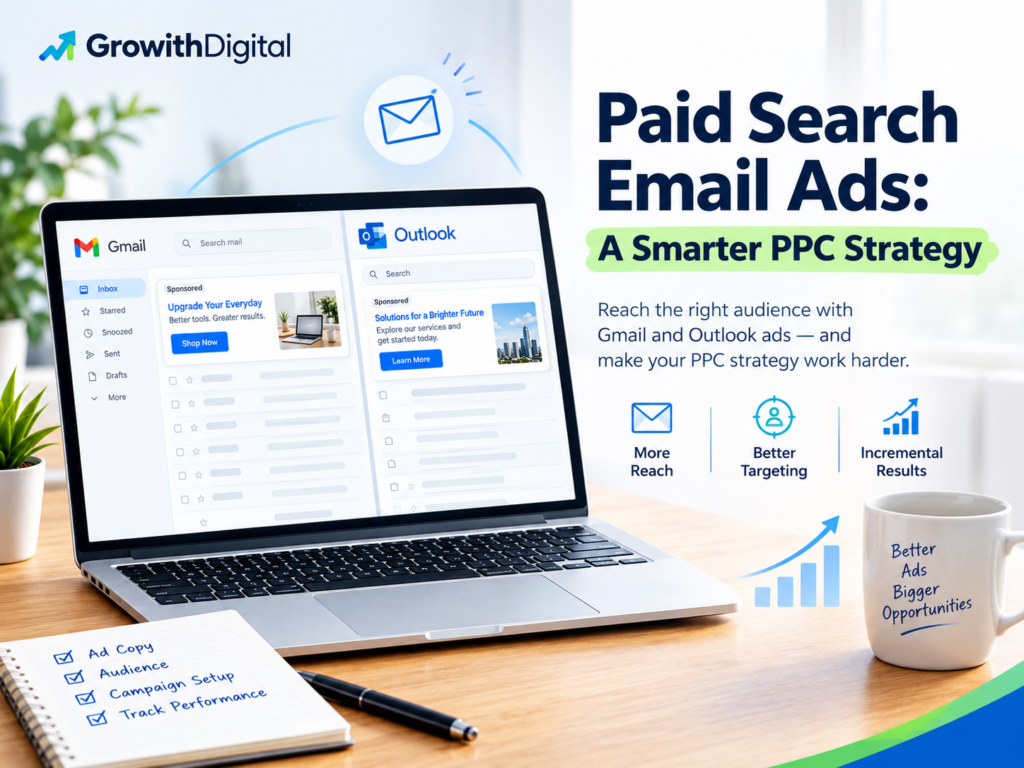
Paid Search Email Ads: A Smarter PPC Strategy helps businesses reach the right audience through Gmail and Outlook advertising placements. These paid email ads allow advertisers to expand their PPC campaigns, improve audience targeting, and discover new opportunities to generate leads and conversions. When planned carefully, email ad placements can complement search campaigns and support overall digital marketing growth.
The Paid ‘Search’ Email Placement: Right Place, Right Time is about understanding how these placements work, when they make sense, and how to test them without allowing them to take budget away from higher-performing campaigns.
Instead of treating email placements as a replacement for search advertising or traditional email marketing, advertisers should consider them an additional channel within a broader PPC strategy.
Paid Search Email Ads: A Smarter PPC Strategy
helps businesses reach relevant audiences through Gmail and Outlook advertising placements. These ads can support PPC campaigns, improve audience targeting, and create additional opportunities to generate leads and conversions.
What Are Paid Search Email Placements?
Paid search email placements are advertisements that appear within email environments through advertising platforms. Although the name includes “search,” these ads do not necessarily appear on a search engine results page.
For example, advertisers may reach users through Gmail advertising in Google Ads or Outlook placements available through Microsoft Advertising’s audience inventory, depending on campaign type, eligibility, and current platform settings.
These placements can help businesses connect with users while they are checking their inboxes rather than actively searching for a product or service.
How Do Gmail and Outlook Ads Work?
Different advertising platforms provide different ways to access email-related inventory.
- Google Demand Gen: Helps advertisers reach audiences across eligible Google-owned and partner environments, which can include Gmail.
- Microsoft Audience Ads: Provides native advertising opportunities across eligible Microsoft audience inventory, including supported Outlook placements.
- Performance Max: Can distribute ads across multiple eligible channels and placements, but advertisers generally have less direct control over individual placement allocation.
Availability and controls can change, so advertisers should confirm the current campaign settings and placement eligibility before launching a test.
Why Should Advertisers Consider Email Ad Placements?
Paid Search Email Ads: A Smarter PPC Strategy helps businesses connect with relevant audiences through email advertising placements. By combining audience targeting, engaging ad creatives, and clear calls to action, advertisers can expand their PPC strategy beyond traditional search campaigns. Regular performance tracking helps identify which placements generate qualified leads and meaningful conversions.
Email remains an important digital environment where people read updates, manage subscriptions, and interact with businesses. Advertising in this environment creates another opportunity to reach users who may be interested in a product or service.
However, an email placement does not automatically mean a user has strong purchase intent. Performance depends on the audience, message, offer, and campaign objective.
Paid Search Email Ads: A Smarter PPC Strategy gives businesses another way to connect with potential customers while they check their inboxes. By using relevant audience targeting, clear ad copy, and a strong call to action, advertisers can make their PPC campaigns more effective. The key is to measure conversions and business value rather than focusing only on clicks.
1. Reach Existing Customers and Interested Users
Remarketing audiences can be a useful starting point. Businesses may be able to reach eligible users who previously visited their website or interacted with their brand, subject to platform policies and audience eligibility.
For example, an online clothing store could test ads promoting a new collection to eligible previous website visitors.
Customer lists may also be useful when the advertiser has the required permissions, consent, and platform eligibility.
2. Discover New Potential Customers
Email advertising can also support prospecting campaigns. Instead of reaching only people who already know the brand, advertisers can test eligible audience segments to find new potential customers.
For example, an insurance provider might test different audience segments and compare qualified leads, cost per lead, and conversion rates.
The goal is not simply to reach more people. It is to discover whether the additional audience contributes meaningful business results.
3. Support Brand Awareness and Conversions
Email placements can help introduce a business to potential customers and encourage them to explore its products or services.
Some users may click immediately, while others may return later through organic search, direct visits, or another advertising channel.
This is why advertisers should examine both direct conversions and broader campaign impact rather than judging success using impressions alone.
Do Gmail and Outlook Advertising Placements Actually Work?
Paid Search Email Ads: A Smarter PPC Strategy can help advertisers reach potential customers beyond traditional search results. By testing relevant audiences and creative formats, businesses can understand whether Gmail and Outlook placements contribute to better campaign performance and additional conversions.
The short answer is that they can work, but results vary from one campaign to another.
A campaign that performs well for an e-commerce business may not produce the same results for a local service provider. Audience quality, creative design, budget, landing-page experience, and conversion tracking all influence performance.
Before launching a campaign, decide what success means for your business.
Advertisers can explore Microsoft Advertising to learn more about reaching audiences through Outlook and other Microsoft platforms.
For example:
- An e-commerce brand may prioritize purchases and return on ad spend.
- A lead generation business may focus on qualified leads and cost per acquisition.
- A new brand may measure reach, engagement, and assisted conversions.
- A remarketing campaign may focus on bringing interested visitors back to the website.ted visitors back to the website.
Which Metrics Should You Measure?
Use metrics that match the campaign objective.
Click-through rate (CTR): Measures how often people click after seeing an ad. A high CTR is useful, but it does not guarantee valuable conversions.
Conversion rate (CVR): Shows the percentage of relevant visits that complete a desired action, such as submitting a form or making a purchase.
Cost per lead (CPL): Helps lead generation businesses understand how much they spend to acquire a lead.
Cost per acquisition (CPA): Measures the cost of obtaining a customer or another defined conversion.
Return on ad spend (ROAS): Compares advertising revenue with advertising expenditure when reliable revenue tracking is available.
Incremental conversions: Help assess whether advertising generated additional results beyond what would likely have happened without the campaign.
Compare email placements with relevant alternatives, such as other audience campaigns or prospecting activity. Avoid comparing different channels using unrelated objectives or measurement windows.
How to Set Up a Paid Email Advertising Campaign
A successful Paid Search Email Ads: A Smarter PPC Strategy begins with a clear campaign objective and a well-defined target audience. Businesses should test suitable Gmail and Outlook advertising placements, review campaign spending, and measure conversion performance. Comparing these results with other PPC channels helps advertisers understand where their budget delivers the most value.
A successful test starts with a clear objective and a controlled campaign structure. Rather than immediately combining every placement, decide what you want to learn.
A successful Paid Search Email Ads: A Smarter PPC Strategy starts with the right campaign objective and audience. Advertisers should test Gmail and Outlook placements, monitor spending, and compare results with other advertising channels. This approach helps businesses understand which placements deliver meaningful results without wasting their advertising budget.
Advertisers can also explore our related Google Ads and PPC strategy guide to learn more about improving campaign performance.
Step 1: Choose the Right Campaign Type
In Google Ads, investigate whether Demand Gen supports the Gmail inventory and campaign controls you need. In Microsoft Advertising, review the available Audience Ads options and Outlook eligibility.
Performance Max may also serve ads across eligible inventory, but it is less suitable when your main goal is to isolate and control email placements specifically.
Check the current platform documentation before setting up your campaign because product features and inventory controls can change.
Step 2: Separate Placements When Practical
If the platform supports the required controls, consider separating email-focused activity from other creative formats or placements.
This can make it easier to review spending, engagement, conversions, and audience quality.
For example, you could compare:
- A campaign focused on eligible Gmail inventory.
- A separate campaign using other eligible audience placements.
- An existing search campaign that captures active demand.
Separate campaigns may provide clearer reporting, but they are not automatically better. They can also divide conversion data and make optimization harder, especially when the budget is small.
Test a consolidated structure against a more segmented structure when you have enough budget and data to make a meaningful comparison.
Step 3: Select Relevant Audiences
Audience selection can have a major impact on performance.
Consider testing:
- Eligible website remarketing audiences.
- Eligible customer audiences.
- Relevant prospecting segments.
- Platform-supported similar or expansion audiences, where available.
Start with a clear hypothesis. For instance, you might expect previous website visitors to generate more qualified leads than a broad prospecting audience.
Evaluate the results instead of assuming that one audience type will always perform best.
Effective Paid Search Email Ads: A Smarter PPC Strategy starts with understanding customer interests, needs, and online behaviour. More relevant targeting can help advertisers deliver useful messages instead of showing ads to an overly broad audience.
Step 4: Create Clear and Compelling Ad Copy
Email placements may display ads differently depending on the device, format, and placement. Headlines can be truncated, and some formats may display additional content only after the user interacts with the ad.
To improve readability:
- Put the main benefit near the beginning of the headline.
- Use straightforward language.
- Make the offer relevant to the audience.
- Include a clear call to action.
- Use suitable images that match the landing page.
- Preview the ad across available formats and devices.
For example, an online retailer could test the headline “Explore Our New Collection” against “Find Your Everyday Style.”
Treat these as creative hypotheses, not guaranteed winners. The better version is the one that produces stronger business results.
Step 5: Set a Realistic Test Budget
Your budget should reflect your audience size, expected costs, conversion volume, and learning goals.
There is no universal daily budget that guarantees successful Demand Gen or Audience Ads performance. A smaller, focused test may be useful when it can gather sufficient data, while a broader campaign may require more investment.
Before launching, define:
- Your total test budget.
- Your test duration.
- Your primary KPI.
- Your acceptable cost per result.
- The conditions under which you will continue, change, or stop the test.
Avoid making decisions from a few clicks or one unusually good day.
Paid Search Email Ads: A Smarter PPC Strategy requires careful budget management and regular performance reviews. Start with a controlled test budget, track campaign results, and adjust spending based on meaningful business outcomes.
How to Avoid Cannibalizing Search Campaigns
One of the biggest concerns in paid media is whether new placements are generating additional value or simply taking credit for conversions that existing campaigns would have captured.
Search advertising often reaches people who are actively looking for a product or solution. Email placements may reach users in a different context, including those who are not currently searching.
Both can contribute to a marketing strategy, but they should have clearly defined roles.
A well-planned Paid Search Email Ads: A Smarter PPC Strategy keeps campaign goals clear and makes performance easier to evaluate. Monitor placement-level results where available, compare acquisition costs, and check whether these ads generate incremental value instead of shifting existing search conversions.
Keep Search and Audience Campaigns Accountable
To reduce the risk of cannibalization:
- Monitor spending and conversions by campaign and eligible placement.
- Compare conversion quality, not just the number of leads.
- Review changes in branded search activity and overall business results.
- Check for duplicate conversions and inconsistent attribution settings.
- Use suitable experiments or holdout tests when available.
- Avoid counting the same business outcome more than once in your reporting.
If email placements appear to be taking budget away from stronger search activity without generating additional value, review the campaign structure, bidding strategy, and available controls.
Performance Max deserves particular attention because it can shift delivery toward inventory that its optimization system expects to perform well. Advertisers should review available reporting and controls rather than assume every eligible placement will receive consistent delivery.
Common Mistakes to Avoid
Email advertising can become inefficient when the campaign is launched without a clear measurement plan. A common mistake with Paid Search Email Ads: A Smarter PPC Strategy is judging success by clicks alone. Advertisers should also assess lead quality, conversion rates, audience relevance, and the actual value generated by each campaign.
Treating every click as valuable: Clicks are only an early signal. Evaluate leads, sales, and customer quality.
Using an audience that is too broad: Poor audience relevance can increase spending without producing useful outcomes.
Ignoring creative limitations: Truncated headlines, unclear offers, and mismatched landing pages can weaken engagement.
Combining every placement without reviewing performance: Consolidation may help optimization, but it can also make it harder to understand which inventory contributes value.
Expecting search-level conversion rates: Different placements serve different user contexts. Set realistic benchmarks for each campaign objective.
Replacing email marketing with paid placements: Paid advertising and owned email campaigns serve different purposes. They should complement one another rather than be treated as interchangeable channels.
Paid Email Ads vs. Traditional Email Marketing
Although both approaches use an email environment, they operate differently.
| Feature | Paid Email Ad Placements | Traditional Email Marketing |
|---|---|---|
| Audience | Eligible platform audiences | Subscribers and opted-in contacts |
| Distribution | Advertising platform | Email service provider |
| Main costs | Advertising spend | Platform, creative, and operational costs |
| Targeting | Available audience and campaign controls | Subscriber data, segments, and preferences |
| Measurement | Ad interactions and attributed conversions | Opens, clicks, conversions, and revenue |
| Primary role | Reach, prospecting, remarketing | Customer communication and retention |
Traditional email marketing can be particularly useful for nurturing subscribers, sharing updates, and building long-term customer relationships.
Paid email placements can extend reach to eligible audiences outside your owned subscriber list. Neither channel is a universal replacement for the other.
Frequently Asked Questions
1. What are paid search email placements?
Paid search email placements are ads delivered within email environments through advertising platforms such as Google Ads and Microsoft Advertising. They are generally accessed through eligible campaign types rather than ordinary search results.
2. Can Google Ads show advertisements in Gmail?
Yes. Eligible Google Ads campaign types, including Demand Gen, can serve ads in Gmail. Actual availability depends on the campaign setup, format, and current platform settings.
3. Can Microsoft Advertising show ads in Outlook?
Microsoft Advertising offers audience advertising across eligible inventory, which can include Outlook placements. Advertisers should verify current inventory availability and targeting options in their accounts.
4. Should email placements be separated from search campaigns?
It depends on your goals and the controls available. Separating eligible placements can improve reporting and budget visibility, but consolidation can sometimes help an account gather more optimization data. Test the structure that best supports your objectives.
5. How do I measure whether email advertising is profitable?
Track conversions, cost per acquisition, qualified leads, revenue, and return on ad spend where appropriate. Where possible, use experiments or other suitable methods to understand whether the campaign creates additional business value rather than simply receiving credit for existing demand.
Conclusion: Put the Right Ad in the Right Place
The Paid ‘Search’ Email Placement: Right Place, Right Time is about more than finding another place to display advertisements. It is about reaching relevant audiences, testing new opportunities, and understanding how each placement contributes to business growth.
Gmail and Outlook advertising can support prospecting, remarketing, and incremental conversions when the campaign has a clear objective, suitable creative, and reliable measurement. With careful audience selection and consistent performance monitoring, Paid Search Email Ads: A Smarter PPC Strategy can help businesses discover new advertising opportunities, improve campaign insights, and work toward better conversion results.
Start with a focused test, compare performance using relevant KPIs, and review how the campaign interacts with existing search activity. Most importantly, keep paid placements accountable for the value they create.
When email advertising complements search campaigns and traditional email marketing, it can become a useful part of a balanced PPC strategy. With the right targeting and performance tracking, Paid Search Email Ads: A Smarter PPC Strategy can support audience growth, improve campaign insights, and create additional opportunities for conversions. Businesses can use Paid Search Email Ads: A Smarter PPC Strategy to test new audience opportunities while keeping their advertising budget focused on measurable results.
Ultimately, Paid Search Email Ads: A Smarter PPC Strategy works best when it complements other paid media channels, reaches relevant audiences, and is measured against clear conversion goals. Test carefully and use real performance data to guide future decisions.