
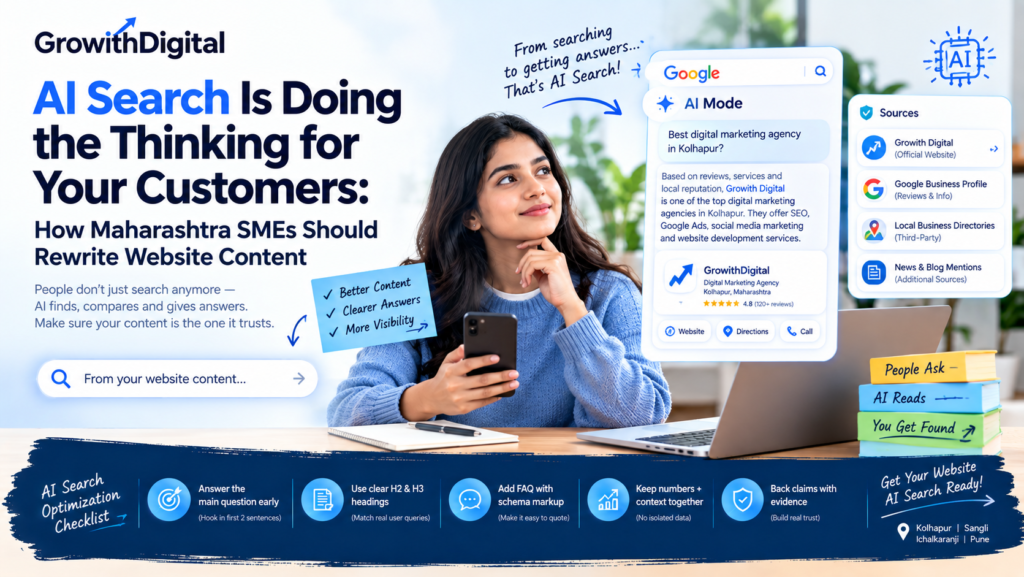
AI search optimization is now deciding which businesses get found online before a customer ever sees a website. For twenty years, search worked the same way: you typed a few words, scanned a list of blue links, and decided for yourself which page to trust. That bargain is breaking. Increasingly, Google’s AI Mode and tools like ChatGPT read the pages, compare the sources and hand your customer a finished answer before they ever visit a website. For small businesses in Kolhapur, Sangli, Ichalkaranji and Pune, this is not a future problem, it is already changing who gets found, and getting AI search optimization right is becoming as important as the ranking itself.
Search Didn’t Get Easier, the Work Just Moved
According to a recent Search Engine Journal analysis, AI answer systems now handle retrieval, source selection and synthesis before the customer sees a result. The person still has a goal, but the AI does most of the information work that used to belong to them. The catch is that citations and links attached to an AI answer can increase a customer’s trust even when the underlying information is incomplete, because a source-looking answer feels more reliable than it actually is. That puts more pressure on your website to be the source the AI trusts, not just a page a human happens to click.
What This Means If You Run a Local Business Website
We already wrote about this shift when Google AI Mode crossed 1 billion users and forced every website owner to rethink content strategy. The same applies here: your service pages, blog posts and even your Google Business Profile description are being read, compressed and sometimes rewritten by AI before a customer ever reaches your site. If a sentence like “we serve 500+ clients across Maharashtra” is pulled out of context, it needs to still make sense on its own. AI search optimization is about writing content that survives being taken apart and reassembled somewhere else.
How to “AI-Proof” Your Website Content
- Keep numbers attached to their unit and context, for example “31% increase in leads over 3 months for a Kolhapur retail client,” not just “31% increase”
- Answer the core question in the first two sentences of every page, then explain the details after
- Use clear H2 and H3 headings that match how customers actually ask questions
- Add FAQ sections with direct, quotable answers, and mark them up with schema structured data so both Google and AI tools can read them accurately
- Keep evidence next to the claim it supports, instead of separating data from context
Don’t Confuse “Simple” With “Short”
Search Engine Journal’s coverage put it well: removing words is not the same as removing information. If a qualification decides when a claim is true, or a date changes how a statement should be read, cutting it to make a page shorter can make it easier for an AI tool to misquote you. The goal of AI search optimization isn’t the shortest possible page, it’s a page where every fact still makes sense if it gets separated from the rest of your content.
Related Reading
- Google AI Mode Just Crossed 1 Billion Users. Here’s Why Your Website Needs To Change
- Instagram’s Biggest 2026 Update Isn’t An Algorithm Change. It’s Google Reading Your Posts
Where Growith Digital Fits In
We build website and blog content with AI search optimization in mind from the first draft, structured so it works for a human reader and an AI system at the same time. If your website content hasn’t been reviewed since before AI Mode launched, our SEO and content strategy services can help you catch up.
AI search isn’t replacing your customers’ judgment, it’s moving where that judgment happens, further downstream, after the answer is already in front of them. The businesses that win from here are the ones whose content survives that trip intact. Talk to us about auditing your website content for AI search readiness.
[…] being mentioned in the answer a customer actually reads. We covered this shift in detail in how AI search is doing the thinking for your customers, and the technical layer is where most local businesses fall short […]
[…] This connects directly to what we cover in why regulators now treat ChatGPT as a search engine and in our breakdown of how AI search is doing the thinking for your customers. […]