

A Series B software client had 14 page-one Google keywords and still showed up in only 4 out of 20 AI assistant answers about their category. That gap is exactly why every serious AI search budget conversation now starts with a hard truth: ranking well on Google no longer means showing up where your buyers are actually asking questions.
The org chart problem
As Search Engine Journal explains in its guide to restructuring for the AI search era, most marketing teams and budgets were built entirely around Google rankings. Buyers now skip the results page and ask ChatGPT, Gemini or Google AI Mode directly, and a business with a strong Google presence but no strategy for this shift can still be invisible in the answer that matters.
The same software client mentioned above raised their citation rate from 3 to 12 out of 20 test answers within six months, simply by restructuring roles and spend, not by producing more content.
Where an AI search budget actually goes
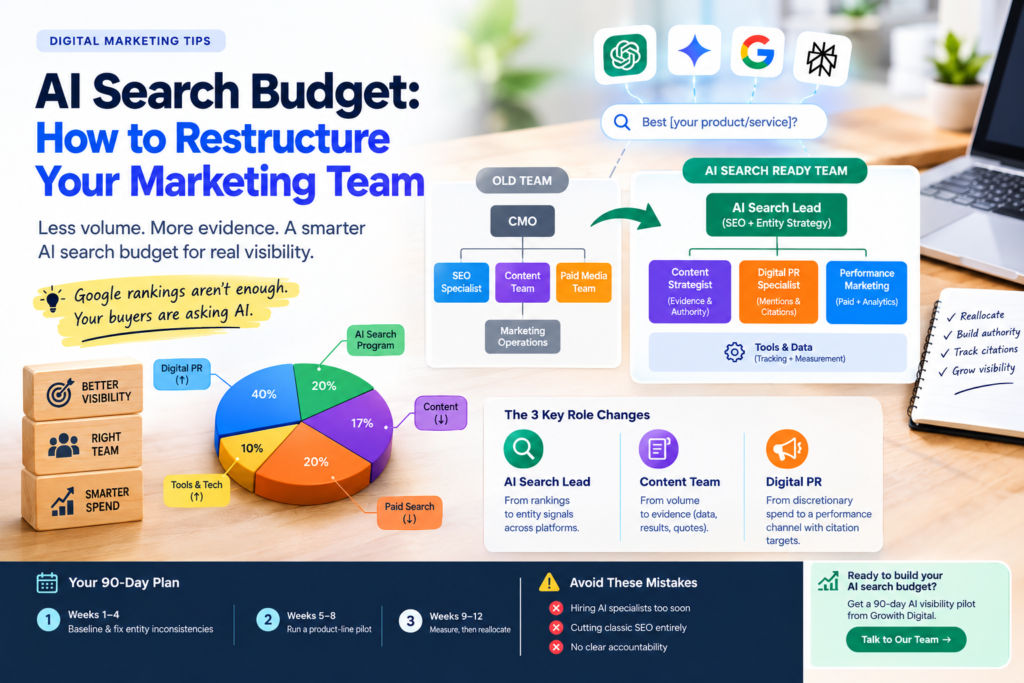
One example from the research shows a $60,000 monthly budget reallocated like this: paid search cut 20% (from $30K to $24K), content production trimmed 17% (from $12K to $10K), a new $10K AI search program introduced, digital PR doubled from $5K to $10K, and tools spend raised to $6K. The shape of that shift matters more than the exact numbers: less volume, more evidence, more third-party mentions.
This connects directly to what we cover in why regulators now treat ChatGPT as a search engine and in our breakdown of how AI search is doing the thinking for your customers.
Three roles that need to change
- Your SEO lead becomes your AI search lead. The job grows from ranking optimization to keeping brand entity signals consistent across LinkedIn, G2, Crunchbase, Reddit and industry directories.
- Your content team trades volume for evidence. Fewer posts, more original data, quantified outcomes and content structured so an AI answer engine can quote it directly.
- Digital PR moves into the performance budget. PR stops being discretionary spend and becomes a channel with citation targets, because AI models reward mentions across independent sources.
A 90-day plan for reallocating your AI search budget
- Weeks 1-4: Baseline your current visibility across four major AI assistants and fix obvious entity inconsistencies.
- Weeks 5-8: Run a single product-line pilot while keeping existing marketing running as normal.
- Weeks 9-12: Compare citation rates and referral traffic, then move budget toward what actually worked.
Avoid the three mistakes the research flags most often: hiring AI specialists before you have a measurement baseline, cutting classic SEO entirely, or treating your AI search budget as an unowned side project with no clear accountability.
FAQ
How much should I set aside for an AI search budget? Start small and specific rather than large and vague. A pilot of 10-15% of your existing digital marketing budget, tested for 90 days, is enough to show whether reallocation is working.
Do I need to cut traditional SEO spend? No. The goal is rebalancing an AI search budget alongside classic SEO, not replacing one with the other.
Plan your AI search budget with us
Growith Digital helps SMEs across Kolhapur, Sangli and Pune build a realistic AI search budget without abandoning what already works. Talk to our team about a 90-day AI visibility pilot for your business.
[…] is precisely the kind of gap that invites regulatory scrutiny, the same pattern we described in how marketing budgets need to be restructured for the AI search era and in our guide to AI search for local businesses in […]