

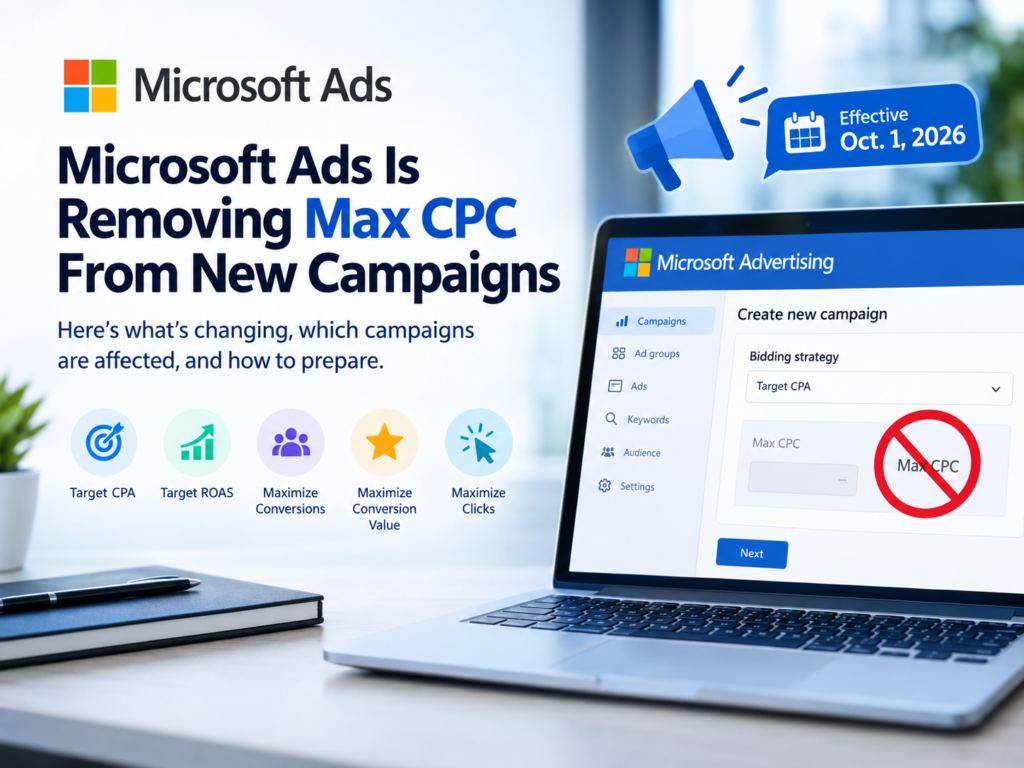
MicrMicrosoft Ads Removes Max CPC for New Campaigns: What Advertisers Need to Know
Microsoft Ads Removes Max CPC for New Campaigns starting October 1, 2026, changing how advertisers configure bidding for selected new campaigns. The update removes the Maximum Cost Per Click (Max CPC) setting from certain new non-portfolio campaigns using supported automated bidding strategies.
The change is intended to give Microsoft’s automated bidding system greater flexibility to optimize campaigns toward performance goals. Advertisers who rely on individual CPC limits will need to understand the new restrictions and review their bidding strategies before launching new campaigns.
As of October 22, 2026, the October 1 change is already in effect. However, it does not remove Max CPC from every Microsoft Advertising campaign. Eligible existing campaigns can retain their current settings, and portfolio bid strategies continue to support Max CPC.
Understanding why Microsoft Ads Removes Max CPC for New Campaigns is essential for businesses planning their next PPC campaign. Advertisers should review their bidding options, campaign objectives, and budget requirements before creating new campaigns. This preparation can help businesses adapt to the updated bidding settings while keeping their advertising strategy focused on conversions, qualified leads, and measurable results.
Understanding how Microsoft Ads Removes Max CPC for New Campaigns can help PPC professionals adjust their campaign management processes, control advertising expenditure, and make more informed bidding decisions.
What Is Changing as Microsoft Ads Removes Max CPC for New Campaigns?
Microsoft Ads Removes Max CPC for New Campaigns using specific automated bidding configurations. The change applies to new non-portfolio campaigns that use the following strategies:
- Maximize Conversions with Target CPA: Focuses on generating conversions while optimizing toward a target cost per acquisition.
- Maximize Conversion Value with Target ROAS: Aims to maximize conversion value while optimizing toward a target return on advertising spend.
- Maximize Clicks: Focuses on generating clicks within the campaign’s available budget.
Starting October 1, 2026, the Max CPC setting is no longer available when creating new non-portfolio campaigns using these affected bidding configurations.
Microsoft has also indicated that the setting will be removed from Microsoft Advertising Editor, although the timing of that change has not been announced. An API update is expected later.
Advertisers should distinguish between the specific bidding configurations affected by the change and other bidding strategies. The announcement does not mean that Max CPC has disappeared from the entire Microsoft Advertising platform.
Which Microsoft Advertising Campaigns Are Affected?
The impact depends on when a campaign was created, which bidding strategy it uses, and whether it uses a portfolio bid strategy.
The most important distinction is between creating a new non-portfolio campaign and managing an eligible campaign that already uses Max CPC.
Before making account-wide changes, advertisers should review the campaign settings and consult the latest official Microsoft Advertising guidance.
Official reference: “Microsoft Advertising — AI Max for Search and Other Product News for August 2026” (https://about.ads.microsoft.com/en/blog/post/august-2026/ai-max-for-search-and-other-product-news-for-august-2026).
Why Is Microsoft Removing Max CPC From New Campaigns?
Max CPC allows advertisers to specify the maximum amount they are willing to bid for an individual click.
This restriction can be useful when a business wants to limit bids. However, automated bidding systems use available signals to determine bids according to campaign objectives.
Microsoft explains that a maximum CPC restriction can conflict with an advertiser’s CPA or ROAS targets. This can happen even when the maximum CPC is higher than the campaign’s average CPC.
For example, an automated bidding system might identify an auction with a strong likelihood of producing a valuable conversion. If the CPC limit prevents the system from bidding competitively, the advertiser could miss that opportunity.
Removing the Max CPC setting from the affected new campaigns gives the automated system more flexibility to pursue its optimization goals.
However, greater bidding flexibility does not guarantee improved performance in every account. Results still depend on competition, conversion tracking, campaign budgets, landing-page quality, and realistic performance targets.
The Microsoft Ads Removes Max CPC for New Campaigns update encourages advertisers to review how they manage automated bidding. By understanding the available bidding options and setting realistic performance goals, businesses can adapt their PPC strategies while maintaining better visibility into campaign costs and conversion results.
How Does Max CPC Conflict With Automated Bidding?
Consider a lead-generation campaign using Maximize Conversions with a Target CPA.
The advertiser wants to generate qualified leads at a reasonable acquisition cost. The automated bidding system evaluates available auction signals and adjusts bids to pursue that objective.
A restrictive Max CPC limit may prevent the system from bidding competitively in some auctions, even when those auctions could produce valuable leads.
This creates two potentially conflicting instructions:
- Generate conversions efficiently according to the campaign’s performance target.
- Restrict the maximum bid for an individual click.
Microsoft’s update is intended to reduce this conflict in the affected new campaigns.
Advertisers should remember that Target CPA and Target ROAS are optimization targets, not guarantees of a specific result. Campaign performance still requires monitoring, accurate conversion data, and informed budget management.
Understanding Microsoft Ads Removes Max CPC for New Campaigns can help advertisers choose the right bidding approach for their business objectives. Before launching a campaign, review the available bidding settings, conversion goals, and budget requirements. This preparation can help PPC teams make informed decisions and evaluate campaign performance more effectively.
How Microsoft Ads Removes Max CPC for New Campaigns Affects Advertisers
The practical impact depends on how advertisers currently manage their PPC accounts.
Businesses already using automated bidding without a Max CPC restriction may need few changes. Advertisers who rely on CPC limits to control spending will need to review their approach when creating
When Microsoft Ads Removes Max CPC for New Campaigns, advertisers need to understand how the change affects their campaign setup. Reviewing existing bidding strategies can help PPC teams identify which campaigns may need a different approach. Businesses should also evaluate conversion tracking, budget limits, and performance targets to make informed decisions about future advertising campaigns.affected new campaigns.
The Microsoft Ads Removes Max CPC for New Campaigns update makes campaign planning more important for PPC advertisers. Before creating a new campaign, review the available bidding options, expected conversion costs, and business objectives. A clear strategy helps advertisers adapt to the updated settings while monitoring campaign performance and advertising expenditure.
The following steps can help PPC teams adapt.
1.Review Your Existing Bidding Strategies
Start by auditing campaigns that currently use Max CPC.
Ask the following questions:
- Which campaigns currently use a maximum CPC limit?
- Why was the limit introduced?
- Is it protecting profitability or restricting bidding opportunities?
- Are the current CPA and ROAS targets realistic?
- Does the bidding strategy match the campaign’s business objective?
Documenting these decisions will help your team understand which existing campaigns can remain unchanged and which new campaigns require a different setup.
Avoid changing every campaign automatically. Review each campaign according to its current configuration and performance.
2.Set Realistic Target CPA and Target ROAS Goals
Performance targets are important controls for automated bidding.
A lead-generation business might use Target CPA to guide the cost of acquiring a qualified lead. An online retailer might use Target ROAS to optimize advertising revenue relative to advertising expenditure.
Before setting these targets, consider historical campaign performance, profit margins, customer lifetime value, conversion rates, and lead quality.
Unrealistically low CPA targets or excessively high ROAS targets can restrict campaign delivery or reduce conversion volume.
Targets should reflect achievable business outcomes rather than arbitrary numbers.
Advertisers should also remember that setting a target does not guarantee that every conversion will meet that target.
3.Improve Conversion Tracking Accuracy
Automated bidding depends on reliable conversion data.
If a campaign records duplicate purchases, incorrect form submissions, or conversions that do not represent meaningful business outcomes, its optimization decisions can suffer.
Before launching a new campaign, check that:
- Important conversion actions are configured correctly.
- Duplicate conversion events are identified and resolved.
- Purchase values and revenue data are accurate.
- Lead quality is measured wherever possible.
- Landing pages and checkout processes track conversions correctly.
For lead-generation campaigns, connecting advertising data with qualified leads or actual sales can provide a clearer picture of business performance.
Accurate tracking helps advertisers evaluate campaign results and gives automated bidding more useful information.
4.Use Budgets and Conversion Value Rules
Campaign budgets remain important tools for managing advertising expenditure.
Set budgets according to business objectives and monitor spending regularly. Review performance before making major budget changes.
Conversion value rules can provide additional information about the relative value of supported audiences, locations, or devices.
For example, an online retailer may have evidence that customers in a particular region generate higher revenue. Appropriate conversion value rules can help communicate those differences to the bidding system.
These controls do not directly replicate an individual CPC ceiling. Instead, they help advertisers guide automated bidding toward the outcomes that matter to their businesses.
Microsoft also recommends using seasonality adjustments where appropriate.
5.Consider Portfolio Bid Strategies
Microsoft Ads Removes Max CPC for New Campaigns in selected non-portfolio configurations, but Max CPC remains available for new and existing campaigns using portfolio bid strategies.
Portfolio bid strategies can help advertisers manage bidding across multiple campaigns under a shared strategy when the configuration is supported.
Advertisers who have a specific reason to retain Max CPC may investigate this option.
However, switching to a portfolio strategy should not be automatic. Consider campaign objectives, conversion volume, available settings, and management requirements before changing the account structure.
The goal is to select a bidding approach that fits the business, not simply to preserve one setting.
6.Test Changes and Monitor Performance
Before making significant changes to an established PPC account, review historical performance and identify the metrics that matter most.
Depending on the campaign objective, these may include:
- Cost per conversion.
- Conversion rate.
- Total conversion volume.
- Average CPC.
- Return on advertising spend.
- Qualified leads and actual sales.
Microsoft encourages advertisers to use experiments to evaluate the impact of removing Max CPC.
Where suitable testing options are available, compare results before making wider changes. Monitor performance over an appropriate period rather than drawing conclusions from a small number of clicks or conversions.
What Advertisers Should Know After the October 1, 2026, Max CPC Change
The October 1, 2026, change is now in effect for the affected new non-portfolio campaigns.
Advertisers creating campaigns using the supported automated bidding configurations should review the available settings before launch.
The practical next steps are straightforward:
- Identify campaigns that currently use Max CPC.
- Confirm which new campaign configurations are affected.
- Review CPA and ROAS targets against actual business performance.
- Verify conversion tracking and conversion values.
- Set appropriate budgets and use supported value rules where relevant.
- Review Microsoft’s latest documentation before changing campaign structures.
Eligible existing campaigns created before October 1, 2026, that already use Max CPC can retain the setting. Portfolio bid strategies also continue to support Max CPC.
Advertisers do not need to assume that every existing campaign requires an immediate change.
What Does This Change Mean for Automated PPC Bidding?
The update reflects a broader shift toward automated campaign management.
Advertising platforms increasingly use auction-time signals, conversion data, and performance objectives to guide bidding decisions.
For PPC professionals, the quality of campaign inputs is therefore especially important.
Accurate conversion tracking, realistic targets, appropriate budgets, and meaningful conversion values can help advertisers make better-informed bidding decisions.
Automation does not eliminate the need for human oversight. Advertisers must still evaluate profitability, lead quality, campaign structure, and the relationship between advertising results and business outcomes.
A balanced approach combines automated bidding with regular performance analysis and clear business goals.
As Microsoft Ads Removes Max CPC for New Campaigns, PPC professionals should focus on campaign efficiency rather than relying only on individual click limits. Regular performance reviews, accurate conversion tracking, and appropriate budget management can help advertisers understand whether automated bidding is delivering meaningful business results.
Frequently Asked Questions
1.When did Microsoft Ads remove Max CPC for affected new campaigns?
The change took effect on October 1, 2026, for new non-portfolio campaigns using the specified automated bidding configurations. As of October 22, 2026, the change is already in effect.
2.Will existing campaigns lose their Max CPC setting?
Eligible campaigns created before October 1, 2026, that already use Max CPC can retain the setting. Advertisers should verify their individual campaign configuration before making changes.
3.Which bidding strategies are affected?
The published announcement identifies Maximize Conversions with Target CPA, Maximize Conversion Value with Target ROAS, and Maximize Clicks for new non-portfolio campaigns.
4.Can advertisers still use Max CPC after October 1, 2026?
Yes. Max CPC remains available for new and existing campaigns using portfolio bid strategies. The update does not remove the setting from every campaign in Microsoft Advertising.
5.How can advertisers manage costs without Max CPC?
Advertisers can manage spending through campaign budgets, realistic performance targets, accurate conversion tracking, and appropriate conversion value rules. Seasonality adjustments may also be useful when supported and relevant to the campaign.
These measures do not provide the same control as an individual CPC ceiling, so advertisers should monitor spending and performance regularly.
6.Should advertisers change all their existing campaigns?
No. The update primarily affects the creation of specified new non-portfolio campaigns. Advertisers should review their existing configurations and make changes only when there is a clear business or performance reason.
For more insights into PPC advertising and campaign optimization, explore our other articles on the GrowithDigital website. Our digital marketing guides help businesses understand paid advertising, improve campaign performance, and make better marketing decisions. Read our latest digital marketing tips to learn more about search advertising, bidding strategies, and campaign management.
Conclusion
Microsoft Ads Removes Max CPC for New Campaigns, changing how advertisers configure bids for selected new automated campaigns.
The October 1, 2026, change removes the individual Max CPC setting from specific new non-portfolio campaign configurations. However, eligible existing campaigns can retain their settings, and portfolio bid strategies continue to support Max CPC.
The best response is to review current bidding strategies, understand why CPC restrictions are being used, and strengthen the controls that guide automated optimization.
Accurate conversion tracking, realistic CPA and ROAS targets, suitable budgets, and meaningful conversion values remain important for campaign performance.
The Microsoft Ads Removes Max CPC for New Campaigns update also highlights the importance of reviewing PPC performance regularly. Advertisers should monitor average CPC, conversion costs, lead quality, and return on advertising spend to understand whether their bidding strategies are delivering business value. Combining accurate tracking with realistic campaign goals can help businesses manage the transition and make better-informed advertising decisions.
For businesses adapting to Microsoft Ads Removes Max CPC for New Campaigns, regular campaign reviews are essential. Track conversion costs, lead quality, average CPC, and return on advertising spend to understand the impact of automated bidding. These insights can help advertisers improve their campaign strategy and keep their advertising goals aligned with business outcomes.
To respond effectively to Microsoft Ads Removes Max CPC for New Campaigns, advertisers should regularly review their bidding strategies and conversion data. Monitoring average CPC, cost per conversion, and return on advertising spend can help businesses understand whether their campaigns are meeting their goals and where further improvements may be needed.
By reviewing campaign templates, testing changes where appropriate, and monitoring business outcomes, PPC teams can adapt to Microsoft’s update while keeping advertising decisions focused on measurable results..