
To understand whether advertising is working, marketers often look at clicks, conversions, cost per acquisition (CPA), and return on ad spend (ROAS). However, customer journeys are becoming more complex as AI-powered search, organic listings, and multiple digital touchpoints influence purchasing decisions.
A potential customer might see an advertisement, research a product through an AI search experience, compare competitors, and return to a website days later. The final click may not show the complete influence of the original advertisement.
This is why businesses need to Measure PPC Beyond Clicks and understand how advertising contributes to genuine business outcomes. By combining impression data, conversion tracking, website analytics, and CRM insights, marketers can make better decisions about campaign performance and advertising budgets.
Why Measure PPC Beyond Clicks in the AI Search Era?
Traditional PPC reporting focuses on measurable interactions, such as clicks and conversions. These metrics remain essential, but they may not capture every influence that shapes a customer’s decision.
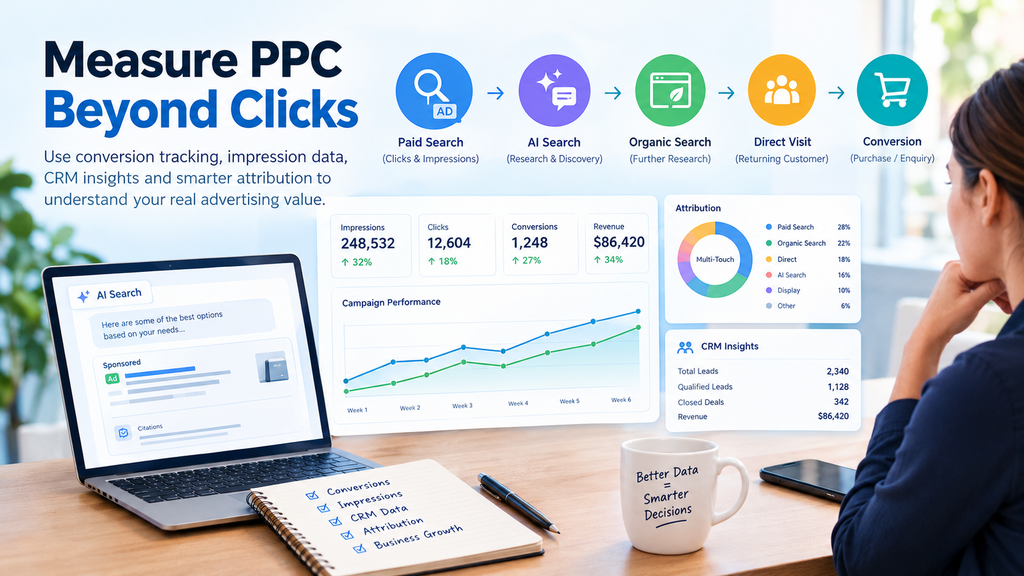
Modern customers can discover brands through paid search, research products using AI-powered tools, revisit websites through organic search, and finally convert through a direct visit.
This creates a measurement challenge for advertisers.
When you Measure PPC Beyond Clicks, you examine the relationship between advertising exposure, customer behavior, qualified leads, and sales. Instead of relying on one metric, you evaluate multiple signals to understand the broader marketing picture.
For example, an increase in advertising visibility might coincide with more branded searches and qualified enquiries. This could indicate growing awareness, although other marketing activities and market conditions may also contribute.
1. Use Impressions to Measure PPC Beyond Clicks
Impressions show how often your advertisements are displayed. They help marketers understand campaign visibility even when users do not immediately click an ad.
However, an impression does not guarantee that someone noticed the advertisement, remembered the brand, or completed a purchase.
Track Impressions and Impression Share
Impression share measures the percentage of eligible impressions your ads received compared with the estimated number available.
Monitor these metrics to understand:
- Whether your campaign visibility is increasing or decreasing.
- Whether budget limitations may be restricting eligible impressions.
- Whether greater visibility coincides with more branded searches.
- Whether campaign exposure changes alongside qualified leads or sales.
To Measure PPC Beyond Clicks effectively, compare impression trends with other business indicators over consistent time periods.
Connect Advertising Visibility With Brand Demand
Suppose a company increases its advertising budget and later observes more branded searches, direct visits, and enquiries.
These trends may suggest that advertising exposure is contributing to demand. However, correlation alone cannot prove that the campaign caused the increase.
Consider seasonality, promotions, competitor activity, and organic marketing before attributing changes to paid advertising.
Remember: Impressions measure exposure opportunities, not guaranteed conversions or revenue.
2. Improve Conversion Tracking for Better PPC Measurement
Accurate conversion tracking is essential when you Measure PPC Beyond Clicks. Advertising platforms rely on conversion signals to report performance and optimize eligible automated bidding strategies.
Incorrect or incomplete tracking can lead to misleading reports and poor budget decisions.
Choose the Right Conversion Actions
Your conversion goals should match your business objectives.
For ecommerce businesses, important actions may include:
- Completed purchases.
- Purchase revenue.
- Qualified product enquiries.
- Add-to-cart events for funnel analysis.
For service-based businesses, useful conversions may include:
- Qualified contact form submissions.
- Calls from potential customers.
- Appointment bookings.
- Sales-qualified leads.
- Closed deals and confirmed revenue.
Not every interaction has the same business value. A page view may indicate interest, but a qualified lead or completed purchase usually provides stronger evidence of commercial success.
Audit Your Tracking Setup
Review Google Ads conversion actions, Google Tag Manager, Google Analytics 4 events, and relevant website integrations.
Check for duplicate conversions, missing transaction values, broken tags, incorrect event triggers, and consent-related measurement gaps.
Reliable conversion data makes it easier to evaluate campaign profitability and identify opportunities for optimization.
3. Measure PPC Beyond Clicks With CRM Data
Advertising platforms can report leads and conversions, but businesses also need to know whether those leads become customers.
Customer relationship management (CRM) systems help connect advertising activity with the sales process.
For example, Campaign A might generate 100 leads, while Campaign B generates only 40. If Campaign B produces more qualified prospects and completed sales, it may deliver greater business value despite generating fewer leads.
This is why marketers should Measure PPC Beyond Clicks by evaluating lead quality alongside lead volume.
Track the Complete Customer Journey
For lead-generation campaigns, monitor:
- Total leads generated.
- Qualified leads.
- Appointments booked.
- Sales opportunities created.
- Deals closed.
- Revenue generated from advertising leads.
Where supported, import qualified lead and offline conversion data into your advertising platforms. These signals can help eligible campaign strategies optimize toward more valuable outcomes.
Always follow the relevant platform requirements and applicable privacy rules when sharing customer data.
Calculate Cost Per Qualified Lead
Cost per qualified lead (CPQL) measures how much you spend to generate a lead that meets your business requirements.
For example, suppose your advertising campaign spends ₹20,000 and generates 40 qualified leads.
Cost per qualified lead = ₹20,000 ÷ 40 = ₹500.
This gives you a clearer view of lead quality than cost per lead alone. Compare CPQL with conversion rates, sales revenue, and customer acquisition costs to evaluate overall performance.
4. Compare PPC Reports With Actual Business Results
Google Ads and other advertising platforms may report different conversion totals because of attribution models, reporting windows, conversion definitions, and measurement limitations.
These differences do not automatically mean that a platform is incorrect. They mean that advertisers should understand how each system measures results.
To Measure PPC Beyond Clicks accurately, compare platform reports with your CRM, ecommerce orders, invoices, and verified sales records.
Establish a Reliable Source of Truth
Review the following data points regularly:
- Advertising-platform conversions.
- Actual orders and qualified leads.
- Confirmed sales revenue.
- Duplicate or cancelled transactions.
- Conversion values and refunds.
- Differences in attribution windows.
For instance, if an advertising platform reports 60 conversions but your CRM contains 45 unique qualified leads, investigate the difference before changing your budget.
The two systems may be measuring different events. Your goal is to identify the reason and establish consistent reporting definitions.
5. Understand Attribution Across Marketing Channels
Attribution assigns credit to marketing interactions associated with a conversion. It helps advertisers understand which recorded touchpoints receive credit for business outcomes.
However, attribution is not a perfect record of every influence on a customer’s decision, particularly when interactions occur outside observable website sessions.
Compare Different Attribution Approaches
Last-click attribution: Assigns credit to the final eligible interaction before a conversion. It can be useful for understanding the closing touchpoint but may underrepresent earlier interactions.
Data-driven attribution: Uses platform-specific modelling to distribute credit among eligible interactions according to the platform’s methodology.
Cross-channel analysis: Compares measurable activity across paid search, organic search, direct traffic, and other acquisition sources.
Incrementality testing: Uses controlled experiments or suitable comparison groups to assess whether advertising generates additional outcomes.
Attribution and incrementality answer different questions. Attribution distributes credit according to a model, while incrementality testing investigates whether advertising caused additional results.
When you Measure PPC Beyond Clicks, use attribution reports to understand recorded interactions and experiments to strengthen your understanding of advertising impact.
6. Use Website Analytics to Find Conversion Opportunities
A click shows that someone interacted with an advertisement. Website analytics helps explain what happened after that visitor arrived.
Google Analytics 4 can provide acquisition, engagement, and conversion data. Microsoft Clarity can provide additional behavioral insights through session recordings and interaction analysis, subject to its configuration and privacy requirements.
Identify Problems That Reduce Conversions
Investigate whether visitors encounter:
- Slow-loading landing pages.
- Confusing navigation.
- Difficult forms.
- Poor mobile experiences.
- A mismatch between ad messaging and landing-page content.
- Unclear calls to action.
These issues can prevent advertising traffic from producing valuable outcomes.
Compare identifiable AI-related referrals with paid search, organic search, and direct traffic where the data is available. Avoid assuming that visitors from any particular source are automatically more valuable.
Some AI-assisted journeys will not appear as identifiable referral traffic, so analytics cannot reveal every interaction.
7. Include Consent and Privacy in PPC Measurement
Privacy choices, browser restrictions, and technical issues can limit the information available to advertisers.
However, a customer who researches a product without visiting your website presents a different measurement challenge from a visitor whose website activity cannot be fully observed.
Improve Privacy-Conscious Measurement
Follow these practices:
- Configure your consent management platform correctly.
- Audit tracking tags and consent signals.
- Use supported conversion measurement features where eligible.
- Follow applicable privacy laws and advertising-platform policies.
- Collect only the data necessary for legitimate business purposes.
- Avoid sending personal information without an appropriate legal basis.
Consent-aware measurement can improve the use of eligible signals, but it cannot reveal every interaction that occurs outside your website.
8. Build a Practical Framework to Measure PPC Beyond Clicks
A consistent reporting process helps marketers understand performance without depending on a single metric.
Follow these steps during your regular campaign reviews.
Step 1: Review attributed performance. Examine clicks, costs, conversions, CPA, conversion value, and ROAS.
Step 2: Analyze advertising visibility. Review impressions, impression share, and eligible placement data.
Step 3: Compare channel trends. Investigate changes in branded searches, organic traffic, direct visits, and other measurable sources.
Step 4: Validate conversion tracking. Check tags, event definitions, transaction values, and duplicate events.
Step 5: Connect CRM outcomes. Review qualified leads, sales opportunities, completed deals, and revenue.
Step 6: Analyze website behavior. Identify landing-page problems and obstacles in the conversion funnel.
Step 7: Test incrementality where practical. Use suitable experiments to assess whether additional advertising exposure generates additional business results.
Step 8: Make informed budget decisions. Consider profitability, lead quality, measurement limitations, and business goals before reallocating spend.
Following this process allows you to Measure PPC Beyond Clicks while keeping reported results separate from assumptions about unobserved customer behavior.
Frequently Asked Questions
1. What does Measure PPC Beyond Clicks mean?
Measure PPC Beyond Clicks means evaluating advertising performance through conversions, impressions, qualified leads, CRM data, revenue, and incremental business outcomes rather than relying only on click counts.
2. Can impressions prove that PPC advertising generated sales?
No. Impressions indicate advertising exposure but do not prove that a person noticed an ad or purchased because of it. Compare impression trends with conversions and business outcomes, and use controlled experiments when feasible.
3. How can I measure PPC when AI search interactions are difficult to track?
Combine available conversion data, impression trends, identifiable referral traffic, branded search demand, CRM outcomes, and incrementality tests where practical. Some AI-assisted interactions will remain unobservable, so acknowledge measurement limitations.
4. Why do advertising platforms and CRM systems report different conversions?
Differences can result from attribution windows, conversion definitions, duplicate events, reporting delays, tracking errors, and lead qualification rules. Investigate discrepancies using consistent definitions before changing campaign strategy.
5. Which metrics should I monitor to understand PPC business value?
Important metrics include qualified leads, cost per qualified lead, conversion rate, customer acquisition cost, revenue, profit, and ROAS. Incrementality testing can also help establish whether advertising produces additional business results.
Conclusion: Focus on Business Value, Not Just Clicks
Customer discovery is changing as AI-powered search experiences and multiple digital channels influence purchasing decisions. As a result, measuring advertising performance requires more than counting clicks and assigning credit to the final interaction.
To Measure PPC Beyond Clicks, combine accurate conversion tracking, impression trends, website analytics, CRM information, and verified sales outcomes. Use these signals to identify opportunities, investigate discrepancies, and improve campaign decisions.
Most importantly, distinguish correlation from causation. An increase in impressions alongside higher sales may be encouraging, but it does not prove that advertising generated every additional sale.
The goal is simple: understand how advertising contributes to measurable business outcomes and use the strongest available evidence to make smarter marketing decisions.