
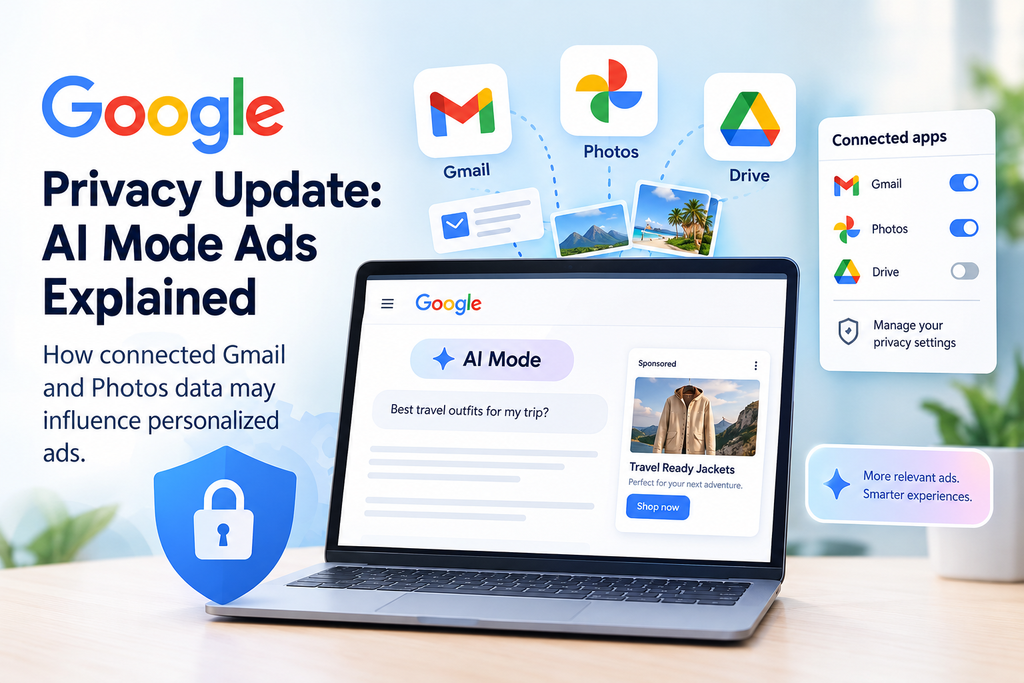
Google is changing how personal information may influence advertising in its AI-powered search experience. The Google Privacy Update: AI Mode Ads Explained highlights a policy change that allows information from connected apps, including Gmail and Google Photos, to potentially influence personalized ads when users enable supported Google services.
The revised Google Privacy Policy took effect on October 16, 2026. Google has also started testing ads in AI Mode for users who enable Personal Intelligence. This development raises important questions about data privacy, personalized advertising, and the future of Google Ads.
For advertisers, the main takeaway is that AI-powered search advertising is becoming more context-aware. However, Google has not announced a dedicated targeting option that lets advertisers select audiences based on connected-app information.
Google Privacy Update: AI Mode Ads Explained
The Google Privacy Update: AI Mode Ads Explained focuses on how information from connected Google services may be used to personalize experiences, including advertisements.
Previously, Google’s privacy policy stated that it did not show personalized ads based on content from Gmail, Google Drive, or Google Photos. The updated policy adds an exception for users who choose to make information from these services available to other Google services that support personalized advertising.
This means connected-app information may influence the ads users see when they use eligible Google experiences, depending on their settings and the policies of the service involved.
However, this change does not give advertisers direct access to users’ private emails, photos, or files. Google manages the advertising process within its own services.
You can read the official Google Privacy Policy for further details.
Why Did Google Update Its Privacy Policy?
Google is developing AI-powered search experiences that provide more personalized and useful responses. Connected apps can give AI additional context about a user’s preferences, activities, and plans.
For example, someone planning a holiday might have a flight confirmation in Gmail and travel photographs in Google Photos. When that person asks AI Mode for clothing recommendations, connected information could help the system understand the destination, timing, and preferences.
The Google Privacy Update: AI Mode Ads Explained is relevant because similar contextual information may also influence advertising within supported experiences.
The key distinction is that connected-app information may help personalize ads, but advertisers do not receive direct access to the user’s connected Gmail inbox or Google Photos library.
How Personal Intelligence Influences Google AI Mode Ads
Personal Intelligence is a Google feature that allows eligible AI experiences to use information from connected Google apps to provide more relevant responses.
When users choose to connect supported apps, AI Mode can use relevant context to understand questions beyond the words entered in the search box.
For instance, someone searching for travel clothing might receive recommendations that take an upcoming trip or preferred brands into account, provided the relevant information is available through connected services.
Google announced Personal Intelligence for AI Mode in January 2026 as an opt-in Labs experiment for eligible users in the United States. Availability and eligibility may change as Google expands its features.
How Connected Apps May Influence Ad Personalization
The process can be understood in three steps:
- Users connect their apps: Users choose whether to connect supported services, such as Gmail or Google Photos, to eligible Google experiences.
- AI Mode uses relevant context: The system may use information from connected sources to understand the user’s needs and personalize responses.
- Ads may reflect that context: Information made available to supported services may also influence personalized advertising.
This approach could help Google understand shopping interests or upcoming plans that are not fully expressed in a search query.
However, the Google Privacy Update: AI Mode Ads Explained does not mean that every advertisement is based on connected-app information. The influence of these signals depends on the experience, settings, and advertising systems involved.
Google has not announced a separate report that identifies when connected-app information influences an individual ad impression.
Does Google Use Gmail and Photos Data to Show Ads?
Google’s updated privacy policy says it does not show personalized ads based on content from Gmail, Drive, or Google Photos unless users choose to make data from those services available to other Google services that support personalized ads.
According to reporting about the AI Mode advertising test, the system may use summaries, excerpts, and inferences from connected sources rather than matching advertisements directly to the raw contents of an email or photo library.
Advertisers do not receive direct access to connected Gmail inboxes or Google Photos libraries through this advertising experience.
Google also states that personalized advertising excludes sensitive categories such as race, religion, sexual orientation, and health.
Users should review their privacy settings if they prefer to keep connected-app information separate from personalized search and advertising experiences.
What the Google Privacy Update Means for Advertisers
The Google Privacy Update: AI Mode Ads Explained is important for businesses that rely on Google Search, Shopping, and Performance Max campaigns.
As AI-powered search develops, advertising may become more responsive to the broader context of a user’s needs. However, advertisers should distinguish between potential opportunities and confirmed campaign features.
Advertisers can strengthen their campaign strategy by learning how to measure PPC beyond clicks and track advertising performance in the AI era.
1. No New Connected-App Targeting Option
Google has not announced a dedicated Google Ads audience segment or targeting control for Personal Intelligence data.
Advertisers cannot directly select users based on private Gmail messages or Google Photos information. Instead, Google manages the personalization within its own systems.
Businesses should continue using their existing campaign settings and targeting options rather than expecting to target users through connected-app data.
2. Existing Campaign Eligibility Still Matters
Google has identified Performance Max, Shopping, and Search campaigns using broad match, including AI Max for Search, as eligible for AI Mode advertising tests.
However, eligibility does not guarantee that a campaign will appear in AI Mode or reach users who have enabled Personal Intelligence.
Advertisers should follow Google’s existing campaign requirements and monitor their available reporting to understand how their campaigns perform.
3. Relevant Ad Copy and Landing Pages Remain Important
The Google Privacy Update: AI Mode Ads Explained highlights the evolving role of AI in search advertising, but relevant ad copy and useful landing pages remain essential.
Businesses should make sure their landing pages clearly explain:
- The products or services they offer.
- Their key benefits and differentiators.
- Pricing, availability, and important conditions.
- How customers can contact the business or complete a purchase.
Clear messaging helps users understand an offer after clicking an advertisement, regardless of which contextual signals may have influenced its delivery.
4. Conversion Tracking and Performance Analysis Still Matter
Advertisers should continue measuring conversions, cost per lead, return on ad spend, and other business outcomes that match their campaign goals.
Google has not announced dedicated reporting that identifies when Personal Intelligence influences an ad impression. Existing search term, asset, and landing page reports can help evaluate campaign performance, but they do not identify whether connected-app signals contributed to an individual impression.
Avoid attributing changes in campaign results to this update without supporting evidence. Instead, compare performance over time and use reliable conversion data to guide decisions.
What Privacy Controls Are Available to Users?
The Google Privacy Update: AI Mode Ads Explained also highlights the importance of understanding how connected Google services share information.
Users who do not want Gmail or Google Photos information to influence supported personalized experiences can review their Google Account settings and connected-app permissions.
How to Review Connected-App Settings
Users can check the available controls by following these steps:
- Open Google Search and sign in to the relevant Google Account.
- Open the profile menu and select Search personalization, if available.
- Look for Connected Content Apps or the corresponding connected-app setting.
- Review which services are connected.
- Disconnect apps that you do not want to use for personalization.
The exact labels and available options may vary by account and feature availability.
Users can also review their advertising preferences in Google My Ad Center.
It is important to understand that advertising personalization and AI personalization may have separate controls. Turning off personalized ads may not disconnect an app from an AI feature. Users who want to prevent connected-app information from being used by that feature should review and manage the relevant app connections as well.
What Is Still Unknown About AI Mode Advertising?
Although the Google Privacy Update: AI Mode Ads Explained clarifies Google’s approach to connected-app data, several questions remain unanswered.
Will Google Introduce New Advertiser Controls?
Google has not announced dedicated targeting controls or reporting for ads influenced by Personal Intelligence.
Advertisers should not expect to find a connected-app audience option in Google Ads unless Google announces one. Any future controls or reporting features will depend on Google’s product updates.
Will This Change Affect Other Google Services?
Google’s privacy policy discusses personalized experiences across supported services. However, the specific advertising test described in current reporting concerns AI Mode and users who have enabled Personal Intelligence.
The full scope of connected-app influence across other Google experiences remains unclear. Advertisers should avoid assuming that the same signals affect every Google advertising placement.
When Will the Test Become More Widely Available?
Google has started testing AI Mode ads for users who enable Personal Intelligence, but a definitive timeline for the test’s expansion or broader rollout has not been announced.
Businesses should follow official Google announcements and review new campaign information as it becomes available.
How Advertisers Should Prepare for AI-Powered Search
Businesses do not need to rebuild their advertising strategies solely because of this update. Instead, they should strengthen the fundamentals that support effective search advertising.
Here are four practical steps:
- Improve keyword relevance: Use search terms that closely match your products, services, and customer needs.
- Create useful landing pages: Provide clear information, transparent offers, and straightforward conversion paths.
- Review campaign performance: Monitor conversion rates, cost per acquisition, and return on ad spend over time.
- Stay informed about Google Ads changes: Follow official announcements and review campaign reporting as new advertising experiences develop.
The best approach is to focus on relevant campaigns, accurate conversion tracking, useful landing pages, and measurable business results. As Google shares more information about AI Mode advertising, advertisers should adapt their strategies based on confirmed features rather than assumptions.
Frequently Asked Questions
1. What is the Google Privacy Update: AI Mode Ads Explained update?
It refers to Google’s updated privacy policy, effective October 16, 2026, which allows information from connected apps to potentially influence personalized advertising in supported Google services. Google has also started testing ads in AI Mode for users who enable Personal Intelligence.
2. Can Google use Gmail and Google Photos data for personalized ads?
Google’s updated policy allows data from these services to be used by other Google services that support personalized ads when users choose to make that data available. The exact use depends on the service, settings, and applicable policies.
3. Can advertisers access users’ private Gmail messages or photos?
Google says it does not share users’ connected Gmail inboxes or Google Photos libraries directly with advertisers through this advertising experience.
4. Can advertisers target users based on Personal Intelligence data?
Google has not announced a dedicated targeting option for Personal Intelligence data. Advertisers cannot directly select audiences based on private Gmail or Google Photos information.
5. How can users prevent connected apps from influencing personalization?
Users can review their Google Account’s Search personalization and connected-app settings, then disconnect services they do not want to use. They can also review advertising preferences in My Ad Center. The available controls may differ, so users should check both settings areas.
Conclusion
The Google Privacy Update: AI Mode Ads Explained highlights an important development in personalized search advertising. By allowing information from connected apps to influence certain personalized experiences, Google is exploring a more context-aware approach to AI-powered advertising.
For users, the change makes privacy settings and connected-app permissions more important. For advertisers, it highlights the evolution of AI-powered search without introducing a new way to target people through their private app data.
Businesses should continue focusing on relevant campaigns, useful landing pages, accurate conversion tracking, and regular performance reviews. As Google releases more information about AI Mode ads, advertisers should adapt their strategies based on confirmed features and measurable results rather than assumptions.
Stay updated with GrowithDigital for the latest Google Ads news, SEO insights, and practical digital marketing strategies.