
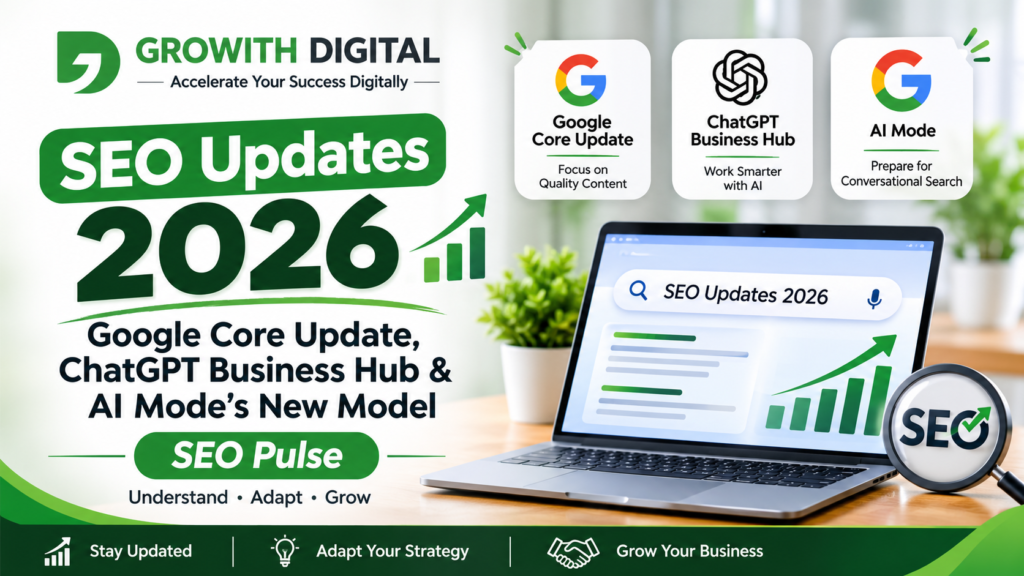
Core Update, ChatGPT Business Hub & AI Mode’s New Model – SEO Pulse
Search is changing rapidly. People are no longer relying only on traditional search results to discover businesses, compare products, and find answers. They are also exploring AI-powered search experiences, asking conversational questions, and using AI tools to research business decisions.
For businesses, marketers, and website owners, these changes make SEO updates 2026 an important topic to understand. Google’s Core Updates can influence how websites appear in search results, while ChatGPT’s business-focused capabilities and Google’s AI Mode represent a broader shift towards AI-assisted information discovery.
But what do these developments actually mean for SEO? Should businesses change their content strategies? Is traditional SEO becoming less important? And how can brands remain visible when customers use both search engines and AI assistants?
In this SEO Pulse, we explore three important areas: Google Core Updates, ChatGPT Business Hub, and the evolving model behind Google AI Mode. More importantly, we explain the practical steps businesses can take to strengthen their online presence.
1. Google Core Updates: Why Website Quality Still Matters
Google regularly improves its search systems to deliver useful, relevant, and reliable results. A Core Update is a broad change to Google’s ranking systems. It can affect how Google evaluates and ranks content across many websites and topics.
A ranking change after a Core Update does not automatically mean that a website has received a penalty. It may mean that Google’s systems now assess the relative usefulness of pages differently.
What can happen after a Core SEO updates 2026?
A website may experience:
- Improvements in organic search visibility.
- Declines in rankings for some search queries.
- Changes in impressions and clicks.
- Different pages appearing for the same search intent.
- Changes in traffic across particular categories or topics.
Not every ranking fluctuation is caused by a Core Update. Competition, seasonality, technical issues, changes in search demand, and other search-system updates can also influence performance.
What should businesses do after a Core SEO updates 2026 ?
The best response is to investigate rather than make sudden changes.
1. Check Google Search Console
Compare performance before and after the update period. Review clicks, impressions, average position, and affected search queries. Identify whether the change is site-wide or limited to particular pages.
2. Review content quality
Ask whether each page genuinely answers the visitor’s question. Look for outdated information, shallow explanations, repetitive content, and unsupported claims.
3. Improve experience and usability
Make sure the website is easy to navigate, mobile-friendly, readable, and technically accessible to search engines.
4. Avoid unnecessary content deletion
Do not remove pages simply because their rankings have dropped. First identify whether the content is genuinely unhelpful, outdated, duplicated, or no longer relevant.
Google’s people-first content approach
Google’s guidance encourages content that is created primarily to help people rather than manipulate search rankings.
Businesses should focus on:
- Original insights and practical explanations.
- Accurate, updated information.
- Clear authorship and relevant experience.
- Useful examples that support the topic.
- Transparent business and contact information.
- Content that satisfies the visitor’s search intent.
For example, a real estate company in Kolhapur should not publish another generic article about buying property. It could provide a useful local guide explaining property documentation, home-loan considerations, location factors, and questions buyers should ask before booking.
That additional usefulness can make content more valuable to readers.
2. ChatGPT Business Hub: What It Means for Businesses
AI assistants are becoming part of everyday business workflows. Companies use them to research topics, organise information, prepare documents, analyse data, and support communication.
ChatGPT’s business-oriented offerings are part of this broader shift. The term ChatGPT Business Hub should be checked against the exact official product announcement before publication, because product names, availability, and capabilities can change.
Rather than assuming a particular feature set, businesses should understand the wider opportunity: AI can support knowledge work, but people remain responsible for decisions, accuracy, privacy, and final output.
How AI business tools can support marketing teams
Depending on the product, plan, integrations, and permissions available, AI tools may help teams with tasks such as:
- Researching customer questions and market trends.
- Creating first drafts of marketing content.
- Summarising documents and meeting notes.
- Organising campaign ideas.
- Analysing structured information.
- Preparing reports and presentations.
- Supporting internal knowledge discovery.
For a digital marketing agency, this can reduce repetitive work and create more time for strategy, creative thinking, and campaign optimisation.
What does this mean for SEO professionals?
AI can assist with SEO workflows, but it does not replace strategic judgement.
An SEO professional can use AI to help:
Research topics: Identify possible questions, subtopics, and content gaps to investigate.
Build content briefs: Organise headings, search intent, target audience, and supporting information.
Improve readability: Find unclear sentences, repetition, and missing explanations.
Analyse data: Help interpret exported performance data, provided the data is accurate and handled appropriately.
Generate ideas: Explore possible titles, FAQs, and content formats.
However, AI-generated information must be reviewed. A fluent answer is not automatically a correct answer.
Responsible AI use in business
Before using any AI tool with company information, businesses should review the relevant plan’s data controls, privacy terms, retention settings, administrative controls, and connected-app permissions.
Avoid uploading confidential customer records, passwords, financial information, or sensitive business documents unless the organisation has approved the tool and understands the applicable protections.
The practical lesson: Use AI to improve productivity, not to remove human accountability.
3. Google AI Mode and the Changing Search Experience
Traditional search often presents a list of links. AI-powered search experiences can provide a more conversational way to explore a topic, ask follow-up questions, and discover information from multiple sources.
Google AI Mode is part of this evolution. Its exact features, model capabilities, availability, and interface can vary over time and by market. Businesses should consult Google’s official documentation for current details.
How AI Mode changes search behaviour
Consider a person searching for a digital marketing agency.
A traditional search might be:
“Digital marketing agency in Kolhapur”
A more conversational search could be:
“Which digital marketing services should a small manufacturing business in Kolhapur consider to generate enquiries?”
The second query communicates more context. The user is not simply looking for a list of websites; they want an explanation that considers their business situation.
AI-assisted search can make complex research more conversational. It may also change how users discover sources and decide which websites to visit.
What is the role of a new AI model?
When an AI-powered search experience changes its underlying model, the quality and behaviour of generated responses may change too.
Potential areas of change include:
- Understanding longer and more conversational questions.
- Connecting information across related subtopics.
- Interpreting context and user intent.
- Summarising information from sources.
- Handling follow-up questions.
- Presenting information in different formats.
These are general capabilities associated with evolving AI systems, not a claim that every capability has been confirmed for a particular AI Mode model release.
For SEO professionals, the important point is to monitor how search experiences evolve instead of assuming that one model change automatically creates a specific ranking factor.
How can websites prepare for AI-powered search?
Businesses should make their content easy to understand, useful, and well organised.
Practical recommendations include:
- Answer important questions directly.
- Use descriptive headings and clear page structure.
- Explain technical terms in simple language.
- Include relevant examples and original insights.
- Support factual claims with reliable sources.
- Keep important business information accurate.
- Use structured data where it accurately describes visible page content.
- Build a consistent presence across relevant digital platforms.
There is no guaranteed method to make a website appear in every AI-generated answer. The goal is to publish genuinely useful information that can be understood and evaluated by both people and search systems.
4. Traditional SEO vs AI Search Optimisation
Traditional SEO and AI search optimisation are connected. They should not be treated as completely separate marketing disciplines.
| Area | Traditional SEO | AI search optimisation |
|---|---|---|
| Main objective | Improve visibility in search results | Improve the usefulness and discoverability of information in AI-assisted experiences |
| Content approach | Relevant, well-structured pages | Clear, contextual, trustworthy explanations |
| Keyword strategy | Search terms and intent | Natural-language questions and related concepts |
| Technical foundation | Crawlability, indexing, performance | Strong technical foundations remain important |
| Authority | Relevant links, reputation, expertise | Credible information and recognisable sources matter |
| Measurement | Rankings, clicks, impressions, conversions | Referral traffic where measurable, brand mentions where trackable, and business outcomes |
What is Generative Engine Optimisation (GEO)?
Generative Engine Optimisation, often shortened to GEO, refers to practices intended to improve how content is understood, retrieved, or represented in generative AI experiences.
The terminology is still evolving. GEO is not a replacement for sound SEO fundamentals, nor is there a universally accepted checklist that guarantees inclusion in AI answers.
A sensible approach is to:
- Publish original and helpful content.
- Use clear entity names, descriptions, and context.
- Provide evidence for important claims.
- Maintain accurate company information.
- Create useful pages around real customer questions.
- Earn relevant editorial mentions and links naturally.
5. What Businesses Should Do: A Practical SEO Action Plan
Understanding industry developments is useful, but businesses need a plan they can implement.
Here is a practical approach for companies, startups, local businesses, and marketing teams.
Step 1: Audit your existing website
Start by reviewing the website’s current condition.
Check:
- Important pages are accessible and indexable.
- Page titles and meta descriptions are relevant.
- Pages have descriptive headings.
- Mobile usability is satisfactory.
- Broken links and unnecessary redirects are addressed.
- Images have descriptive alternative text where appropriate.
- Important pages load reliably.
Use Google Search Console to understand indexing and search performance. Use an analytics platform to understand visitor behaviour and conversions.
Step 2: Review content against search intent
Every page should have a clear purpose.
For example:
- An informational page should explain a topic.
- A service page should describe the service, process, and value.
- A comparison page should help visitors evaluate options.
- A location page should provide genuinely useful local information.
Do not create multiple pages that repeat the same information with only a city name changed. Local pages should contain meaningful details relevant to each location.
Step 3: Build topic clusters
A topic cluster is a group of related pages organised around a main subject.
For a digital marketing agency, a cluster could include:
Main page: Digital Marketing Services
Supporting blogs:
- What Is SEO and How Does It Work?
- Google Ads vs Meta Ads
- How to Build a Social Media Strategy
- How to Measure Website Traffic
- SEO Trends and AI-Powered Search
Link related pages naturally so visitors can explore the subject in greater depth.
Step 4: Add real experience and useful examples
Generic content is easy to produce. Useful, specific content takes more thought.
Include:
- Lessons from actual projects where permission allows.
- Original screenshots with private information removed.
- Expert explanations.
- Local business examples.
- Clear processes and practical checklists.
- Updated information with reliable references.
Never invent customer stories, campaign results, or testimonials to make a page appear more authoritative.
Step 5: Measure meaningful results
Do not judge SEO only by keyword rankings.
Track:
- Organic clicks and impressions.
- Relevant search queries.
- Organic landing-page traffic.
- Enquiry form submissions.
- Phone calls and qualified leads.
- Conversion rate.
- Engagement and user journeys.
The objective is not simply to attract more visitors. It is to attract relevant visitors and help them take meaningful action.
6. Local SEO: Opportunities for Businesses in Maharashtra
Local search visibility is particularly important for businesses serving specific cities or areas.
A customer searching for a service in Ichalkaranji, Kolhapur, Sangli, or nearby locations may be looking for a provider they can contact immediately.
Local SEO recommendations
Optimise your Google Business Profile
Keep your business name, address, phone number, opening hours, categories, and services accurate. Add genuine photographs and respond professionally to reviews.
Create useful location pages
Explain the services available in each location. Include relevant local information rather than publishing duplicate pages.
Maintain consistent business details
Use consistent contact information across your website and legitimate business directories.
Collect genuine customer reviews
Invite real customers to share honest feedback. Do not purchase reviews or offer misleading incentives.
Example: Local SEO for an Ichalkaranji business
Imagine a training institute that offers digital marketing courses.
Its website could include:
- A clear digital marketing course page.
- Course modules and learning outcomes.
- Trainer information and relevant experience.
- Details about practical assignments.
- Location and contact information.
- Answers to common student questions.
This gives prospective students useful information before they enquire.
7. Common SEO Mistakes to Avoid in 2026
New technologies can create excitement, but the fundamentals still matter. Avoid these common mistakes:
1. Publishing large volumes of generic AI content
AI can assist with drafting, but unreviewed, repetitive, or low-value content may not satisfy readers.
Solution: Add original expertise, fact-check information, and edit every article for usefulness.
2. Chasing every algorithm update
Making sudden changes after every ranking fluctuation can damage a website unnecessarily.
Solution: Review reliable data, identify patterns, and prioritise meaningful improvements.
3. Ignoring technical SEO
Good writing cannot compensate for important pages that cannot be crawled or indexed.
Solution: Review indexing, internal links, redirects, mobile usability, and page performance.
4. Writing only for keywords
Repeating a keyword does not make an article valuable.
Solution: Address the topic comprehensively and use natural language.
5. Ignoring conversions
Traffic without enquiries or business outcomes may not support commercial goals.
Solution: Improve service pages, calls to action, contact options, and enquiry journeys.
6. Treating AI visibility as guaranteed
No agency or tool can honestly guarantee that a website will be cited in every AI-generated answer.
Solution: Build a strong digital presence and measure outcomes that can be reliably observed.
8. Frequently Asked Questions About SEO Updates in 2026
What is a Google Core Update?
A Google Core Update is a broad change to Google’s search ranking systems. It can change how pages are evaluated and ranked, resulting in fluctuations in organic visibility.
Does a Core Update mean Google has penalised my website?
No. A ranking decline after a Core Update does not automatically indicate a penalty. Review Search Console data and assess content quality, technical health, and search intent before making changes.
What is ChatGPT Business Hub?
The phrase should be matched to the exact official OpenAI product announcement before publication. ChatGPT offers business-oriented products and capabilities, but names, availability, and features can change. Consult OpenAI’s official business pages for the current offering.
What is Google AI Mode?
Google AI Mode is an AI-powered search experience designed to support more conversational and exploratory searches. Its capabilities and availability may change, so consult Google’s current product documentation.
Is traditional SEO still important with AI search?
Yes. Technical accessibility, useful content, relevant information, and a trustworthy website remain important foundations. AI search adds new discovery experiences rather than making website quality irrelevant.
What is GEO in digital marketing?
GEO stands for Generative Engine Optimisation. It describes approaches intended to improve how content is understood or surfaced in generative AI experiences. The discipline is evolving and does not offer guaranteed placement.
Should small businesses invest in AI SEO?
Small businesses should first establish strong SEO fundamentals: a useful website, accurate business information, relevant service pages, local visibility, and quality content. They can then experiment with AI search optimisation as part of a broader strategy.
9. Conclusion: Build an SEO Strategy That Can Adapt
The search landscape is evolving. Google Core Updates continue to influence organic visibility, AI assistants are becoming part of business workflows, and AI-powered search experiences are changing how people explore information.
For businesses, the answer is not to abandon traditional SEO or chase every new technology. It is to build a reliable digital foundation, publish useful content, maintain accurate information, and monitor how customers discover and interact with the brand.
The most practical SEO updates 2026 strategy combines technical SEO, people-first content, local visibility, trustworthy information, and meaningful performance measurement.
At Growith Digital, based in Ichalkaranji, Maharashtra, we help businesses strengthen their digital presence through SEO, social media marketing, and digital marketing strategy. Whether you are a local business owner, entrepreneur, or marketing professional, the right strategy starts with understanding your audience and giving them useful information.
Want to improve your website’s search visibility? Connect with Growith Digital to explore an SEO strategy suited to your business goals.