

Introduction
Artificial intelligence is changing how businesses create ads, reach audiences, and optimize advertising campaigns. Automated bidding, AI-generated creative, and audience expansion can help marketers save time and improve campaign performance.
However, these capabilities also create challenges for businesses operating in regulated industries. Healthcare providers, financial institutions, legal firms, and other organizations often need to follow strict rules regarding advertising claims, customer privacy, targeting, and disclosures.
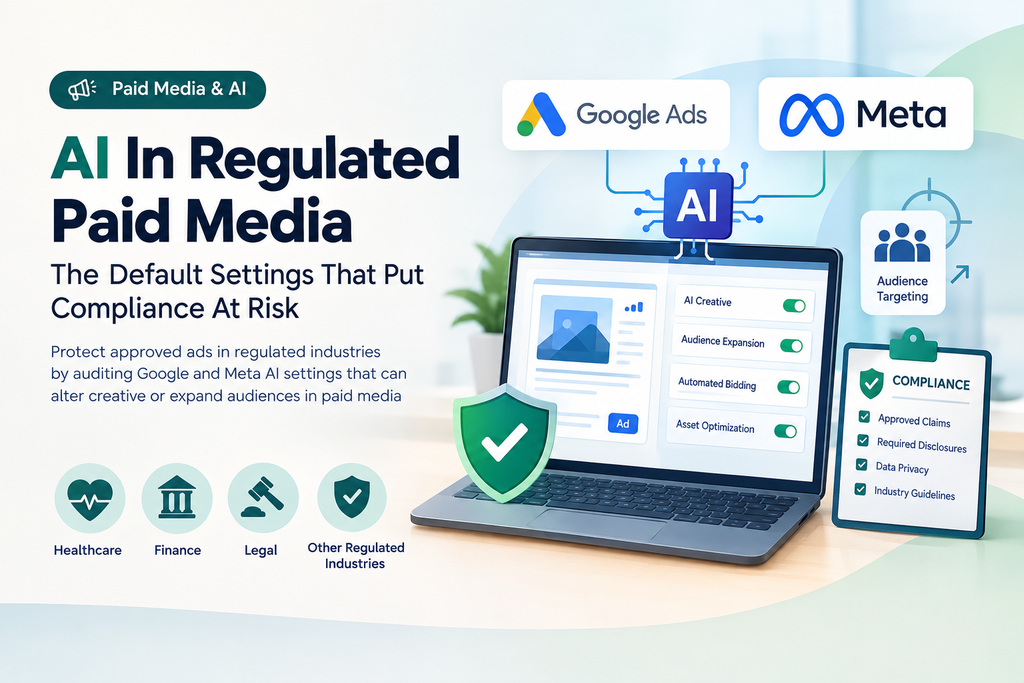
AI in regulated paid media requires more than campaign optimization. It requires clear oversight, controlled automation, and consistent compliance checks.
A setting that works well for a general e-commerce campaign may introduce unexpected risks when an advertisement requires precise wording, approved visuals, or legally required disclaimers.
In this guide, we explain the major AI advertising risks and practical steps marketers can take to maintain control over Google Ads, Meta Ads, and other paid media campaigns.
What Is AI in Regulated Paid Media?
AI in regulated paid media refers to the use of artificial intelligence and automated advertising features in campaigns that must comply with industry regulations, platform policies, and internal business requirements.
These technologies can support several advertising activities, including:
- Automated bidding and budget optimization.
- AI-generated headlines, descriptions, images, and videos.
- Audience targeting and expansion.
- Campaign performance analysis.
- Conversion tracking and optimization.
- Automated creative enhancements.
Although these features can improve efficiency, marketers must understand how they affect campaign delivery.
For example, an AI system might generate a new advertising headline based on a website page. The headline could sound persuasive but omit an important qualification or introduce a claim that the legal team has not approved.
In regulated industries, even a small change in wording or presentation can create a significant compliance concern.
Why AI Advertising Can Create Compliance Risks
AI-powered advertising platforms are designed to automate tasks and improve performance. However, automation does not automatically guarantee that every output meets a company’s legal and compliance requirements.
Several factors make regulated campaigns particularly sensitive.
1. Unapproved Advertising Claims
AI-generated copy may introduce statements that go beyond the organization’s approved messaging.
For example, a financial services advertisement might describe an investment product as offering “guaranteed returns” when that claim is not accurate or authorized.
Similarly, a healthcare advertisement could imply that a treatment produces certain results without sufficient evidence or appropriate qualifications.
What marketers should do: Use approved messaging, maintain a documented claims library, and require appropriate review before new creative goes live.
2. Missing Disclaimers and Disclosures
Some advertisements require disclaimers, eligibility conditions, risk warnings, or other disclosures.
When automated tools modify ad text, generate a new layout, or create additional assets, important information may be omitted, shortened, or made less visible.
A disclaimer that appears clearly in the original design may become difficult to read after an automated format adjustment.
What marketers should do: Check all required disclosures in the final ad format, including mobile placements, video ads, and shorter text variations.
3. Customer Privacy and Sensitive Data
AI tools often require data to analyze performance or generate recommendations. Uploading customer information to an unapproved tool can expose businesses to privacy, security, or contractual risks.
This is especially important for healthcare, financial services, and other sectors that handle sensitive personal information.
What marketers should do: Follow organizational data-handling policies, minimize the information shared with AI tools, and obtain privacy or security approval when necessary.
Google Ads AI Settings Marketers Should Audit
Google Ads offers automation features across multiple campaign types. Their availability and controls can change, so marketers should review the current campaign interface and applicable policies before making changes.
1. AI Max for Search Campaigns
AI Max includes AI-powered features that can expand how Search campaigns match queries and generate or customize ad content.
For regulated advertisers, two areas deserve particular attention.
Text customization: Automatically generated text may introduce wording that has not passed the organization’s approval process.
Final URL expansion: Depending on the campaign and configuration, traffic may be directed to a different relevant page on the website rather than only the advertiser’s preferred landing page.
This can be problematic if some website pages contain outdated offers, unapproved claims, incomplete disclosures, or information intended for a different audience.
Recommended safeguards include:
- Review text customization settings before activation.
- Evaluate final URL expansion and available URL exclusions.
- Check landing pages for current claims and disclosures.
- Test automated features in a controlled environment where appropriate.
- Document which settings have been approved by compliance teams.
Disabling a feature may reduce certain risks, but it does not replace the need to review the entire campaign.
2. Performance Max Asset Optimization
Performance Max uses automation to distribute ads across eligible Google advertising inventory. Depending on the campaign configuration, asset optimization features may generate or modify creative elements.
For regulated advertisers, these changes can introduce uncertainty around the final advertisement.
Potential issues include altered headlines, modified images, different creative combinations, or text that does not communicate the approved message accurately.
To reduce these risks:
- Review available text, image, and video optimization controls.
- Check automatically created assets where reporting and review options are available.
- Confirm that landing pages support the claims made in advertisements.
- Monitor asset performance and policy notifications.
- Keep records of approved creative and campaign settings.
The goal is to balance useful automation with the level of creative control required by the business.
3. Demand Gen Creative Automation
Demand Gen campaigns can use automated features to adapt or generate creative for different placements.
A video or image variation may look visually appealing but fail to meet an organization’s brand or compliance standards.
For example, a generated video might omit a required qualification or place text where it becomes difficult to read on a mobile screen.
Before launching a campaign, marketers should:
- Preview creative across relevant placements.
- Review video, image, and text variations.
- Verify that required disclosures remain visible.
- Check that every variation uses approved claims.
- Revisit the campaign after meaningful setting changes.
A creative asset should be reviewed in the format in which people will actually see it, not only in the original design file.
Meta Ads: Review Advantage+ Creative Enhancements
Meta Ads provides creative and audience automation features that can help advertisers adapt campaigns to different people and placements.
However, automated creative enhancements can change the appearance or presentation of an advertisement.
Depending on the feature and campaign setup, potential changes may affect image presentation, text, layouts, or other creative elements.
For regulated brands, these changes deserve careful review.
What Should You Check in Meta Ads?
Start by reviewing the available creative controls in Ads Manager. Names and locations of settings may change as Meta updates its interface.
Check the following:
- Creative enhancements: Determine whether automated changes are enabled and whether each is appropriate for the campaign.
- Text variations: Verify that alternative text remains accurate and approved.
- Image and video presentation: Confirm that branding and required information remain clear.
- Placement previews: Inspect how the advertisement appears in feeds, Stories, Reels, and other selected placements.
- Destination links: Ensure that users reach an approved and relevant landing page.
Not every enhancement carries the same level of risk. Evaluate each feature individually rather than assuming that all automation must be disabled.
Audience Targeting and Automated Bidding Risks
Creative compliance is only one part of the challenge. Audience targeting and automated bidding also require attention.
AI-powered systems can use signals and optimization models to decide which eligible users see an advertisement. This can make campaign delivery less predictable than manually defined targeting alone.
1. Audience Expansion
Features such as Meta’s Advantage+ audience capabilities and Google’s optimized targeting can extend delivery beyond some of an advertiser’s initial audience selections, depending on the campaign type and settings.
That may be useful for ordinary campaigns but inappropriate when a business has strict audience restrictions.
Marketers should confirm:
- Which audience signals are suggestions rather than hard restrictions.
- Whether the campaign can expand beyond the selected audience.
- Which geographic, age, or other restrictions are available and applicable.
- Whether the targeting approach complies with platform policies and local laws.
Do not assume that every targeting option can be restricted in every campaign type.
2. Sensitive Audience Data
Uploading customer lists or using sensitive personal information for advertising can create privacy concerns.
Healthcare advertisers, for example, must carefully evaluate whether their data collection, disclosure, sharing, and advertising practices comply with applicable privacy obligations.
In the United States, HIPAA applies to covered entities and business associates in specified circumstances; it does not automatically apply to every healthcare-related business or every advertising activity.
Other privacy laws and platform-specific restrictions may also apply.
Best practice: Obtain approval from the appropriate privacy or legal team before uploading customer data, creating sensitive audience segments, or activating retargeting.
3. Automated Bidding and Fairness
Automated bidding systems optimize delivery toward campaign objectives, but the resulting delivery patterns may raise concerns for certain regulated products.
For example, financial advertisers may need to assess whether their advertising practices comply with fair lending and anti-discrimination requirements.
Marketers should not assume that an algorithm is unbiased simply because it optimizes toward conversions.
Review applicable policies, monitor delivery patterns, and involve compliance specialists when a campaign could affect access to regulated products or services.
Conversion Tracking: Improve Measurement Without Exposing Sensitive Data
Conversion tracking helps advertising platforms understand which campaigns generate useful business outcomes. This information can support automated bidding and campaign optimization.
However, regulated advertisers must balance measurement needs with privacy and data governance requirements.
Audit Your Tracking Setup
Review the complete path from the advertisement to the conversion event.
Important checks include:
- Tracking pixels and tags: Confirm that their use is approved for the relevant website and data.
- Consent management: Apply consent requirements and regional privacy rules where applicable.
- Conversion events: Record only the information needed for the intended measurement purpose.
- Offline conversion uploads: Verify that uploaded records and identifiers are permitted under applicable rules and platform policies.
- Data retention and access: Follow organizational rules for storing and sharing advertising data.
Avoid sending sensitive health information, financial details, or other restricted personal data to advertising platforms unless the specific processing is lawful and expressly permitted under applicable requirements.
Consider Alternative Measurement Methods
If a business cannot use certain tracking technologies, it may still be able to measure campaign performance through approved alternatives.
Depending on the situation, these may include:
- Aggregated reporting.
- Properly configured analytics.
- CRM reporting with appropriate access controls.
- Campaign-specific UTM parameters.
- Lead-source reporting that avoids unnecessary sensitive information.
UTM parameters can help identify traffic sources, but they are not a replacement for privacy controls or consent requirements.
Measurement plans should be developed with the relevant technical, privacy, and compliance teams.
A Practical AI Compliance Audit Checklist
Before launching or expanding a regulated paid media campaign, use a documented review process.
| Audit Area | What to Check |
|---|---|
| AI-generated copy | Are all claims accurate and approved? |
| Creative automation | Can automated changes remove or obscure disclosures? |
| Landing pages | Are destinations current, relevant, and approved? |
| Audience targeting | Can delivery expand beyond permitted audiences? |
| Customer data | Are uploads and data sharing authorized? |
| Conversion tracking | Are events and identifiers appropriate and permitted? |
| Automated bidding | Are campaign objectives and delivery outcomes monitored? |
| Documentation | Are approvals, settings, and changes recorded? |
Establish a Clear Approval Workflow
A reliable workflow should define who can create, approve, publish, and modify campaign assets.
A practical process looks like this:
- The marketing team develops the campaign and proposed creative.
- Compliance or legal reviewers approve claims and required disclosures.
- The campaign manager audits AI settings, audience controls, and landing pages.
- The team previews the final ads across relevant placements.
- An authorized person approves publication.
- The team monitors performance, policy notifications, and configuration changes.
The exact workflow will depend on the organization’s size, risk profile, and regulatory obligations.
How to Use AI Safely in Regulated Advertising
Avoiding every AI feature is not necessarily the right approach. Instead, identify which uses provide value without creating unacceptable risks.
Create an Approved AI Usage Policy
Your organization should clearly define:
- Which AI tools are permitted.
- What data may be entered into those tools.
- Whether AI-generated creative requires additional review.
- Which campaign settings require compliance approval.
- Who is responsible for monitoring automated changes.
- How incidents and unexpected outputs should be reported.
Maintain a Library of Approved Claims
Create a central resource containing approved headlines, descriptions, product information, disclaimers, and supporting evidence.
This can help marketing teams produce consistent creative while reducing the risk of unverified claims.
However, a library alone cannot guarantee that an AI-generated advertisement will be compliant. Final outputs still need appropriate review.
Monitor Changes After Launch
Compliance is not a one-time task. Advertising platforms update their products, campaign settings, and available automation features.
Review campaigns regularly, especially after changes to creative, targeting, landing pages, or optimization settings.
Keep a record of significant changes so that the organization can investigate issues and identify where additional safeguards are needed.
Frequently Asked Questions (FAQs)
1. What is AI in regulated paid media?
AI in regulated paid media refers to using artificial intelligence and automated advertising tools in industries where marketing activities must comply with legal requirements, platform policies, and internal controls. Examples include automated bidding, AI-generated creative, audience expansion, and conversion optimization.
2. Why can AI-generated ads create compliance problems?
AI-generated ads may introduce unsupported claims, change approved wording, omit disclosures, or produce creative that has not passed the required review process. Marketers should validate claims, check disclosures, and approve final ad variations before publication.
3. Should regulated advertisers disable all AI features?
Not necessarily. Some features may provide value when appropriate controls are in place. Advertisers should assess each feature individually, consider the consequences of automated changes, and disable or restrict capabilities that cannot meet their compliance requirements.
4. How can healthcare and financial advertisers protect customer data?
They should follow applicable privacy laws, platform policies, consent requirements, and internal data-handling rules. Sensitive information should not be uploaded to advertising or AI tools without confirming that the specific use is authorized and permitted.
5. How often should paid media campaigns be audited for AI compliance?
The frequency depends on the organization’s risk level and internal policies. High-risk campaigns may need checks before launch, after significant changes, and at regular intervals. Advertisers should also review campaigns when platforms introduce new automation features or update existing settings.
Conclusion
AI is making paid media more automated, but greater automation does not remove the advertiser’s responsibility to protect customers and maintain compliant messaging.
For regulated businesses, the most important risks often arise from seemingly small changes: a generated headline, an altered creative layout, an expanded audience, or a tracking configuration that shares information in an unintended way.
A structured compliance process can help marketers identify these risks before they affect live campaigns. By auditing Google Ads and Meta Ads settings, protecting sensitive data, validating creative, and documenting approvals, businesses can make more informed decisions about where AI belongs in their advertising strategy.
The goal is not to eliminate useful automation. It is to make sure every automated feature operates within clearly defined business, privacy, and compliance boundaries.