

Amazon advertisers have access to more customer and advertising data than ever, but having more data does not automatically mean having a clearer picture of customer behavior.
The Amazon Marketing Cloud 5-Year Dataset changes that by giving advertisers a much longer historical view of Amazon Store purchase behavior. Instead of relying on a relatively short purchase window, brands can analyze customer activity across multiple years.
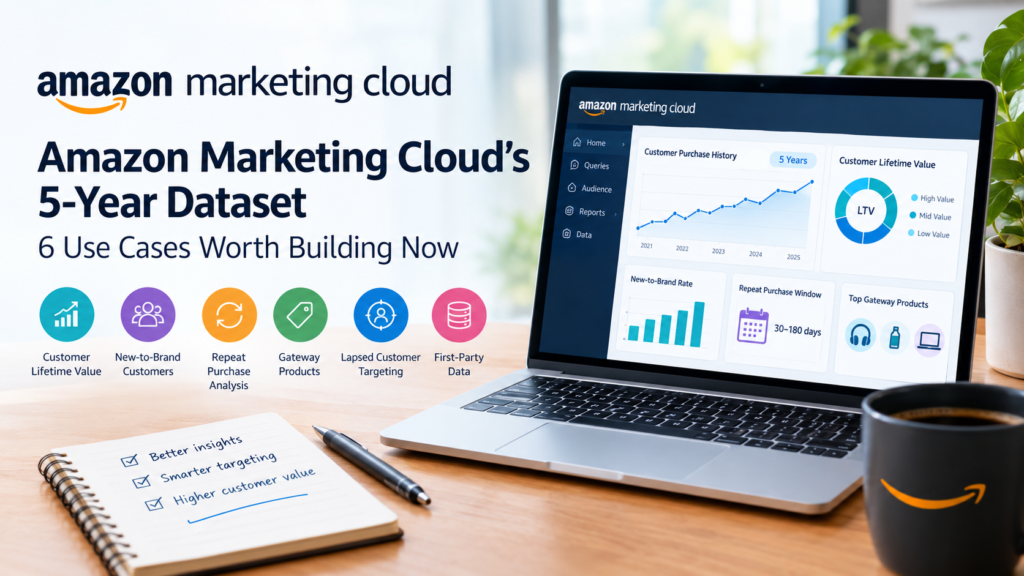
That longer view can help advertisers understand customer lifetime value, identify new-to-brand shoppers, discover repeat-purchase patterns, find gateway products, and build strategies for re-engaging lapsed customers.
For brands investing heavily in Amazon Ads, the Amazon Marketing Cloud 5-Year Dataset creates an opportunity to move beyond short-term campaign reporting and make decisions based on the broader customer journey.
Here are six practical use cases worth building now.
What Is the Amazon Marketing Cloud 5-Year Dataset?
The Amazon Marketing Cloud 5-Year Dataset is based on Amazon’s Amazon Retail Purchases dataset, which provides advertisers with access to historical Amazon Store purchase information within Amazon Marketing Cloud.
Amazon Marketing Cloud, or AMC, is a privacy-safe clean room environment that allows advertisers to analyze pseudonymized signals and generate insights about advertising performance and customer behavior.
Historically, AMC purchase analysis was constrained by a shorter lookback period. That made it difficult to understand customers whose purchasing cycles extended beyond one year.
The Amazon Marketing Cloud 5-Year Dataset expands that historical perspective, allowing eligible advertisers to analyze purchase behavior across a much longer period.
That matters because customers do not all purchase on the same schedule.
Someone buying household consumables might purchase several times a year. A customer buying a laptop, television, appliance, luxury product, or other durable item may not return for several years.
A longer purchase history provides more context around these different customer journeys.
1. Measure Customer Lifetime Value More Accurately
One of the biggest opportunities created by the Amazon Marketing Cloud 5-Year Dataset is a better understanding of customer lifetime value.
Customer lifetime value, or LTV, estimates the revenue a customer can generate over the course of their relationship with a brand.
Short purchase windows can underestimate that value.
Imagine a customer purchases an entry-level product today. Over the next few years, that customer might purchase complementary products, upgrade to a premium model, buy a multipack, and eventually become a regular customer.
Looking only at the first transaction would miss much of that journey.
With a longer historical view, advertisers can investigate how customer value develops after the initial purchase.
Why LTV matters for Amazon advertising
Suppose Product A generates a $10 first purchase while Product B generates a $40 first purchase.
Product B might initially appear more valuable.
However, if customers acquired through Product A consistently make additional purchases over the next several years, the original transaction value does not tell the complete story.
This can influence:
- Customer acquisition cost targets.
- Campaign budgets.
- Product promotion strategies.
- Bid decisions.
- New-customer acquisition tactics.
- Long-term profitability analysis.
The goal is not simply to acquire the cheapest customer.
It is to understand which customers become valuable over time.
2. Improve New-to-Brand Customer Analysis
The Amazon Marketing Cloud 5-Year Dataset can also provide more context when advertisers analyze new-to-brand (NTB) customers.
New-to-brand measurement helps brands determine whether advertising is reaching genuinely new customers rather than primarily generating additional purchases from existing customers.
A shorter purchase-history window can create problems for categories with long replacement cycles.
Consider consumer electronics.
A customer who purchased a laptop 18 months ago may still be an existing customer, even though that purchase could fall outside a shorter measurement window.
A longer historical dataset gives advertisers more information when determining whether a shopper should be considered new to a brand.
Build an NTB window that matches your category
Five years does not mean every brand should automatically use five years for every analysis.
The right lookback period depends on customer behavior.
For example:
- Frequently purchased products may require a shorter window.
- Consumer electronics may require a longer window.
- Seasonal products may benefit from multiple years of history.
- Luxury products can have long gaps between purchases.
The Amazon Marketing Cloud 5-Year Dataset gives advertisers more flexibility to examine these longer customer relationships and develop measurement approaches that better match their category.
Instead of assuming that every shopper follows the same purchasing cycle, marketers can use historical behavior to make more informed decisions.
3. Find the Right Repeat-Purchase Window
Another important application of the Amazon Marketing Cloud 5-Year Dataset is understanding when customers are likely to purchase again.
A brand may discover that customers typically return:
- 30–60 days after an initial purchase.
- Around six months later.
- Once every year.
- After a product reaches its expected replacement period.
Without enough historical information, these patterns can be difficult to identify.
A five-year purchase history can help advertisers examine repeat behavior over a much longer period.
Turn purchase timing into a marketing strategy
Suppose a brand discovers that customers typically replace a particular product every 24 to 30 months.
Instead of targeting every previous buyer continuously, the brand could build a strategy around the period when customers are most likely to need a replacement.
This can make retention campaigns more relevant and potentially reduce unnecessary advertising exposure.
The same approach can be applied to:
- Replenishable products.
- Seasonal purchases.
- Product upgrades.
- Replacement products.
- Subscription-related purchasing behavior.
The key question is simple:
When is a previous customer most likely to become a buyer again?
Longer purchase history can help brands answer it.
4. Identify Gateway Products
The Amazon Marketing Cloud 5-Year Dataset can also help brands identify products that act as entry points into longer customer relationships.
Not every product plays the same role in a customer’s journey.
Some products generate immediate revenue.
Others introduce shoppers to a brand and eventually lead to purchases of higher-value products.
These are often described as gateway products.
For example:
Entry-level product → complementary product → premium product → repeat purchase
Looking only at the first transaction makes that progression difficult to see.
A longer customer history allows brands to examine what happens after a shopper purchases the initial product.
Why gateway products matter
Suppose a lower-priced product consistently attracts shoppers who later purchase premium products.
That initial product may deserve greater attention in customer acquisition campaigns even if its first-order revenue is relatively low.
This insight could influence:
- Sponsored Ads campaigns.
- Amazon DSP strategies.
- Product promotions.
- Cross-selling.
- New-customer acquisition budgets.
- Product positioning.
The important question becomes:
Which products start valuable customer relationships?
That can be more useful than simply asking which products generate the most immediate sales.
5. Reacquire Customers Who Have Gone Quiet
Customer retention strategies often focus heavily on recent purchasers.
But what about someone who purchased 18, 24, or 36 months ago?
A customer who has not purchased recently is not necessarily lost forever.
They may simply have a longer purchase cycle.
The Amazon Marketing Cloud 5-Year Dataset gives advertisers a broader historical view that can help identify these older customer relationships and develop more sophisticated win-back strategies.
AMC can be used to analyze purchase behavior and create audience segments for activation across eligible Amazon advertising products.
Build more useful win-back segments
Instead of creating one broad “past customers” audience, brands can develop segments based on factors such as:
- Previous product purchased.
- Time since last purchase.
- Number of historical purchases.
- Customer value.
- Product category.
- Purchase frequency.
For example, a brand could distinguish between:
Recent customers: Purchased within the last six months.
Slipping customers: Previously frequent buyers who have not purchased recently.
Lapsed customers: Customers whose last purchase occurred more than a year ago.
High-value lapsed customers: Previous customers with strong historical value who have become inactive.
Each segment can receive a different marketing approach.
That is more useful than treating every previous customer identically.
6. Combine Amazon Signals With First-Party Data
The Amazon Marketing Cloud 5-Year Dataset becomes even more useful when Amazon signals are considered alongside a brand’s own first-party data.
Brands may have valuable information from:
- Ecommerce websites.
- CRM systems.
- Email databases.
- Loyalty programs.
- Offline purchases.
- Website conversions.
- Customer-service interactions.
Combining relevant first-party signals with Amazon data can provide a broader view of customer behavior.
Example: Amazon plus direct-to-consumer sales
Imagine a brand sells products through both Amazon and its own website.
A customer might discover the brand through Amazon and later purchase directly from the company’s website.
Looking at only one channel can make that customer journey appear incomplete.
AMC provides a privacy-safe environment where permitted first-party signals can be analyzed alongside Amazon signals.
This can help brands investigate questions such as:
- Do Amazon customers also purchase directly?
- Which customer groups have the highest long-term value?
- How does Amazon advertising contribute to broader customer behavior?
- Which audiences should receive additional marketing attention?
The result is a more connected view of customer activity across channels.
Why the Five-Year Lookback Changes Amazon Advertising
The biggest change created by the Amazon Marketing Cloud 5-Year Dataset is not simply the amount of data.
It is the time horizon.
A shorter reporting window encourages marketers to think about recent campaigns and recent purchases.
A five-year history makes it possible to ask much bigger questions:
- What makes a customer valuable over time?
- Which products acquire the best long-term customers?
- When do customers typically return?
- Which customers are worth winning back?
- How long should an NTB lookback window be?
- Which products act as gateways to premium products?
- How does Amazon purchasing relate to first-party customer behavior?
These questions move Amazon advertising away from campaign-level reporting and toward customer-level business strategy.
How Brands Can Start Using the Dataset
You do not need to build all six analyses immediately.
Start with one business question that could influence your advertising strategy.
Step 1: Choose a high-value question
Pick a question that could influence your budget, product strategy, or customer acquisition approach.
For example:
Which products generate the highest long-term customer value?
Step 2: Match the lookback period to the category
Do not automatically assume five years is the correct window for every analysis.
Test different periods based on your customers’ actual buying cycles.
Step 3: Segment customers
Break customers into meaningful groups based on purchase history, product behavior, or value.
Step 4: Turn insights into audiences
Where appropriate, use AMC’s audience capabilities to move from analysis to activation.
The Amazon Marketing Cloud 5-Year Dataset is particularly valuable when analysis is connected to a clear audience strategy rather than being used only for reporting.
Step 5: Measure what happens next
The analysis should lead to an action.
If you create a win-back audience, measure its performance.
If you identify a gateway product, compare its acquisition results.
If you discover a long-term LTV pattern, use it to inform budget decisions.
Data becomes valuable when it changes what you do.
What This Means for Amazon Advertisers
The Amazon Marketing Cloud 5-Year Dataset gives advertisers an opportunity to look beyond the immediate transaction.
That matters because customers rarely behave according to a neat 30-day reporting cycle.
Some customers buy frequently.
Some return once a year.
Others may disappear for several years before purchasing again.
A longer purchase history gives advertisers more context around these different customer journeys.
It can also make advertising decisions more closely connected to business outcomes such as customer value, retention, product progression, and long-term growth.
The biggest opportunity is therefore not simply “more data.”
It is using that data to make better decisions about who to acquire, which products to promote, when to retarget, and which customers are worth winning back.
FAQs
What is the Amazon Marketing Cloud 5-Year Dataset?
The Amazon Marketing Cloud 5-Year Dataset refers to Amazon’s Amazon Retail Purchases dataset, which provides up to five years of historical Amazon Store purchase data for eligible AMC use cases.
What can brands use the Amazon Retail Purchases dataset for?
Brands can use the extended purchase history for customer lifetime value analysis, new-to-brand measurement, repeat-purchase analysis, gateway-product research, customer segmentation, and audience creation.
Why is a five-year purchase history useful?
A longer history helps advertisers analyze products and customer relationships that extend beyond a traditional annual reporting window. This is especially useful for categories with long replacement or repurchase cycles.
Can Amazon Marketing Cloud use first-party data?
Yes. AMC can incorporate eligible advertiser-provided signals alongside Amazon Ads signals for analysis and audience creation within its privacy-safe environment.
Is Amazon Marketing Cloud only useful for reporting?
No. AMC supports both analytics and audience creation. Advertisers can use insights to build custom audiences and activate them across eligible Amazon advertising products.
Final Takeaway
The Amazon Marketing Cloud 5-Year Dataset changes the questions advertisers can ask about their customers.
Instead of focusing only on the last click or most recent purchase, brands can investigate the longer customer journey.
The most valuable starting points are:
- Customer lifetime value.
- New-to-brand measurement.
- Repeat-purchase timing.
- Gateway-product discovery.
- Lapsed-customer reacquisition.
- First-party data analysis.
For Amazon advertisers, the opportunity is to turn historical purchase behavior into practical decisions about acquisition, retention, products, and audience strategy.
The brands that get the most value from the Amazon Marketing Cloud 5-Year Dataset will not necessarily be the ones with the most data.
They will be the ones asking the right business questions of that data.