
Advertising inside AI platforms is moving into a new phase.
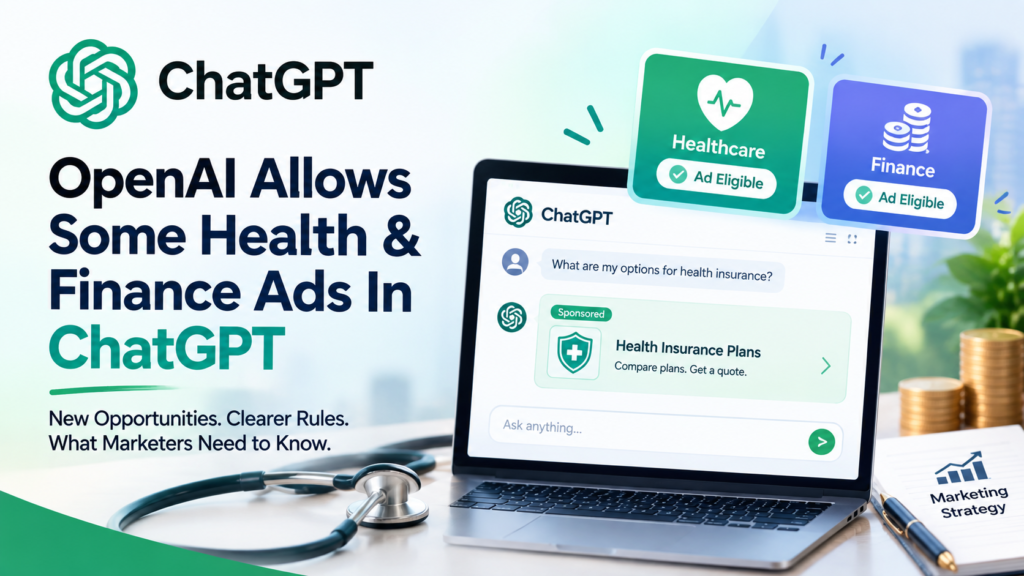
OpenAI’s current advertising policies allow some advertisers in healthcare and medicine and financial services to advertise on ChatGPT, subject to eligibility requirements and case-by-case approval. At the same time, OpenAI maintains restrictions on where ads can appear, particularly around sensitive user conversations.
That distinction matters.
A healthcare or finance company may be eligible to advertise, but that does not mean its ads can appear beside every health- or finance-related conversation.
For marketers, the bigger change is that ChatGPT is developing into another paid media environment alongside traditional search, social platforms, and AI search experiences.
What Are ChatGPT Ads?
ChatGPT ads are sponsored placements displayed separately from ChatGPT’s generated response.
OpenAI says ads can appear below a ChatGPT response and are clearly identified as sponsored content. Advertisers cannot control, rank, or modify ChatGPT’s answers.
The advertising system can consider several signals when determining relevance, including:
- The context of the current conversation
- User intent
- The ad headline and copy
- The landing page
- Advertiser-provided context hints
- Certain broader ChatGPT signals when ad personalization is enabled
This makes ChatGPT advertising different from traditional keyword-based search advertising.
Instead of thinking only about keywords, advertisers need to think about conversational intent and context.
Can Health Companies Advertise on ChatGPT?
Healthcare Advertising Is Eligible in Some Cases
OpenAI’s current advertising policy says advertisers in healthcare & medicine may be approved, with eligibility reviewed manually on a case-by-case basis.
The policy covers categories that may include certain healthcare-related products and services.
However, eligibility doesn’t remove the requirement to comply with advertising standards.
Health advertisers still need to pay close attention to:
- Health claims
- Promotional language
- Creative assets
- Landing-page content
- Product descriptions
- Regulatory requirements
OpenAI also states that its advertising standards apply across the complete ad experience, including copy, images or video, and landing pages.
Can Financial Services Advertise on ChatGPT?
Financial-services advertisers may also be eligible under OpenAI’s current advertising policies.
Like healthcare advertising, approval is not automatic. OpenAI says regulated categories are being rolled out gradually and reviewed manually on a case-by-case basis.
For financial marketers, this makes compliance especially important.
Advertising should avoid:
- Misleading claims
- Deceptive offers
- Unrealistic guarantees
- Unsupported financial promises
- Landing pages that introduce prohibited content
In other words, simply getting an ad approved does not mean every future creative or landing-page variation will automatically be acceptable.
Advertiser Eligibility and Ad Placement Are Two Different Things
This is one of the most important points for understanding ChatGPT ads Health & Finance.
There are effectively two separate questions.
Question 1: Can the business advertise?
This depends on the advertiser’s category, market, campaign and OpenAI’s eligibility requirements.
Question 2: Where can the advertisement appear?
This depends on OpenAI’s placement rules and the context of the conversation.
OpenAI says ads are not eligible near sensitive or regulated user contexts, including personal health, mental health and political conversations.
So a healthcare advertiser can potentially be eligible while a particular personal-health conversation remains ineligible for advertising.
That’s an important distinction that can easily get lost when looking only at headline statistics.
What SE Ranking’s ChatGPT Ads Study Found
Independent research gives an early look at how frequently ads appeared in ChatGPT.
SE Ranking analyzed 50,006 commercial prompts across 20 niches in the United States. Its August 2026 study found that 12,974 prompts returned an advertisement, producing an overall ad rate of 25.94%.
The study reported an even higher rate in healthcare:
28.69% of healthcare prompts returned an ad.
SE Ranking compared that with 2.64% in Google AI Mode in its separate analysis.
However, the numbers need to be interpreted carefully.
The study used commercial prompts categorized by niche. A healthcare-category commercial prompt is not necessarily the same thing as a personal health conversation protected by OpenAI’s sensitive-context restrictions.
Therefore, the study’s healthcare advertising rate should not automatically be interpreted as evidence that ads appeared beside personal medical conversations.
ChatGPT Ads Are Still an Evolving Advertising Channel
One reason marketers need to be careful with older articles is that OpenAI’s advertising policies have changed during 2026.
OpenAI’s policy changelog records several updates:
- March 2026: Initial advertising policy
- April 2026: More precise treatment of regulated-advice contexts
- May 2026: Additional advertising standards
- July 2026: Clarifications around financial and health services
- August 2026: Further category and market updates
- September 2026: Additional clarification around OpenAI’s ability to decline certain ads
This means a campaign strategy based on an old article can become outdated relatively quickly.
For marketers, the safest approach is to check the current OpenAI advertising policy before launching a campaign.
Why This Matters for Health and Finance Marketers
ChatGPT advertising introduces another way to reach people while they are researching, comparing and making decisions.
OpenAI describes ChatGPT Ads as a system that can use conversational context and intent to determine relevant advertising opportunities.
That creates several opportunities for marketers.
1. Conversational Intent Becomes Important
Users don’t always search with short commercial keywords.
They may ask complete questions such as:
- “What should I consider when choosing health insurance?”
- “How can I compare financial services?”
- “What should I look for before choosing a healthcare provider?”
This type of conversational behavior creates a different environment from conventional search advertising.
2. Relevance Matters
OpenAI says its advertising system considers relevance and expected outcomes when selecting ads.
Advertisers therefore need to create ads that clearly communicate:
- What they offer
- Who the service is for
- What problem it addresses
- Why the user should consider it
3. Landing Pages Matter Too
The landing page is not just an afterthought.
OpenAI says the landing page is among the signals considered by its advertising system, and its policies apply to the destination experience as well.
A compliant advertisement leading to a problematic landing page can still create issues.
What Marketers Should Check Before Running ChatGPT Ads
1. Verify Your Industry Eligibility
Don’t assume that being a healthcare or finance company automatically means you can advertise.
Check the latest OpenAI advertising policies and the availability of Ads Manager for your market.
OpenAI says advertising availability can change as testing expands.
2. Review Every Claim
Health and finance are sensitive categories.
Review your:
- Headlines
- Descriptions
- Images
- Offers
- Calls to action
- Disclaimers
- Landing pages
Make sure the entire customer journey is consistent with the applicable advertising requirements.
3. Think Beyond Keywords
ChatGPT’s advertising system is not simply matching exact search terms.
OpenAI says advertisers can provide context hints describing conversations, topics or keywords where their products may be relevant. These hints guide matching but don’t guarantee delivery for a particular conversation.
That means marketers should build messaging around customer problems and use cases rather than relying only on a keyword list.
4. Track Paid AI Visibility Separately
Don’t confuse paid ChatGPT visibility with organic AI visibility.
An advertiser can receive a sponsored placement without being cited in the organic answer.
SE Ranking’s research found that advertisers were also cited among ChatGPT’s organic sources in only 3.63% of its ad placements.
Paid and organic AI visibility should therefore be measured separately.
ChatGPT Ads vs Traditional Search Advertising
| Traditional Search Ads | ChatGPT Ads |
|---|---|
| Primarily keyword-driven | Conversational context can matter |
| Search query is central | Conversation and intent can matter |
| Ads appear in search results | Ads appear below ChatGPT responses |
| Keyword strategy is important | Context and use cases are important |
| Search terms can be analyzed | Conversation-level matching works differently |
| Mature advertising ecosystem | Newer and evolving advertising environment |
This doesn’t mean ChatGPT advertising replaces Google Ads.
Instead, it creates another channel that marketers can evaluate based on their audience, objectives and available inventory.
What About ChatGPT Ad Audience and Reach?
ChatGPT advertising is currently not shown to everyone.
OpenAI says ads may appear for users on Free and Go plans, while Plus, Pro, Business, Enterprise and Edu accounts do not have ads. OpenAI also says ads are not shown to accounts identified as belonging to users under 18.
This creates an important planning consideration.
A business should ask:
Is the audience I want actually inside the ad-eligible portion of ChatGPT?
If the answer is uncertain, campaign testing and measurement become even more important.
ChatGPT Ads Don’t Control the AI’s Answer
Another important distinction is the relationship between advertising and ChatGPT’s generated answers.
OpenAI says advertisements operate separately from the chat model and that advertisers cannot shape, rank or alter ChatGPT’s responses.
So an advertisement appearing below an answer should not be interpreted as ChatGPT recommending that company.
Likewise, paying for advertising does not automatically turn a business into an organic source or citation.
Common Mistakes to Avoid
Mistake 1: Assuming Health or Finance Ads Are Automatically Approved
Eligibility is subject to OpenAI’s requirements and, for regulated categories, case-by-case review.
Mistake 2: Treating Every Healthcare Prompt as a Personal Health Conversation
Third-party research may categorize commercial prompts as healthcare.
That doesn’t mean those prompts are personal medical conversations.
Mistake 3: Planning From an Old Policy
OpenAI’s advertising rules have changed several times in 2026.
Always check the latest policy before launching.
Mistake 4: Focusing Only on the Advertisement
The landing page is also part of the advertising experience.
Make sure your ad and destination communicate the same compliant offer.
Mistake 5: Assuming Paid Visibility Equals Organic AI Visibility
Paid advertising and organic citations are separate systems.
A campaign should not be evaluated as an SEO or AI-search visibility strategy automatically.
What This Means for AI Search Marketing
The development of ChatGPT Ads points toward a larger change in digital marketing.
Search marketing is no longer limited to traditional search-engine results pages.
Businesses are increasingly dealing with:
- Google Search
- AI search results
- AI-generated answers
- Organic AI citations
- Paid AI advertising
- Conversational discovery
For marketers, this means reporting should become more detailed.
Instead of asking only:
“Where do we rank?”
Businesses may also need to ask:
“Where are we being discovered, cited, recommended, or advertised across AI search experiences?”
That is a much broader visibility picture.
Frequently Asked Questions
1. Can healthcare companies advertise on ChatGPT?
Some healthcare and medicine advertisers may be eligible to advertise on ChatGPT, subject to OpenAI’s requirements and case-by-case approval. Ads still cannot appear near sensitive personal-health conversations.
2. Can financial-services companies advertise on ChatGPT?
Some financial-services advertisers may be eligible under OpenAI’s current advertising policies. Eligibility is subject to applicable requirements and review.
3. Will health ads appear next to personal health conversations?
No. OpenAI says ads are not eligible to appear near sensitive user contexts, including personal health and mental-health conversations.
4. Do ChatGPT ads influence ChatGPT’s answers?
No. OpenAI says ads are separate from ChatGPT’s answers and advertisers cannot shape, rank or alter those responses.
5. Are ChatGPT advertising rules likely to change?
The advertising program is still developing, and OpenAI’s policy changelog shows multiple updates during 2026. Marketers should therefore check the current policies before launching campaigns.
Final Takeaway
ChatGPT Ads are becoming a new part of the AI advertising ecosystem, and health and financial-services companies are now part of that conversation.
But the change is more nuanced than simply saying “ChatGPT allows health and finance ads.”
OpenAI separates advertiser eligibility from ad placement. Some regulated advertisers may be approved, while ads remain excluded from sensitive contexts such as personal health conversations.
The third-party data also shows that ChatGPT ads are already appearing across a meaningful share of commercial prompts. SE Ranking’s 2026 study recorded ads on 25.94% of its 50,006 commercial prompts, with healthcare at 28.69%.
For marketers, the practical lesson is straightforward:
Don’t build your ChatGPT advertising strategy from old assumptions. Check the current policy, verify eligibility, create contextually relevant ads, review the complete landing-page experience, and measure paid AI visibility separately from organic AI visibility.