
Google is expanding its first-party data capabilities with a broader rollout of Data Manager and a new measurement feature designed to show advertisers the impact of stronger data signals.
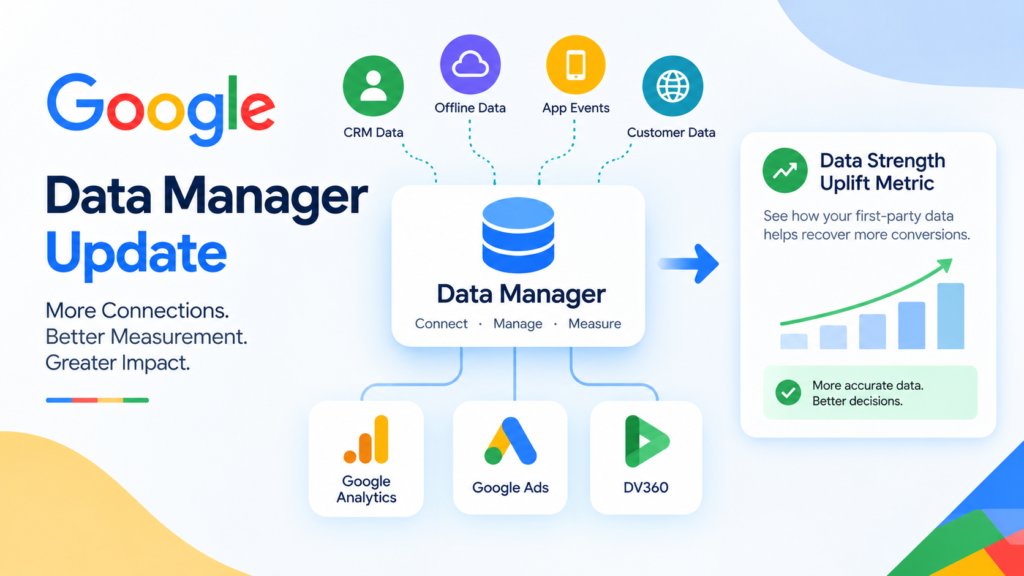
The Google Expands Data Manager update brings Data Manager into Google Analytics and Display & Video 360 (DV360), while improvements to its API aim to make data connections easier to manage across advertising platforms.
Google Ads is also introducing a Data Strength Uplift Metric, giving advertisers more visibility into how improvements to their measurement setup can help recover conversions that may otherwise go unmeasured.
For businesses investing in better tracking, CRM integrations, and enhanced conversions, these changes could make it easier to understand whether those efforts are actually improving measurement.
What Is Google Data Manager?
Google expands Data Manager to give advertisers a central way to connect and manage first-party data used across Google’s advertising and measurement products.
Instead of handling different data connections separately, advertisers can use Data Manager to work with information such as:
- CRM data
- Offline conversion data
- App events
- Customer information
- Website conversion signals
- First-party measurement data
This becomes increasingly important as advertisers rely more heavily on automated bidding and optimization.
Better data can give Google’s systems more information about the actions that matter to a business.
Google Expands Data Manager To Analytics And DV360
Google expands Data Manager into Google Analytics and Display & Video 360.
Previously, advertisers working across multiple Google products could face separate data setup and management requirements. Bringing Data Manager into more of the Google ecosystem is intended to make those connections easier to manage.
The expansion is particularly relevant for advertisers that use several Google marketing products at the same time.
What Advertisers Can Expect
The broader Data Manager integration can help advertisers manage:
- First-party customer data
- Offline conversion information
- App data
- Enhanced conversion signals
- Data connections between Google products
Google says advertisers connecting offline and app data through Data Manager see an average 26% increase in incremental ROAS.
However, individual results can vary significantly depending on an advertiser’s tracking infrastructure, campaign strategy, data quality, and business model.
Enhanced Conversions Expand Across More Google Products
Enhanced conversions are also becoming more widely available across Google’s ecosystem.
The technology helps advertisers provide additional first-party information that can improve conversion measurement when traditional tracking signals are incomplete.
For advertisers, this matters because customer journeys don’t always happen entirely within a website.
A potential customer might:
- Visit a website.
- Submit a lead form.
- Complete a purchase later.
- Make an offline transaction.
- Return through another device or channel.
Without appropriate measurement signals, some of these interactions can be difficult to connect back to advertising activity.
Better first-party data can help close some of those gaps.
Google Data Manager API Adopts A Broader Standard
Google is also expanding the Data Manager API by adopting the IAB Tech Lab’s Event and Conversions API (ECAPI) standard.
The goal is to create a more consistent approach to sending event and conversion information across advertising platforms.
For organizations managing multiple advertising systems, standardized data connections could reduce some of the technical complexity involved in maintaining separate integrations.
Why The API Change Matters
Large advertisers often work with multiple platforms, analytics systems, CRM databases, and internal data infrastructure.
Without common standards, each platform can require its own implementation.
A broader API standard could help teams:
- Reduce duplicated integration work
- Maintain data connections more efficiently
- Connect conversion events across supported platforms
- Simplify technical data workflows
- Scale first-party measurement more effectively
This is especially relevant for businesses with large volumes of customer and conversion data.
Data Manager Adds Data Diagnostics
Google expands Data Manager with built-in diagnostics to help advertisers identify data issues before they affect advertising campaigns. Incorrect conversion values, missing events, broken connections, or inconsistent customer data can affect the signals used by measurement and automated bidding systems.
Data problems can create serious issues for advertising campaigns. Incorrect conversion values, missing events, broken connections, or inconsistent customer data can affect the signals used by measurement and automated bidding systems.
Diagnostics are intended to help advertisers identify data issues before they have a larger impact.
This can be useful when managing:
- Offline conversions
- CRM integrations
- App events
- Website conversions
- First-party customer signals
For advertisers relying heavily on automated campaign optimization, the quality of these inputs is increasingly important.
What Is The Data Strength Uplift Metric?
Another important part of the update is Google’s new Data Strength Uplift Metric in Google Ads.
The metric is designed to estimate how many additional conversions advertisers recover through improvements to their first-party measurement setup.
This gives advertisers another way to evaluate the effect of measurement improvements.
For example, a company could improve its setup by:
- Implementing enhanced conversions
- Improving website tagging
- Connecting offline conversion data
- Adding additional first-party data sources
- Improving its Google tag implementation
If the number of measured conversions increases afterward, advertisers may want to understand how much of that increase comes from previously unmeasured activity.
The uplift metric is intended to provide more visibility into that change.
Google Reports Conversion Uplift From Better Data Strength
Google says advertisers improving data strength through Google tag gateway see an average 14% conversion uplift.
That figure should be viewed as Google’s reported average rather than a guaranteed result for every advertiser.
The actual impact can depend on the advertiser’s existing measurement setup, website implementation, conversion volume, customer journey, and data quality.
Still, the direction is important.
Advertisers are increasingly being encouraged to treat measurement infrastructure as part of their marketing strategy rather than simply a technical implementation.
Why First-Party Data Matters More For Advertisers
First-party data has become increasingly important as advertising measurement becomes more complex.
Advertisers cannot always rely on a single browser-based tracking signal to understand the entire customer journey.
First-party information can provide additional context about what happens before and after an advertising interaction.
This can include:
- Lead status
- Purchase information
- Customer value
- Offline sales
- Subscription activity
- Qualified leads
- Revenue data
The more accurately these outcomes are connected to advertising activity, the more useful the resulting measurement can become.
Better Measurement Does Not Automatically Mean Better Results
There is an important distinction advertisers should keep in mind.
Recovering more conversions is not the same as generating more valuable customers.
Suppose an advertiser improves its tracking and suddenly records more conversions.
That is useful from a measurement perspective, but the business still needs to determine:
- Are these qualified leads?
- Are customers generating revenue?
- What is the profit generated?
- Are acquisition costs improving?
- Are repeat purchases increasing?
- Are automated campaigns optimizing toward the right customers?
A larger conversion count alone cannot answer those questions.
Connect Google Ads Data With Business Outcomes
Advertisers should ideally connect advertising data with downstream business information.
For example:
Ad click → Lead → Qualified lead → Customer → Revenue → Profit
This provides a much clearer picture than stopping measurement at the initial form submission.
For lead-generation businesses, sending only raw lead volume to Google may encourage optimization toward quantity rather than quality.
Connecting qualified leads or valuable customer outcomes can provide a stronger signal for automated bidding.
What Advertisers Should Do Next
The Google Expands Data Manager update gives advertisers another reason to review their measurement infrastructure.
Businesses can start by checking:
1. Audit Existing Conversion Tracking
Review whether important conversions are being recorded correctly.
Check for:
- Duplicate conversions
- Missing events
- Incorrect conversion values
- Broken tags
- Unnecessary conversion actions
2. Review First-Party Data Connections
Identify the customer and business data that could improve advertising measurement.
This might include CRM information, offline sales, qualified leads, or app activity.
3. Check Enhanced Conversions
If enhanced conversions are relevant to the business, review whether they are correctly implemented and providing useful signals.
4. Monitor Data Quality
Don’t assume that a successful connection means the underlying data is accurate.
Regularly check whether conversion events, values, and customer information are being transmitted correctly.
5. Measure Business Value
Look beyond the number of conversions.
Track metrics such as:
- Revenue
- Profit
- Customer acquisition cost
- Lead quality
- Customer lifetime value
- Qualified conversion rate
These metrics help determine whether improved measurement is actually supporting better business decisions.
Google Data Manager And The Future Of Advertising Measurement
The expansion of Google Data Manager reflects a broader shift in digital advertising.
Advertisers are being asked to provide stronger first-party signals while platforms increasingly use automation to make bidding and optimization decisions.
That creates a simple but important relationship:
Better inputs → Better measurement → More informed optimization
But the first step cannot be skipped.
If the data going into an advertising platform is incomplete, duplicated, or focused on the wrong business outcome, better automation will not necessarily solve the underlying problem.
The new Data Strength Uplift Metric can help advertisers understand whether their measurement improvements are recovering additional conversion information. However, advertisers still need to evaluate whether those conversions represent meaningful business outcomes.
FAQs
What is Google Data Manager?
Google Data Manager is a Google tool that helps advertisers connect and manage first-party data, including CRM, offline, app, and conversion information, across supported Google products.
What is the Data Strength Uplift Metric?
The Data Strength Uplift Metric is designed to estimate additional conversions recovered through improvements to an advertiser’s first-party measurement setup.
Why is first-party data important in Google Ads?
First-party data can provide additional information about customers and conversions that may not be captured through traditional tracking alone. It can also provide stronger signals for measurement and automated bidding.
Does better conversion tracking guarantee better campaign performance?
No. Better tracking can improve the completeness of measurement, but campaign performance also depends on conversion quality, bidding strategy, targeting, creative, landing pages, and business outcomes.
What should advertisers check after the Data Manager update?
Advertisers should review their conversion tracking, first-party data connections, enhanced conversions, data quality, and whether the conversion signals being sent to Google represent valuable business outcomes.
Conclusion
Google’s latest Data Manager updates show how important first-party data has become for modern advertising measurement.
By expanding Data Manager into Google Analytics and DV360, adopting a broader API standard, adding diagnostics, and introducing the Data Strength Uplift Metric, Google is giving advertisers more tools to connect and evaluate their data.
But better measurement should not be treated as the final goal.
Advertisers still need to make sure the signals sent to Google reflect what the business actually values — whether that means qualified leads, revenue, profitable customers, or long-term customer value.
The real opportunity is not simply to measure more conversions, but to give Google’s automated systems better information about the conversions that matter.