

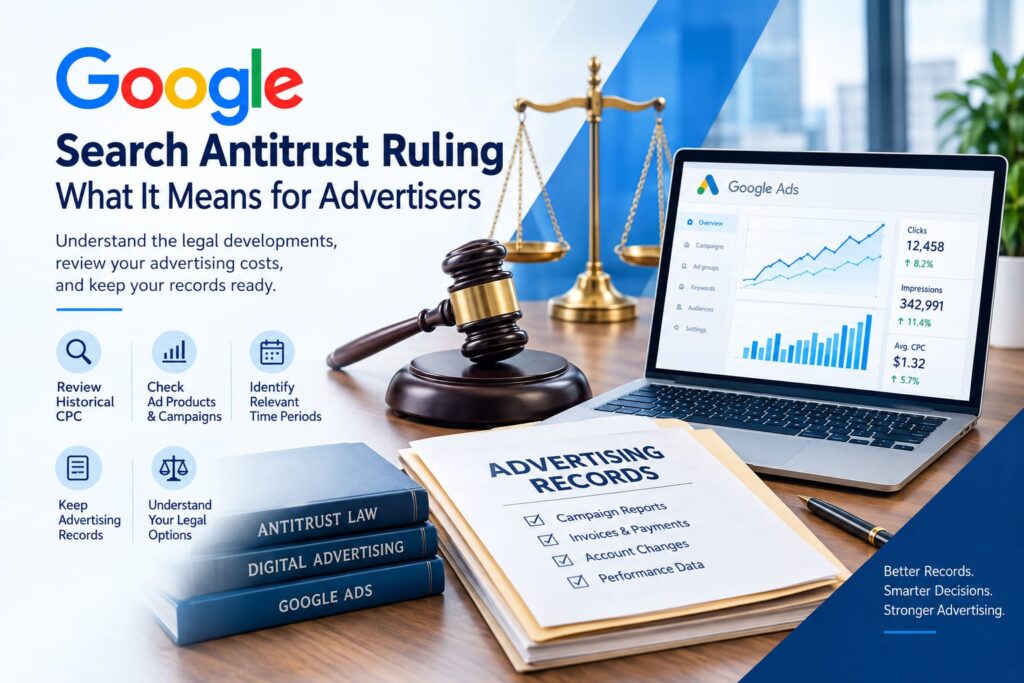
Google’s Search Antitrust Ruling has raised important questions about competition, search advertising, and the way digital advertising markets operate. For businesses investing in Google Ads, the case is a reason to understand the legal developments, review historical advertising costs, and keep accurate campaign records.
In August 2024, a U.S. federal court found that Google had illegally maintained monopolies in general search services and general search text advertising through exclusive distribution agreements. The case subsequently moved into the remedies phase, with a final judgment entered in December 2025 and appeals following in 2026. Read the U.S. Department of Justice’s case records.
However, the ruling does not automatically establish that every Google Ads advertiser overpaid or is entitled to compensation. Individual businesses need to distinguish the court’s findings from separate allegations about auction pricing, potential damages, and their own legal options.
For marketers, agencies, and business owners, the practical next step is to understand what the case covers, identify the advertising records worth preserving, and evaluate any concerns with qualified legal and financial advisers.
What Google’s Search Antitrust Ruling Means for Advertisers
The search antitrust case examined whether Google used anticompetitive practices to maintain its position in general search services and general search text advertising.
The court’s August 2024 liability decision found that Google had violated U.S. antitrust law through exclusive distribution agreements. The proceedings then moved to determining appropriate remedies, including measures intended to address the competitive effects identified by the court.
For advertisers, the case matters because competition influences the broader environment in which search advertising operates. However, it is important not to assume that the ruling proves a particular advertiser’s cost per click was improperly increased.
Advertisers should understand three separate issues:
- Court findings: What the judge actually determined in the search antitrust case.
- Auction-pricing concerns: Whether particular advertising mechanisms affected costs and what evidence supports that conclusion.
- Individual claims: Whether a business has a legally supportable claim based on its own advertising history, contractual terms, and applicable law.
Keeping these issues separate helps businesses make better decisions without relying on exaggerated headlines or unsupported compensation estimates.
How the Search Advertising Market Became a Legal Issue
Search advertising allows businesses to compete for visibility when users search for products, services, and information.
Advertisers typically manage budgets, keyword targeting, ad relevance, bidding strategies, and conversion tracking to improve campaign performance. The price paid for a click can vary according to auction conditions and the advertising system’s pricing mechanisms.
The antitrust case examined Google’s market position and exclusive distribution arrangements, including their impact on competition in general search and general search text advertising. It was not a blanket finding that every advertising price or every Google Ads auction was unlawful.
This distinction is important when interpreting the case from a digital marketing perspective.
A rise in cost per click can have many possible explanations, including increased competition, changing search demand, different keyword targeting, shifts in conversion strategy, and auction dynamics. Advertisers should investigate their own data before attributing cost changes to any single cause.
Which Google Ads Costs Should Advertisers Review?
A practical review begins with historical advertising records. The aim is to understand how spending changed over time and whether unusual patterns deserve further investigation.
1. Review Historical Cost Per Click
Cost per click (CPC) measures the average amount paid for an advertising click.
Compare CPC trends across relevant periods rather than looking at a single month in isolation.
Check:
- Average CPC by campaign and keyword.
- Changes in impressions, clicks, and click-through rate.
- Search impression share and competitive pressure.
- Changes in bidding strategies and campaign settings.
- Performance before and after major account changes.
For example, if a campaign’s CPC increased substantially while its targeting and bidding settings remained stable, investigate other possible explanations. Review the search terms, auction insights, competition, and account history before drawing conclusions.
A CPC increase by itself does not prove an antitrust-related overcharge.
2. Separate Search Text Ads From Other Advertising Products
Not every advertising product belongs to the same market or legal proceeding.
The search case focused on general search services and general search text advertising. Shopping ads, display advertising, and Performance Max campaigns should not automatically be treated as equivalent to the text advertising discussed in that case.
Create a clear breakdown of advertising spend by product and campaign type.
For example, an ecommerce business might separate its historical spending into:
- Google Search text campaigns.
- Shopping campaigns.
- Performance Max campaigns.
- Display campaigns.
- YouTube and other video campaigns.
This classification helps the business understand its advertising mix and identify which records may be relevant to a particular legal review. It does not determine eligibility for a claim on its own.
3. Identify the Relevant Advertising Period
Historical records are useful only when their dates and context are clear.
Create a timeline of advertising expenditure and major account changes. Include campaign launch dates, changes to bidding strategies, agency transitions, and adjustments to budgets or targeting.
Where a legal adviser identifies a relevant period for investigation, use that period to organize the records.
Do not assume that all advertising spend from a particular year is eligible for compensation. Relevant dates, legal requirements, contracts, and evidence depend on the specific claim.
How Google Ads Auction Pricing Affects Campaign Costs
Google Ads uses an auction system to determine which ads can appear and how much advertisers pay.
Ad rank, competition, expected performance, and other auction factors can affect the outcome. Advertisers therefore need to distinguish ordinary auction variability from evidence of a specific pricing concern.
Understanding CPC Changes
Consider a business that records the following average CPC figures:
| Period | Average CPC |
|---|---|
| January | $1.20 |
| February | $1.35 |
| March | $1.50 |
The figures show a rising average CPC, but they do not explain why the increase occurred.
The business should investigate whether keyword mix, competition, geographic targeting, conversion goals, or bidding settings changed during the same period.
The same principle applies to historical data connected with the antitrust case: an observed cost increase is a starting point for analysis, not proof of unlawful conduct or recoverable damages.
Keep Auction Pricing Separate From Account Optimization
Advertisers should continue improving the factors they can control.
These include:
- Improving ad relevance and landing-page experience.
- Reviewing search terms and negative keywords.
- Evaluating bidding strategies against actual business goals.
- Improving conversion tracking.
- Monitoring campaign profitability rather than clicks alone.
Legal developments do not replace normal campaign management. Businesses still need to understand which marketing activities generate profitable customers and which consume budget without delivering sufficient value.
How to Organize Google Ads Records for a Review
A well-organized advertising history makes it easier for a business, agency, accountant, or lawyer to investigate cost concerns.
Step 1: Export Historical Campaign Reports
Where historical data is available, export relevant reports from Google Ads.
Useful fields include:
- Campaign and ad group names.
- Advertising product or campaign type.
- Reporting dates.
- Impressions and clicks.
- Cost and average CPC.
- Conversions and conversion value.
- Bidding strategy and major configuration changes.
Preserve the original exports and document the date on which each report was downloaded.
Step 2: Collect Billing and Payment Records
Campaign reports show performance, while invoices and payment records help establish actual expenditure.
Gather available Google Ads invoices, billing statements, payment records, and relevant account documentation.
If an agency managed the account, determine which legal entity held the advertising contract and which entity paid the invoices. Retain agency agreements and correspondence where they clarify these responsibilities.
The distinction matters because account management and legal ownership of a potential claim are not necessarily the same thing.
Step 3: Document Account and Agency Changes
A change in advertising performance may coincide with a change in management, tracking, or campaign structure.
Record significant events such as:
- Switching from manual bidding to automated bidding.
- Restructuring campaigns or changing match types.
- Changing conversion actions.
- Moving accounts between agencies.
- Changing markets, products, or budgets.
This context helps analysts avoid confusing ordinary account changes with other possible explanations for cost movements.
Step 4: Protect Access and Record Integrity
Store records securely and restrict access to authorized personnel.
Keep original exports, retain relevant timestamps, and avoid modifying source files without documenting changes. Businesses should also review applicable retention requirements and their contractual obligations.
Do not share sensitive customer information or account credentials unnecessarily when consulting an adviser.
What Advertisers Should Know About Potential Compensation
Some commentary about the Google search case discusses possible overcharges and the possibility of recovering damages. These claims require careful interpretation.
A court finding against a company does not automatically establish that every customer suffered legally recoverable harm. A business would need to establish the relevant legal basis, its own circumstances, and the applicable measure of damages.
Does the Ruling Guarantee a Refund?
No. The search antitrust ruling does not automatically entitle every Google Ads advertiser to a refund.
Whether an advertiser can pursue a claim depends on matters such as the relevant legal theory, the advertiser’s contracts, applicable law, evidence of harm, procedural requirements, and any deadlines.
Advertisers should be cautious about any service that promises a guaranteed recovery before reviewing the account and relevant legal documents.
Does U.S. Antitrust Law Allow Triple Damages?
U.S. antitrust law can allow successful private plaintiffs to recover three times their proven damages in qualifying cases under Section 4 of the Clayton Act. However, that principle does not mean every advertiser can simply multiply its Google Ads expenditure by three.
A claim must satisfy the applicable legal requirements, and the damages calculation depends on the evidence and circumstances. Eligible expenditure, actual overcharges, causation, limitations periods, and other legal questions may all matter.
Businesses should consult qualified U.S. antitrust counsel before estimating potential recovery or deciding whether to proceed.
Should Advertisers Contact a Lawyer?
A legal consultation may be appropriate if a business has substantial historical search advertising spend and wants to understand whether the ruling has implications for its circumstances.
Before engaging an adviser, ask:
- What specific court finding or legal claim applies to my business?
- Which advertising products and dates are relevant?
- What evidence would be required to establish harm?
- What are the potential costs, risks, and procedural requirements?
- Are any deadlines or contractual provisions relevant?
These questions encourage a fact-based assessment rather than a decision based on a headline or an advertised recovery figure.
Search Antitrust and the Separate Google Ad Tech Case
Google has also faced a separate U.S. antitrust proceeding involving digital advertising technology used in the publisher advertising ecosystem.
That case concerns different products and market issues from the general search and search text advertising case. The distinction matters for businesses that use multiple Google advertising products.
An advertiser purchasing search text ads should not assume that findings in the ad tech case automatically apply to its transactions. Likewise, a publisher using advertising technology may need a different analysis from a business buying search traffic.
The U.S. Department of Justice maintains official records for both proceedings:
Consult the relevant court opinions and final orders for the precise findings and remedies. News coverage and commentary can provide context, but the underlying legal documents are the better source for determining what a court actually decided.
A Practical Checklist for Advertisers
Before making decisions based on Google’s Search Antitrust Ruling, work through this checklist.
- Export historical Google Ads campaign reports.
- Collect available invoices and payment records.
- Separate search text advertising from other advertising products.
- Document major campaign, bidding, and agency changes.
- Compare CPC and total spend across relevant periods.
- Preserve original reports and supporting records.
- Read the applicable court decisions and remedies.
- Consult qualified legal counsel before assessing a potential claim.
- Continue monitoring campaign profitability and conversion quality.
This process is useful even if a business ultimately decides not to pursue legal action. Reliable records support better financial oversight and more informed advertising decisions.
Frequently Asked Questions
1. What is Google’s Search Antitrust Ruling?
It refers to the U.S. court proceedings in which Google was found to have unlawfully maintained monopolies in general search services and general search text advertising through exclusive distribution agreements. The case later proceeded to remedies and appeals.
2. Does the ruling mean Google Ads advertisers overpaid?
Not automatically. The court’s findings do not establish that every advertiser paid an unlawful price or suffered recoverable harm. Individual cost changes and potential claims require separate analysis.
3. Can advertisers recover three times their Google Ads costs?
Not simply because they used Google Ads. U.S. antitrust law can permit treble damages in qualifying private actions, but a claimant must meet the applicable legal requirements and establish its damages. Advertising spend alone is not the same as proven harm.
4. Which Google Ads records should businesses keep?
Businesses should preserve historical campaign reports, invoices, payment records, conversion data, account-change histories, and relevant agency agreements. The specific records needed depend on the purpose and scope of the review.
5. Should small businesses review the ruling even if they have limited ad spend?
Small businesses can benefit from understanding the ruling and maintaining accurate advertising records. Whether a legal review is worthwhile depends on the amount and type of spend, the available evidence, legal costs, and the business’s circumstances.
Conclusion: Turn Legal Developments Into Better Advertising Oversight
Google’s Search Antitrust Ruling is an important development in the debate over competition in digital search and advertising. It provides a reason for advertisers to understand the legal proceedings, preserve their historical records, and examine their advertising expenditure carefully.
However, the ruling should not be treated as proof that every advertiser overpaid or is entitled to compensation. Court findings, auction-pricing allegations, and individual legal claims are separate matters that require evidence and careful interpretation.
For businesses and marketing teams, the most useful next step is straightforward: organize historical campaign data, verify billing records, distinguish search text ads from other advertising products, and consult qualified advisers when necessary.
At Growith Digital, effective advertising management starts with informed decisions, reliable measurement, and a clear understanding of marketing performance. Keeping accurate records and following authoritative legal developments can help businesses make better decisions about both their advertising budgets and their future strategy.