
When someone asks ChatGPT or Google AI Mode for “the best dentist near me” or “a reliable CA firm in Kolhapur,” the AI has to pick a few businesses to mention. It builds that answer from what it can read online. Your local landing pages are one of the biggest pieces of that puzzle.
The problem? Most local landing pages were written for humans skimming on a phone, not for AI systems trying to check facts. Let’s fix that with a practical, step-by-step approach.
Why Local Landing Pages Matter More Now
A local landing page is a page on your website built around one service in one area. For example, “AC repair in Sangli” or “digital marketing course in Ichalkaranji.”
Earlier, these pages mostly helped you rank in Google’s map pack and local results. Now they also feed AI answers. A recent Search Engine Journal guide by Loren Baker makes a clear point: AI tools can only recommend what they can access, understand, and verify.
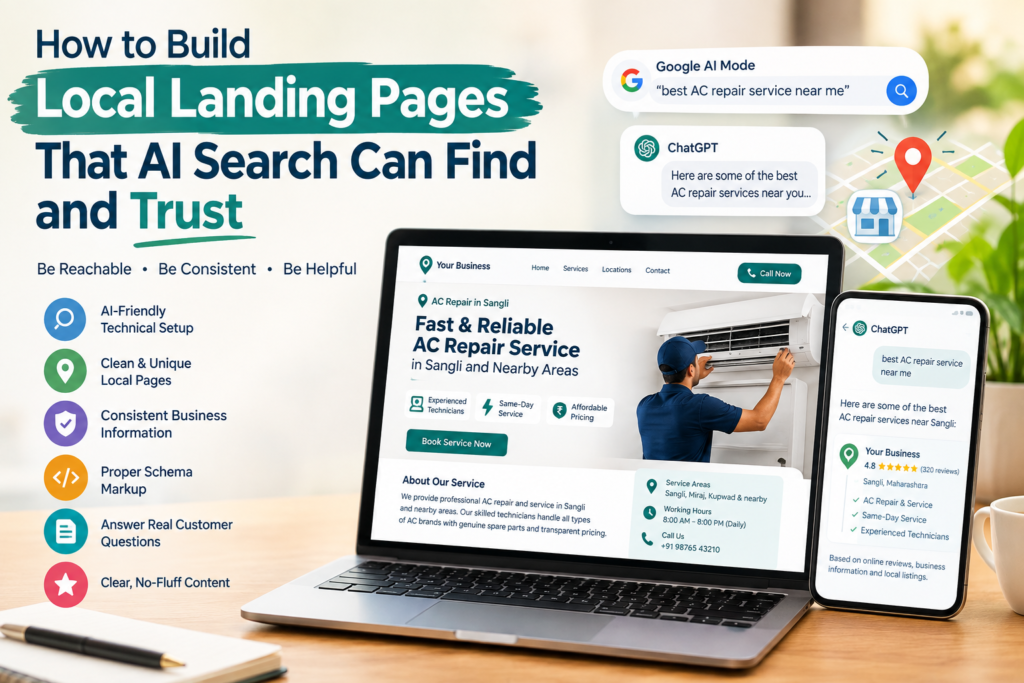
That gives us three jobs for all your local landing pages: be reachable, be accurate, and be clear.
Step 1: Make Sure AI Can Actually Reach Your Pages
It sounds obvious, but many sites block crawlers without knowing it.
Check these quickly:
- robots.txt: make sure important pages are not disallowed
- noindex tags: some themes or plugins add these by mistake
- Security and CDN settings: tools like Cloudflare can block AI crawlers by default, so review your bot settings
- JavaScript-only content: key details like address, services, and prices should be in the page HTML, not loaded later by scripts
The good news is that most small business sites on WordPress or Wix already serve normal HTML, so this part is often fine. But one wrong setting can hide your local landing pages from every AI tool, so it is worth five minutes.
Step 2: Clean Up Old and Duplicate Pages
Over the years, many websites collect pages like “services-old,” “contact-new,” or “home-v2.” These often carry outdated phone numbers, old addresses, or discontinued services.
AI tools may still find them. And when they see two different phone numbers for your business, they get confused about which one is true.
Do a quick sweep:
- Delete or redirect outdated pages
- Keep one clear page per service and location, so your local landing pages never compete with each other
- Make sure your sitemap only lists pages you want found
Step 3: Keep Your Business Details Consistent Everywhere
This is where many local businesses lose trust without realising it.
Your name, address, phone number, hours, and services should match on:
- Your local landing pages
- Your Google Business Profile
- Directories like Justdial and IndiaMART
- Your social media profiles
If you need a quick refresher on the Google side, our Google Business Profile checklist covers the key fields.
Assign one person on your team to own these details. When something changes, like new timings during Diwali, they update every place, not just one.
Step 4: Add Schema That Matches the Page
Structured data (schema) tells search engines exactly what your business is, where it is, and what it offers. Google’s LocalBusiness structured data guide lists the main properties to use.
But here is the key lesson: schema is not “set and forget.” It must match what is visible on the page and on your Google profile. If your schema says you open at 9 AM and your page says 10 AM, you are sending mixed signals.
Treat schema like your shop signboard. When details change, update it.
Step 5: Write Local Landing Pages That Answer Real Questions
This is the part that makes the biggest difference for AI visibility.
Find the questions first
Before writing, ask yourself what a customer wants to know before calling you. You can even ask ChatGPT, “What should a good page for [service] in [city] include?” Also read your competitors’ Google reviews. Complaints like “they never told us the price” or “long waiting time” show you exactly what to address.
Answer them directly on the page
Good local landing pages usually cover:
- What the service includes
- Price range or starting price
- Areas you serve
- Timings and how fast you respond
- What makes you different
- Common questions, answered in plain sentences
Use your business name, not just “we”
This small trick helps AI connect facts to you. Instead of “We offer same-day service,” write “Shree Cooling Solutions, Sangli, offers same-day AC repair across Miraj and Kupwad.” It reads naturally and makes the page far easier to quote.
Put your proof in the text
Review widgets and star badges often load as images or scripts. AI may not see them. So write it out: “Rated 4.8 on Google from 320 reviews.” Just make sure every number is accurate and current, because AI will repeat whatever you write.
Step 6: Cut the Fluff
Read your page and ask one question for every paragraph: “Does this deserve to be here?”
Generic lines like “We are committed to excellence and customer satisfaction” add nothing. Replace them with facts, prices, examples, and answers. Shorter, clearer local landing pages tend to work better for both people and AI.
A Maharashtra Example: One Page Per Service, Per City
Say you run a coaching institute in Kolhapur with a branch in Ichalkaranji. Instead of one “Our Branches” page, build a separate page for each branch. Each page should list that branch’s address, batch timings, fees, faculty, and the questions parents actually ask, such as “Is there a demo lecture?” or “Is transport available from Jaysingpur?” Mention nearby landmarks people use on WhatsApp, like “near Rajarampuri 5th Lane” or “opposite Ichalkaranji bus stand.”
Parents in Tier 2 cities often ask in Marathi or Hinglish. A short FAQ block that includes common local phrases helps both Google and AI tools match your page to how people really search.
A Quick Local Landing Pages Checklist
Before you publish or update any page, run through this list:
- Page is crawlable and not blocked
- One clear service and one clear location
- Business name, address, and phone match Google Business Profile
- Schema matches visible content
- Top customer questions are answered in plain text
- Ratings and proof are written in the copy
- No outdated duplicate pages exist
Final Thoughts
AI search is changing how local customers discover businesses, but the foundations are refreshingly simple: be reachable, be consistent, and be genuinely helpful. Well-built local landing pages do all three.
For a wider view of how AI is changing local search in our region, read our post on AI search for local businesses in Maharashtra. And if you want help planning and writing pages for each of your services and cities, our team can build them for you.