
Pay-per-click (PPC) advertising has changed significantly as advertising platforms have become more automated. Campaign structures that once gave advertisers greater manual control can now make optimization unnecessarily complicated. If your Google Ads account contains dozens of narrowly segmented campaigns, your structure could be limiting the effectiveness of automated bidding.
Why Legacy PPC Account Structures Are Sabotaging Your Smart Bidding Strategy comes down to a fundamental shift in how campaigns are managed. Modern bidding systems use conversion history, contextual signals, and real-time auction information to make decisions. When campaign structures unnecessarily divide budgets and conversion data, advertisers may make it harder to achieve consistent results.
The solution is not to eliminate every campaign split. Instead, advertisers need to distinguish between segmentation that supports business goals and segmentation that creates unnecessary complexity.
Let’s explore why legacy PPC structures can struggle with modern automation, which campaign divisions still matter, and how to build a more effective account.
Why Legacy PPC Account Structures Are Sabotaging your advertising results becomes clearer when campaigns are divided without a meaningful business reason.
Why Legacy PPC Account Structures Are Sabotaging Your Smart Bidding Strategy
Understanding Why Legacy PPC Account Structures Are Sabotaging campaign performance helps advertisers identify unnecessary segmentation and improve budget allocation.
Traditional PPC management relied heavily on manual optimization. Advertisers separated keywords, devices, match types, and locations into different campaigns to control bids and monitor performance.
This approach made sense when advertisers needed to manage many decisions themselves.
Today, Google Ads Smart Bidding uses machine learning to adjust bids for individual auctions based on signals such as device, location, time, audience context, and the likelihood of conversion.
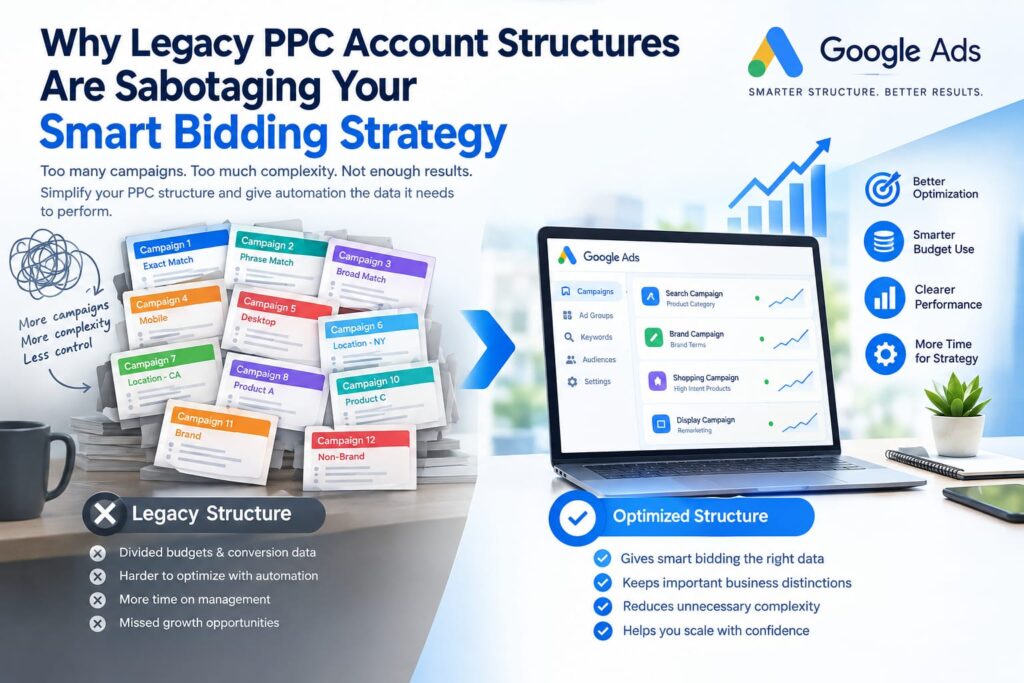
Although campaign segmentation still has legitimate uses, excessive fragmentation can complicate budget allocation and leave individual campaigns with limited conversion history.
Consider an advertiser running 12 campaigns that collectively generate 60 conversions per month. If conversions are distributed evenly, each campaign would receive only five conversions monthly.
This example does not mean that every campaign needs a fixed number of conversions to work. Smart Bidding requirements vary by strategy, account, and conversion patterns. However, it illustrates how unnecessary segmentation can make individual campaign performance harder to evaluate.
The goal is to give automated bidding sufficient relevant data while maintaining the control needed to achieve business objectives.
How Outdated PPC Structures Limit Campaign Performance
Several common practices can create problems when advertisers rely on automated bidding.
1. Single Keyword Ad Groups Can Create Unnecessary Complexity
Single Keyword Ad Groups (SKAGs) were popular because they allowed advertisers to organize campaigns around individual keywords and closely control ad relevance.
However, creating separate ad groups or campaigns for every keyword variation can increase management overhead without necessarily improving performance.
Modern search campaigns can use related keywords, responsive search ads, and automated bidding to reach relevant users across different search queries.
Excessive segmentation may result in:
- More campaigns and ad groups to maintain.
- Smaller budgets distributed across multiple segments.
- Additional negative keyword management.
- More complicated performance reporting.
- Less flexibility when reallocating budgets.
What should advertisers do?
Group closely related keywords around a common search intent, product, or service. Write relevant ad copy and use landing pages that match the user’s needs.
Keep keywords separate when they require genuinely different messaging, landing pages, or business objectives.
2. Fragmented Conversion Data Can Complicate Optimization
Automated bidding depends on conversion signals to estimate which auctions are more likely to produce valuable outcomes.
When an advertiser divides traffic across many campaigns unnecessarily, each campaign may accumulate conversion history more slowly.
For example, imagine an online clothing store running separate campaigns for several closely related T-shirt categories. Each campaign has a small budget and generates only a handful of purchases.
Combining suitable categories into a better-organized campaign structure may provide more conversion activity within that campaign and make budget management easier.
However, consolidation is not a universal solution. Smart Bidding can use signals across auctions, and performance depends on more than campaign-level conversion totals.
Before restructuring an account, check whether the campaigns have compatible goals, economics, and landing-page experiences.
3. Separate Match-Type Campaigns Can Restrict Flexibility
Some advertisers maintain separate campaigns for exact, phrase, and broad match keywords.
This structure can help when different keyword groups need independent budgets or bidding controls. But separating match types simply because they are different can introduce unnecessary complexity.
Modern Google Ads keyword matching considers meaning and search intent, not just the literal words entered by a user.
Overly restrictive negative keyword lists can also prevent relevant search queries from reaching suitable ads.
For example, an advertiser selling premium running shoes might separate every close keyword variation into an individual campaign. This can make management more complicated without creating a meaningful business advantage.
A more practical approach is to organize campaigns around product categories, profitability, and customer intent, while monitoring search terms and using negative keywords carefully.
4. Device-Based Campaign Splits Can Create More Work
In the past, advertisers frequently separated mobile and desktop traffic to control bids independently.
With automated bidding, creating separate campaigns for each device may be unnecessary when both devices support the same conversion goal and customer journey.
Device performance can still differ significantly. The important question is whether those differences justify a separate campaign.
Before splitting campaigns by device, evaluate:
- Conversion rates across devices.
- Revenue or lead quality by device.
- Differences in landing-page experiences.
- Budget requirements.
- Whether independent bidding or reporting is necessary.
If mobile and desktop traffic follow the same business strategy, managing them within a consolidated campaign may be more efficient.
5. Small Campaign Budgets Can Limit Growth
A fragmented account often contains multiple campaigns with separate daily budgets.
This can create situations in which one campaign reaches its budget limit while another has money available but limited traffic.
Although shared budgets and other budget-management approaches may help in suitable accounts, the underlying issue may be unnecessary campaign separation.
Review how budgets are distributed across campaigns and determine whether each campaign needs its own allocation.
Where business objectives and performance targets are compatible, consolidating campaigns can make budget management more straightforward.
The Hidden Costs of Excessive PPC Segmentation
Campaign fragmentation affects more than automated bidding. It can also create operational and strategic challenges.
Slower Testing and Learning
When individual campaigns receive limited traffic, advertisers may need longer to gather enough evidence to evaluate new ads, keywords, or landing pages.
This does not mean that every low-volume campaign is ineffective. It means advertisers should interpret small data samples carefully.
Unreliable Performance Comparisons
A campaign with a small number of conversions can experience large changes in its cost per acquisition (CPA) from one week to the next.
For example, if a campaign generates one conversion after spending ₹2,000, its CPA is ₹2,000. If it generates another conversion after spending an additional ₹500, its cumulative CPA falls to ₹1,250.
These figures illustrate how a small change in conversion count can significantly affect reported performance.
Avoid making major optimization decisions based on a few conversions without considering conversion delays, longer-term trends, and business outcomes.
Increased Account Management Time
Managing hundreds of small campaigns can consume time that would be better spent improving ad messaging, offers, landing pages, conversion tracking, and customer experience.
Simplifying unnecessary structures can help PPC teams focus on improvements that have a more direct impact on results.
When PPC Campaign Consolidation Makes Sense
Consolidation should be based on business logic, not simply on the desire to reduce the number of campaigns.
Campaigns are good candidates for consolidation when they share similar objectives, products, audiences, conversion actions, and profitability requirements.
Consider consolidating when:
- Several campaigns target closely related search intent.
- Separate campaigns advertise similar products with identical goals.
- Match-type splits do not serve a clear strategic purpose.
- Device segmentation creates additional maintenance without meaningful benefits.
- Multiple campaigns compete for limited budgets while serving the same business objective.
Before merging campaigns, review their historical performance, conversion actions, bidding strategies, budgets, negative keywords, and landing pages.
Also consider whether the change could affect reporting, brand protection, or budget control.
Important: Consolidation does not guarantee lower CPA or higher conversion volume. Its value depends on whether the new structure improves decision-making without removing important business controls.
When You Should Keep Campaigns Separate
Not every campaign split is outdated. Some distinctions remain essential for profitability, reporting, and strategic control.
1. Different Business Objectives
Lead generation and ecommerce sales typically have different conversion actions and bidding requirements.
For example, a campaign optimized for qualified consultation requests should not automatically share the same optimization objective as a campaign designed to generate online purchases.
Keep campaigns separate when their goals or success metrics are fundamentally different.
2. Different Profit Margins
Products with different profit margins may require different return on ad spend (ROAS) targets.
Consider a clothing retailer selling basic T-shirts and premium designer jackets. Both categories generate sales, but their margins and acceptable acquisition costs may differ.
Combining them without considering these differences could make it harder to manage profitability.
Use separate campaigns when distinct bidding targets or budget controls are needed to protect business performance.
3. Brand and Non-Brand Search Intent
Brand searches and non-brand searches often represent different stages of customer awareness.
Someone searching for a specific clothing brand may already know what they want. Someone searching for “affordable cotton T-shirts” may still be comparing options.
Keeping brand and non-brand campaigns separate can support budget allocation, performance analysis, and strategic control.
The right approach depends on account size, competition, and the advertiser’s objectives.
4. Different Geographic Markets
Geographic segmentation remains useful when regions require different budgets, languages, offers, or market strategies.
For example, a business may need separate campaigns for regions with different product availability or local promotions.
However, creating a separate campaign for every small geographic area may be unnecessary if the same offer, budget strategy, and customer experience apply everywhere.
5. Different Landing Pages or Conversion Journeys
Campaigns that lead to fundamentally different customer experiences may need separate structures.
A campaign encouraging users to book a product demonstration has a different conversion journey from one promoting an immediate online purchase.
Maintain separate campaigns when doing so improves message relevance, conversion optimization, or business control.
A simple rule: If a campaign split protects a meaningful business difference, keep it. If it only creates another reporting label for an otherwise identical customer journey, consider consolidating it.
How Smart Bidding Changes PPC Account Management
Google Ads Smart Bidding automates bids using machine learning and auction-time signals to estimate the likelihood of conversion.
This changes the role of PPC managers.
Rather than manually controlling every keyword and device bid, advertisers increasingly need to focus on the quality of the information supplied to the platform.
Three areas deserve particular attention.
Conversion Tracking Quality
Automated bidding can only optimize effectively toward the outcomes it is instructed to pursue.
If an advertiser counts low-value actions as conversions or fails to track meaningful purchases, the bidding strategy may optimize toward the wrong results.
Review conversion actions regularly and ensure primary conversions reflect genuine business value.
For lead generation businesses, importing qualified leads or sales outcomes from a CRM can help connect advertising activity with downstream results when the necessary tracking and integrations are available.
Appropriate Bidding Targets
Target CPA and Target ROAS strategies need realistic performance expectations.
An excessively aggressive target may restrict traffic or make growth difficult, particularly when conversion history is limited or market conditions change.
Evaluate targets against historical performance, profit margins, conversion delays, and business goals.
Avoid changing bidding targets too frequently without a clear reason, as repeated adjustments can make results more difficult to interpret.
Relevant Campaign Structure
A well-organized account helps advertisers maintain the distinctions that matter while avoiding unnecessary complexity.
The objective is not to give automation unlimited freedom. It is to combine reliable conversion signals with appropriate budgets, bidding targets, and strategic controls.
A Practical Action Plan to Improve Your PPC Structure
If your account relies on an older campaign structure, use the following process to identify opportunities for improvement.
Step 1: Audit Your Existing Campaigns
Start by reviewing campaigns and identifying unnecessary duplication.
Look for:
- Single Keyword Ad Groups that provide little additional value.
- Separate campaigns targeting nearly identical search intent.
- Duplicate match-type campaigns.
- Device-based campaigns with identical objectives.
- Low-volume campaigns with overlapping products or audiences.
- Campaigns with separate budgets but no clear strategic reason.
Do not assume that low conversion volume alone makes a campaign unnecessary.
Step 2: Group Campaigns by Business Purpose
Organize campaigns around meaningful differences, such as product category, customer intent, profit margin, geographic requirements, and conversion goals.
Document why each major campaign exists.
If two campaigns serve the same audience, promote similar products, and use the same optimization objective, assess whether they can be managed together.
Step 3: Verify Conversion Tracking
Before restructuring, confirm that conversion actions are accurate and that important outcomes are recorded consistently.
Check for duplicate purchase tracking, missing conversion values, incorrectly configured primary actions, and discrepancies between advertising data and actual business results.
Fixing measurement problems before consolidation makes subsequent performance comparisons more useful.
Step 4: Consolidate Carefully
Avoid restructuring an entire account at once.
Start with a suitable group of similar campaigns and document their existing performance, budgets, bidding strategies, and conversion history.
Consolidate only where the business logic supports it.
Check keyword coverage, negative keywords, ad relevance, landing pages, and budget allocation before launching the revised structure.
Step 5: Monitor Results Over an Appropriate Period
After making changes, evaluate performance using a period appropriate to your conversion volume and sales cycle.
Monitor:
- Conversion volume and conversion value.
- Cost per acquisition.
- Return on ad spend.
- Search impression share.
- Budget utilization.
- Lead quality or sales profitability.
- Search term relevance.
Account for conversion delays and other simultaneous changes before drawing conclusions.
If performance improves, determine whether the new structure is genuinely responsible. If performance declines, investigate tracking, budgets, targeting, and bidding settings before deciding whether to reverse the changes.
Common PPC Consolidation Mistakes to Avoid
Simplifying an account can help, but poorly planned consolidation may create new problems.
Avoid these common mistakes:
- Combining campaigns with incompatible goals: Different conversion objectives may require separate optimization strategies.
- Ignoring profit margins: Revenue alone does not show whether a campaign is profitable.
- Removing negative keywords without review: Consolidation can unintentionally expand traffic into irrelevant searches.
- Changing everything simultaneously: Multiple changes make it difficult to identify the cause of performance shifts.
- Expecting immediate improvements: Results depend on traffic volume, conversion delays, competition, and the quality of the existing setup.
- Ignoring lead quality: A lower CPA is not necessarily better if the resulting leads are less likely to become customers.
A strong PPC structure balances simplicity with control. The objective is to make the account easier to manage while preserving the decisions that directly affect business results.
Frequently Asked Questions
1. Why can legacy PPC account structures hurt Smart Bidding?
Legacy structures can divide traffic, budgets, and conversion activity across many campaigns without providing meaningful strategic benefits. This may complicate budget management and make individual campaign results harder to evaluate. However, campaign structure is only one factor affecting bidding performance.
2. Should I eliminate Single Keyword Ad Groups (SKAGs)?
Not necessarily. Review whether each ad group provides meaningful control over messaging, targeting, or landing-page relevance. Where keyword variations share the same intent and customer journey, a more consolidated structure may reduce management overhead.
3. How many conversions does Google Ads Smart Bidding need?
There is no universal conversion threshold that guarantees effective Smart Bidding performance. Requirements and results vary by bidding strategy, account history, conversion patterns, and business circumstances. Use conversion volume as one consideration rather than a rigid rule.
4. Should brand and non-brand campaigns be combined?
Usually, keeping them separate can provide clearer budget control and performance reporting because brand and non-brand searches often reflect different user intent. However, the best structure depends on campaign objectives, account size, competition, and available budget.
5. How can I tell whether my PPC account needs consolidation?
Look for overlapping campaigns, duplicated targeting, fragmented budgets, unnecessary match-type splits, and campaign divisions that do not reflect different business objectives. Compare these findings with performance data and business requirements before making changes.
Ultimately, understanding Why Legacy PPC Account Structures Are Sabotaging performance helps marketers focus on conversion quality and meaningful campaign structure.
Conclusion: Build Your PPC Structure Around Signals and Strategy
Why Legacy PPC Account Structures Are Sabotaging Your Smart Bidding Strategy is an important question for advertisers managing increasingly automated search campaigns.
Account structures designed around manual bid control may introduce unnecessary complexity when they divide similar customer journeys into too many separate campaigns.
However, consolidation is not about removing every distinction. Different profit margins, conversion objectives, geographic requirements, and customer experiences may still justify separate campaigns.
The most effective approach is to audit your existing structure, improve conversion tracking, consolidate redundant campaigns, and preserve the divisions that support real business needs.
By combining reliable conversion data with sensible campaign organization and realistic bidding targets, advertisers can create a more manageable PPC account that supports informed optimization and sustainable growth.
At Growith Digital, the goal is simple: make advertising decisions that support measurable business outcomes, not unnecessary account complexity.