
YouTube Creator Videos and Branded Search Lift is an important topic for digital marketers who want to understand how creator partnerships influence brand awareness, search demand, and customer behavior. While YouTube videos can generate views and engagement, marketers also need to measure whether these campaigns encourage more people to search for a brand or product. Understanding branded search lift helps businesses evaluate campaign performance and identify the attribution gaps that can affect marketing decisions.
The discussion around YouTube Measures Creator Video on Branded Search Lift, But The Attribution Gap Still Exists highlights a critical marketing challenge: measuring the additional search demand created by influencer and creator campaigns is not as simple as counting views.
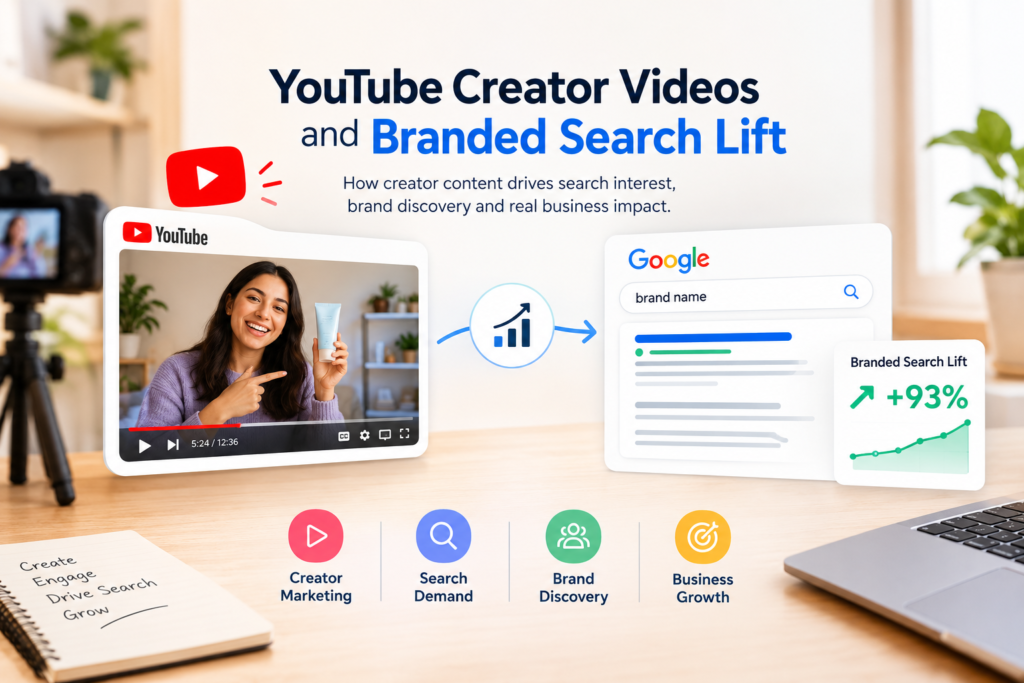
Google’s YouTube creator marketing playbook highlights Supergoop as an example, reporting a 93% increase in searches for its Glowscreen product and a 55% increase in searches for the brand name. These figures illustrate why branded search can be a valuable campaign metric. However, without detailed measurement methodology, marketers cannot confidently determine how much of that growth came directly from creator content.
For businesses, the opportunity is clear: measure more than engagement, establish a reliable baseline, and test whether creator campaigns generate incremental demand.
YouTube Creator Videos and Branded Search Lift: How to Measure Results
YouTube Creator Videos and Branded Search Lift helps marketers understand whether creator partnerships increase brand awareness and search demand. By tracking branded search impressions, organic clicks, and conversions, businesses can evaluate campaign performance more effectively. However, a rise in searches does not automatically prove that creator videos caused the increase. Marketers should establish a baseline and compare results over a defined period.
Businesses can combine creator marketing with other digital marketing services to improve brand awareness and reach their target audience.
Why Branded Search Matters in YouTube Creator Marketing
Branded search occurs when people search for a specific business, product, or brand name on a search engine. YouTube Creator Videos and Branded Search Lift helps marketers understand how creator content can influence brand awareness and search demand. For example, someone who watches a skincare creator demonstrate a sunscreen product might later search for that product by name on Google.
That search can indicate growing interest in a brand, especially when people were previously unfamiliar with its products.
Traditional influencer marketing reports often focus on views, likes, comments, shares, and subscriber growth. These metrics help measure audience engagement, but they do not necessarily show whether people became more interested in buying something.
Branded search provides another perspective.
How Creator Videos Can Increase Brand Search Demand
A creator video can influence the customer journey in several ways:
- Product discovery: Viewers learn about a product they had not considered before.
- Brand awareness: Repeated exposure makes a brand easier to remember.
- Purchase research: Interested viewers search for product details, prices, and reviews.
- Website visits: Searchers may click through to the brand’s website.
- Conversion opportunities: Some visitors eventually purchase a product or contact the business.
These actions do not always happen immediately. A viewer may watch a video today and search for the brand several days later.
This is why YouTube Creator Videos and Branded Search Lift should be evaluated using both engagement metrics and indicators of brand demand to understand how creator campaigns influence audience interest and search behavior.
What Supergoop’s Search Lift Numbers Tell Marketers About YouTube Creator Videos and Branded Search Lift
Supergoop’s creator marketing case study stands out because YouTube Creator Videos and Branded Search Lift highlights the importance of measuring branded search outcomes rather than relying exclusively on views or engagement.
According to the figures highlighted in Google’s creator marketing playbook, searches increased by:
- 93% for Glowscreen, the brand’s featured product.
- 55% for Supergoop, the brand name itself.
These reported increases suggest that creator marketing can be associated with greater interest in both an individual product and the wider brand.
However, a percentage increase alone does not establish the full impact of a campaign.
For example, an increase from 100 monthly searches to 193 represents a 93% lift. An increase from 10,000 searches to 19,300 represents the same percentage but a very different volume of additional searches.
Both the percentage change and the underlying search volume matter when evaluating campaign performance.
Why the Measurement Method Matters
To understand the actual impact of a creator campaign, marketers need additional information, including:
- The period used to calculate the increase.
- The baseline search volume before the campaign.
- Whether other advertising campaigns were running simultaneously.
- Whether seasonal trends influenced consumer interest.
- Whether the results were compared with a suitable control group.
Without these details, YouTube Creator Videos and Branded Search Lift remains an interesting measurement of brand demand, but it is not enough to establish that creator content caused the entire increase in searches.
The Attribution Gap: What Marketers Still Cannot Prove
The attribution gap is the difference between observing a positive marketing outcome and proving which activity caused it. YouTube Creator Videos and Branded Search Lift helps marketers understand this challenge by highlighting the importance of measuring search growth and identifying the actual impact of creator campaigns.
A brand may notice that searches increased after a YouTube creator published a sponsored video. However, other marketing activities may have contributed to the same result.
For example, a company could be running Google Ads, publishing social media content, receiving press coverage, and launching a seasonal offer at the same time.
If branded searches rise during this period, it becomes difficult to isolate the contribution of the creator video without a stronger measurement approach.
1. Missing Baseline Data
A baseline establishes how people searched for a brand before the campaign began.
Without a defined baseline, marketers may compare different periods or select a starting point that exaggerates the apparent improvement.
A consistent pre-campaign measurement period makes results easier to interpret and helps marketers evaluate YouTube Creator Videos and Branded Search Lift more accurately by comparing branded search performance before and after a campaign.
2. Overlapping Advertising Campaigns
Paid search, display advertising, public relations, email marketing, and social media campaigns can all influence brand awareness, making it important to measure YouTube Creator Videos and Branded Search Lift carefully and separate the impact of creator campaigns from other marketing activities.
If these activities run alongside creator partnerships, a simple before-and-after comparison cannot reliably determine which activity generated the additional demand.
3. Delayed Customer Decisions
Not every viewer searches for a product immediately after watching a video.
Some viewers may return to Google several days later, while others may visit a store or purchase through a different channel.
When measuring YouTube Creator Videos and Branded Search Lift, a measurement window that is too short may miss part of the campaign’s influence, while a window that is too long can introduce unrelated factors that affect the accuracy of the results.
4. Search Demand Is Not the Same as Website Traffic
YouTube Creator Videos and Branded Search Lift can help marketers understand changes in brand interest, but more people searching for a brand does not automatically mean more people are visiting its website..
Searchers might click a competitor’s advertisement, watch another YouTube video, or interact with an AI-generated search result instead.
Therefore, marketers should distinguish between increased search interest, organic website clicks, and completed conversions.
How to Measure YouTube Creator Video Search Lift
Businesses do not necessarily need a large data science team to measure YouTube Creator Videos and Branded Search Lift more reliably. A structured approach using existing analytics tools, consistent baseline data, and a well-designed experiment can provide useful evidence of how creator campaigns influence brand search demand.
Marketers can use Google Search Console performance reports to review search queries, clicks, impressions, and changes in website search performance.
Step 1: Establish a Branded Search Baseline
Before the creator campaign begins, record your existing branded search performance to measure YouTube Creator Videos and Branded Search Lift accurately and compare search demand before and after the campaign.
Google Search Console can help you review search impressions, clicks, click-through rate (CTR), and average position for relevant queries.
Create a list of brand-related search terms, such as:
- Your business name.
- Your main product names.
- Your brand name combined with product categories.
- Important branded spelling variations.
Review approximately four to six weeks of pre-campaign data where appropriate. For businesses with strong seasonal patterns or limited search volume, a longer comparison period may be necessary.
Record the dates and conditions of the baseline so that future comparisons use consistent measurement rules.
Step 2: Track Search Demand and Website Clicks Separately for YouTube Creator Videos and Branded Search Lift
Search demand and search traffic are related, but they are not interchangeable.
Use Google Search Console to monitor branded-query impressions and clicks. Where available, supplement these metrics with Google Trends or another search-demand research tool.
Compare the following indicators:
- Branded impressions: How often your website appears for relevant searches.
- Branded clicks: How many clicks your website receives from those searches.
- Organic CTR: The percentage of impressions that generate clicks.
- Conversions: Purchases, enquiries, sign-ups, or other valuable actions.
If impressions rise while clicks remain flat, investigate possible changes in rankings, search-result layouts, competitor advertisements, or the visibility of your own listings.
When measuring YouTube Creator Videos and Branded Search Lift, remember that Search Console does not provide a perfect measure of total market-wide branded search volume, so use it alongside other available evidence to understand changes in brand demand more accurately.
Step 3: Use a Holdout Group or Geographic Test
A holdout test can help measure YouTube Creator Videos and Branded Search Lift by determining whether a creator campaign generated additional search demand beyond what would have happened anyway.
For example, a brand could select comparable geographic markets and expose one group to a creator campaign while holding the other group out of the campaign.
Then compare the change in branded search performance across both groups.
A simplified example:
| Metric | Campaign market | Holdout market |
|---|---|---|
| Before campaign | 1,000 | 1,000 |
| After campaign | 1,300 | 1,100 |
| Change | +30% | +10% |
In this hypothetical example, the campaign market increased by 30%, while the holdout market increased by 10%.
The difference is 20 percentage points. This suggests a possible incremental effect, but it does not prove causation by itself. The markets should be comparable, and other differences between them must be considered.
Where practical, use random assignment, adequate sample sizes, and consistent campaign conditions to improve the reliability of the results.
Step 4: Define the Attribution Window
Decide in advance how long after exposure you will measure branded search activity.
The appropriate window depends on the product, buying cycle, campaign format, and expected customer behavior.
For a low-cost consumer product, interest may develop quickly. For an expensive product or a business-to-business service, research may take much longer.
Document the start date, end date, campaign exposure period, and any additional marketing activities that could affect the result.
When measuring YouTube Creator Videos and Branded Search Lift, avoid choosing a measurement window only after seeing which period produces the largest increase, as this can lead to biased results and unreliable campaign conclusions.
Step 5: Connect Search Lift to Business Outcomes
The purpose of measuring creator campaigns is not simply to report a larger search number. It is to understand whether additional interest creates business value.
Where suitable data is available, examine:
- Product-page visits.
- Qualified leads and enquiries.
- Add-to-cart activity.
- Completed purchases.
- Conversion rate.
- Revenue and customer acquisition cost.
When measuring YouTube Creator Videos and Branded Search Lift, use tracking links and campaign-specific landing pages where appropriate, but remember that these primarily measure identifiable traffic and conversions. They will not capture every person influenced by a creator who later searches for the brand independently..
A combined measurement approach gives marketers a more complete view of campaign performance.
What SEO Teams Can Learn From Creator Marketing
YouTube Creator Videos and Branded Search Lift connects creator marketing with search engine optimization, which are often managed by different teams even though both can influence product discovery and increase brand awareness.
A creator video may introduce a product to a new audience. Later, that audience might search for the brand, read product comparisons, visit a landing page, and eventually convert.
This makes branded search a useful signal for collaboration between SEO, paid media, social media, and brand marketing teams.
A strong search engine optimization strategy helps businesses make useful content easier to discover through Google Search.
Build Content Around the Questions Viewers Ask
When creator campaigns introduce a product, marketers can identify the questions people may ask next.
These questions can inform:
- Product pages and category pages.
- Comparison articles.
- Buying guides and FAQs.
- Educational blog posts.
- Landing pages that explain product benefits.
The aim of YouTube Creator Videos and Branded Search Lift is to help marketers understand how video content influences brand discovery and make it easier for interested consumers to find accurate information about a brand after watching creator videos.
Evaluate Organic Visibility Beyond Rankings
Traditional SEO reporting often emphasizes rankings, clicks, and organic sessions. These metrics remain important, but they may not capture the full influence of brand-building campaigns.
Tracking branded impressions alongside organic clicks can help teams measure YouTube Creator Videos and Branded Search Lift, identify changes in brand demand, and investigate whether the website is capturing that demand effectively.
However, a rise in branded searches should not automatically be credited to SEO or creator marketing alone. Use the timing of campaigns, historical trends, and appropriate tests to interpret the results.
Common Mistakes When Measuring Creator Campaigns
Avoid these mistakes when reporting YouTube creator marketing performance:
- Relying only on views: High reach does not necessarily mean increased purchase intent.
- Ignoring the baseline: A percentage increase is difficult to interpret without the original value.
- Claiming causation from timing: Search growth after a campaign does not prove the campaign caused it.
- Combining every search term: Brand names, product names, and generic searches may behave differently.
- Ignoring other marketing activity: Paid advertising, promotions, and PR can influence the same audience.
- Reporting search lift without conversions: Additional interest is valuable, but its commercial impact should be evaluated separately.
A transparent report on YouTube Creator Videos and Branded Search Lift should explain the metric, time period, comparison method, limitations, and business outcomes to help marketers evaluate campaign performance accurately.
The Future of YouTube Creator Marketing Measurement and Branded Search Lift
YouTube creator marketing measurement is moving toward a broader understanding of performance. Views, engagement, and subscriber growth still matter, but advertisers also want evidence of increased demand and business impact.
Branded search is one useful part of that picture. It can help marketers understand whether a campaign is generating interest beyond the video itself.
However, reliable measurement requires more than a headline percentage. Advertisers need clear baselines, defined measurement windows, appropriate control groups, and a distinction between correlation and causation.
The discussion around YouTube Measures Creator Video on Branded Search Lift, But The Attribution Gap Still Exists highlights an important lesson for marketers: a reported lift is a starting point for investigation, not the end of the measurement process.
Brands that combine search analytics, controlled testing, and conversion data can better measure YouTube Creator Videos and Branded Search Lift and understand which creator partnerships generate meaningful incremental value for their business.
Frequently Asked Questions (FAQs)
1. What is branded search lift in YouTube creator marketing?
Branded search lift is an increase in searches containing a brand or product name during or after a marketing campaign. It can indicate increased interest, although other factors may also influence the change.
2. How can businesses measure branded search performance?
Businesses can use Google Search Console to monitor branded-query impressions, clicks, CTR, and average position. Search-demand tools and carefully designed holdout tests can provide additional context.
3. Why is creator marketing attribution difficult?
Attribution is difficult because customers may encounter several marketing messages before searching for or purchasing a product. Without an appropriate comparison method, marketers cannot confidently isolate the creator campaign’s contribution.
4. Does an increase in branded searches prove that a YouTube campaign worked?
No. An increase is a useful signal, but it does not establish causation. Seasonality, paid advertising, PR, and other campaigns may contribute to the change.
5. What is the best way to improve creator campaign measurement?
Establish a pre-campaign baseline, define the measurement window, track search demand and website activity separately, and use a suitable holdout or geographic test when feasible. Connect the results to business outcomes without overstating attribution.
Conclusion
YouTube creator campaigns can influence how consumers discover and research brands, making branded search an important metric for digital marketers. But increased searches alone cannot explain exactly why demand changed or how much value the campaign generated.
A stronger approach to measuring YouTube Creator Videos and Branded Search Lift combines consistent baseline data, Google Search Console insights, carefully planned holdout tests, and conversion measurement. By documenting both the results and their limitations, businesses can make better decisions about creator partnerships and demonstrate their contribution more credibly.
The goal is not simply to prove that searches increased. It is to understand whether creator marketing generated incremental demand, whether the brand successfully captured that demand, and whether the resulting activity supported meaningful business outcomes.