
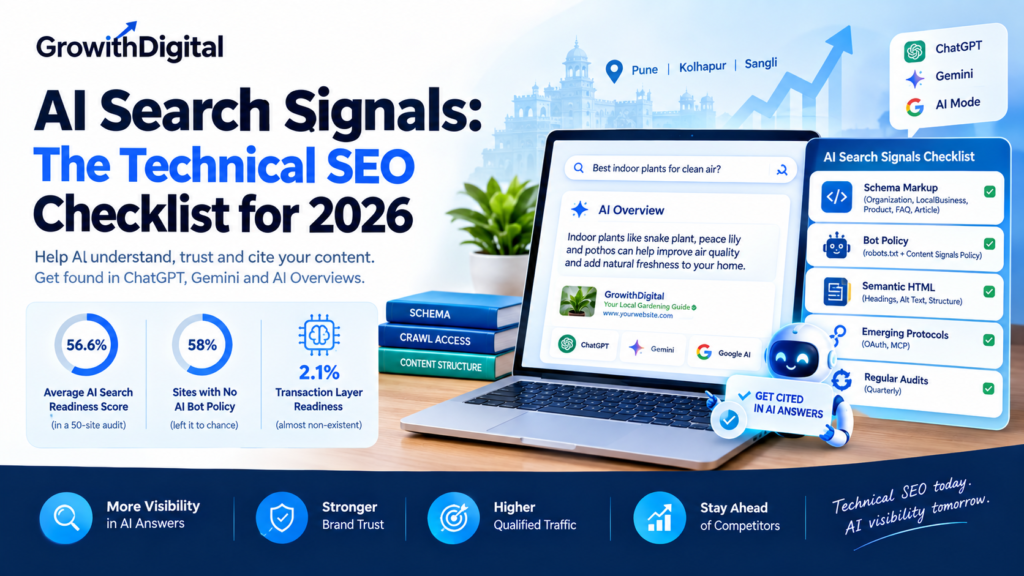
A recent audit of 50 major websites found the average AI search signals readiness score is only 56.6%, and 58% of the sites checked had made no deliberate decision about how AI bots should read their pages. If your business in Ichalkaranji, Kolhapur or Sangli has spent years chasing Google rankings but has never looked at its AI search signals, you are not alone, and you are leaving visibility on the table.
What the research actually found
The study, covered in Search Engine Journal’s breakdown of AI search signals, split site readiness into three layers. The first layer, whether AI can fetch and parse a page at all, scored a healthy 74.4% on average because it overlaps with basic technical SEO most agencies already handle. The second layer, whether AI can understand what a page actually means, dropped to 38.5%. Nearly a third of the sites audited had no structured data at all, and only 5 out of 50 had set up a Content Signals Policy to control AI bot access. The third layer, whether an AI agent can complete a transaction on the page, was almost non-existent at 2.1%.
The pattern is clear: most businesses optimize for the layer that is easiest to fix and ignore the very signals that actually decide whether a brand gets cited or skipped in an AI-generated answer.
Why this matters for Maharashtra SMEs
Customers in Pune, Kolhapur and across Maharashtra are increasingly asking ChatGPT, Gemini and Google’s AI Mode for recommendations before they ever open a search results page. If your website sends weak AI search signals, being on page one of Google no longer guarantees being mentioned in the answer a customer actually reads. We covered this shift in detail in how AI search is doing the thinking for your customers, and the technical layer is where most local businesses fall short first.
The AI search signals checklist
You do not need an enterprise SEO team to close this gap. Start with these steps:
- Add JSON-LD schema everywhere it matters. Organization, LocalBusiness, Product, FAQ and Article schema all strengthen the AI search signals that help models understand who you are and what you sell.
- Decide your bot policy on purpose. Use robots.txt and an emerging Content Signals Policy to say clearly which AI crawlers can access which parts of your site, instead of leaving it to chance.
- Check your semantic HTML. Proper headings, alt text and an accessible page structure make it far easier for AI systems to extract accurate meaning, not just raw text.
- Keep an eye on emerging protocols. Standards like OAuth-based agent access and the Model Context Protocol are early, but businesses that adopt them first tend to keep the advantage.
- Audit regularly. AI search signals are not a one-time fix. Revisit your schema, bot access and content structure every quarter, the same way you would review Google Search Console.
This is the same layered thinking we apply in our Answer Engine Optimization guide: visibility in AI answers starts with technical groundwork most agencies still skip.
FAQ
What are AI search signals? They are the technical and structural elements, such as schema markup, crawl access and semantic HTML, that let AI systems like ChatGPT, Gemini and Google AI Mode understand and trust a website’s content well enough to cite it in an answer.
Is this different from normal SEO? It builds on normal SEO. Traditional technical SEO gets AI bots to your page; strong technical signals help those bots understand and reuse what is on it.
Do small businesses really need this yet? Yes. AI Overviews and AI chat assistants are already answering local and commercial queries. Waiting means competitors with weaker products but stronger AI search signals get recommended instead of you.
Get your AI search signals audited
Most local business websites we review in Kolhapur, Sangli and Ichalkaranji are strong on Layer 1 and almost empty on Layers 2 and 3, exactly like the national study found. Growith Digital runs a technical AI search signals audit covering schema, bot access and content structure, so you know precisely what to fix first. Get in touch with our team to check where your website stands today.
[…] separate markdown file adds work without adding citations. The real leverage, as we outlined in our AI search technical signals checklist, is schema markup, semantic HTML and a deliberate crawler access policy, not file format […]
[…] you are also reviewing the technical side of your site, our technical SEO checklist for 2026 is a good next step. And if you would rather have experts set up tracking, filters, and reporting […]
[…] technical SEO checklist for AI search covers these in […]
[…] on Google was ten years ago. The technical groundwork is identical to what we outlined in our AI search technical signals checklist: clear schema, accessible content and a defined bot access […]
[…] This is the same trust layer we outline in our Answer Engine Optimization guide for 2026, and it builds directly on the crawl and structure basics covered in our AI search technical signals checklist. […]